
Strong hips come down to four muscle groups: the gluteals, the hip flexors, the adductors, and the deep external rotators. Training all four — not just the glutes — is what keeps your hips stable, your stride even, and your risk of falls and hip pain lower as you age. The good news is you do not need a gym full of machines. You need a handful of targeted movements done consistently, with attention to form and gradual progression.
What Are the 4 Key Muscle Groups That Strengthen Your Hips?
The hip is a ball-and-socket joint, and it moves in more directions than almost any other joint in your body. That range of motion is powered by several muscle groups working together. When people talk about hip strength, four groups do most of the work.
- Gluteals. The gluteus maximus, medius, and minimus. These are the largest and most powerful hip muscles. The maximus drives hip extension — pushing your leg backward and standing up from a chair. The medius and minimus sit on the side of your hip and control it during walking, keeping your pelvis level when you stand on one leg.
- Hip flexors. The iliopsoas, rectus femoris, and sartorius. These lift your knee and bend your hip. They are heavily used in walking, climbing stairs, and getting out of a low seat.
- Adductors. The inner thigh muscles. They pull your leg toward the midline and, perhaps more importantly, help stabilize the pelvis during single-leg activities.
- Deep external rotators. A group of smaller muscles behind the hip, including the piriformis. They rotate your thigh outward and help hold the ball centered in the socket.
Weakness in any one of these groups changes how you move. If the gluteus medius is weak, for example, your pelvis may drop with each step — a pattern clinicians call a Trendelenburg gait. That kind of compensation can load other joints and soft tissues in ways they were not designed to handle.
Why Does Hip Strength Matter as You Get Older?
Hip strength is one of the strongest predictors of how well you will move and stay independent in later life. It declines with age if you do not actively use it, and that decline has real consequences.
Research consistently links lower hip and leg strength to a higher risk of falls, which are a leading cause of injury and loss of independence in older adults. Strong hip muscles help you catch yourself when you stumble, recover your balance, and get up from the floor or a chair without help.
Hip strength also affects the health of the joint itself. Muscles around the hip act like shock absorbers and guides for the joint. When they are weak, more load lands on cartilage and other structures. Some studies suggest that targeted strengthening can reduce hip and knee pain and improve function in people with osteoarthritis, though results vary by individual and by how faithfully the exercise is done.
Here is a point that often gets missed. Hip weakness rarely announces itself as hip pain. It more often shows up as knee pain, low back pain, or a general feeling of being unsteady. That is because the hip sits in the middle of a chain linking your spine to your foot. When the hip does not do its job, the joints above and below it take up the slack.
How Do You Strengthen the Glutes?
The glutes respond well to resistance and to single-leg work. Single-leg exercises matter because walking and climbing stairs are single-leg activities — and that is when the gluteus medius has to stabilize your pelvis.
Movements that target the glutes include:
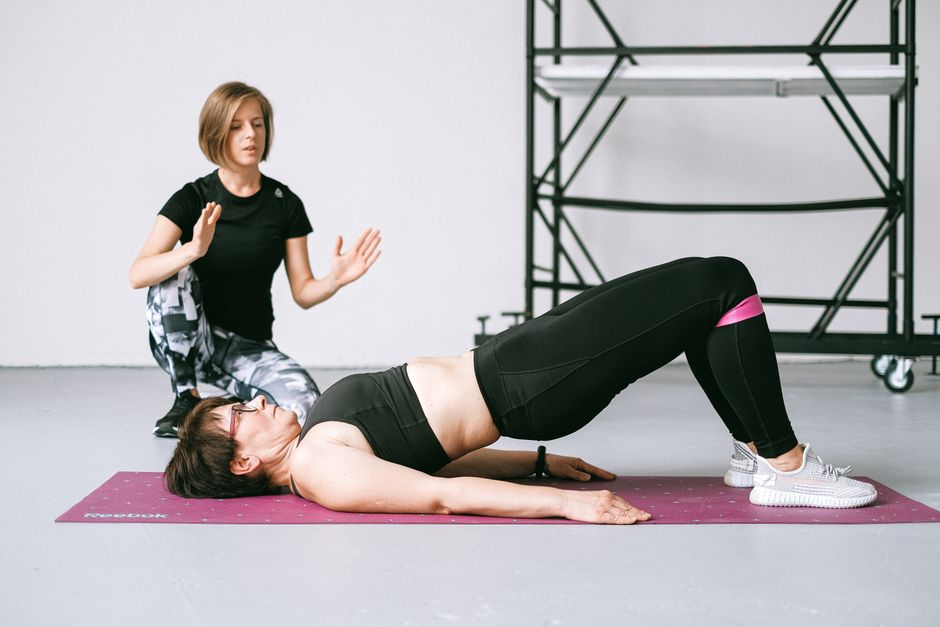
- Bridges. Lie on your back with knees bent and feet flat. Squeeze your glutes and lift your hips until your body forms a straight line from knees to shoulders. Lower with control.
- Sit-to-stand. Rise from a chair without using your hands. This trains the gluteus maximus through a movement you use every day.
- Side-lying leg lifts. Lie on your side and lift the top leg straight up. This targets the gluteus medius.
- Step-ups. Step onto a low, stable platform, leading with one leg, then lower. Keep the step height low enough that your knee does not cave inward.
- Hip thrusts. With your upper back on a bench and feet flat, drive your hips upward. This is one of the more direct gluteus maximus exercises.
Start with a range of motion you can control. Add repetitions or resistance gradually. The muscle adapts to the demand you place on it, so the exercise has to get harder over time to keep producing gains.



How Do You Strengthen the Hip Flexors?
The hip flexors are often neglected because they are working all day just to hold your posture and lift your legs. But they still need to be trained through their full range, and they need to be flexible as well as strong.
Good options include:
- Seated or standing knee raises. Lift one knee toward your chest against gravity, or add a light ankle weight as you get stronger.
- Marching in place. A simple way to train the hip flexors while challenging your balance.
- Resisted hip flexion. With a resistance band anchored behind you and looped around your ankle, drive your knee forward against the band.
Because the hip flexors attach to the lower spine and the front of the pelvis, tightness here can pull on the low back and contribute to a forward-tilted pelvis. That is why many programs pair strengthening with stretching. A gentle hip flexor stretch — a kneeling lunge with the back leg extended — is a common way to do this. Hold it without forcing, and stop if you feel pinching in the front of the hip.
How Do You Strengthen the Adductors and Deep Rotators?
These two groups get the least attention, and they may be where the biggest gaps hide. Both play a major role in hip stability.
For the adductors, the inner thigh muscles, try:
- Squeezing a ball between your knees. Lie on your back with knees bent and a pillow or ball between them. Press the knees together and hold briefly.
- Side-lying adduction. Lie on your side with the bottom leg straight. Lift the bottom leg toward the top one.
- Sumo or wide-stance squats. A wider stance shifts more work to the inner thigh.
For the deep external rotators, try:
- Clamshells. Lie on your side with knees bent and stacked. Keeping your feet together, lift the top knee like a clamshell opening. This is a classic way to target the gluteus medius and deep rotators together.
- Seated hip external rotation. Sit with knees bent and press one knee outward against a light band.
These movements are small and controlled. That is by design. The deep rotators are not built for heavy loads — they are built for fine control, and that is exactly what you are training.
How Often Should You Train Your Hips?
Two to three sessions per week is a reasonable target for most healthy adults. Muscles need time to recover between sessions, so daily heavy work is not necessary and can work against you.
A practical approach is to pick one or two exercises from each of the four groups and do them in a single session. That gives you a balanced workout in a short amount of time.
Progression matters more than variety. Doing the same easy exercises for months will not build strength. Once you can complete your repetitions with good form and without strain, make the movement harder — add repetitions, add resistance, or move to a single-leg version.
If you have hip or knee pain, a history of hip surgery, or a diagnosed joint condition, talk with a clinician or physical therapist before starting. Some movements are not appropriate for every hip, and a professional can tailor a program to your situation. This is especially true if you have had a hip replacement, since certain positions may be restricted.
For general cardiovascular and bone health, government physical activity guidelines for adults recommend at least 150 minutes of moderate-intensity aerobic activity per week plus muscle-strengthening activities on two or more days per week. Hip strengthening fits naturally into that second recommendation.
What Are Common Mistakes When Strengthening Hips?
The most common mistake is training only the glutes and ignoring the other three groups. A hip that is strong in one direction but weak in another is not a stable hip.
Another mistake is using momentum instead of muscle. Swinging a leg quickly through a movement lets gravity and momentum do the work. Slower, controlled reps build more strength.
Letting the knee cave inward during squats, step-ups, or bridges is also common. This usually signals that the gluteus medius is not doing its job, and it places stress on the knee. Watching your knee track in line with your foot is a simple cue.
Finally, many people stop progressing too soon. The body adapts to whatever load it is given, and once that load feels easy, the gains slow. Adding challenge over time is what keeps the muscle responding.
Frequently Asked Questions
How long does it take to strengthen your hips?
Most people notice improvements in strength and ease of movement within several weeks of consistent training, with more meaningful changes over a few months. Muscle adapts gradually, so steady progress matters more than speed.
Can you strengthen your hips without equipment?
Yes. Bridges, sit-to-stands, side-lying leg lifts, clamshells, and knee squeezes all use only your body weight. As these get easy, you can add resistance with bands or light weights to keep making progress.
Which hip muscle is most important for balance?
The gluteus medius, on the side of your hip, plays the largest role in keeping your pelvis level and steady during single-leg movement. Weakness here is strongly linked to a wobbly, unsteady walk.
Should you stretch or strengthen hips first?
A brief warm-up or gentle stretch before strengthening is fine, but the strength work is what builds lasting change. Save longer stretching for after your session or on separate days.
