
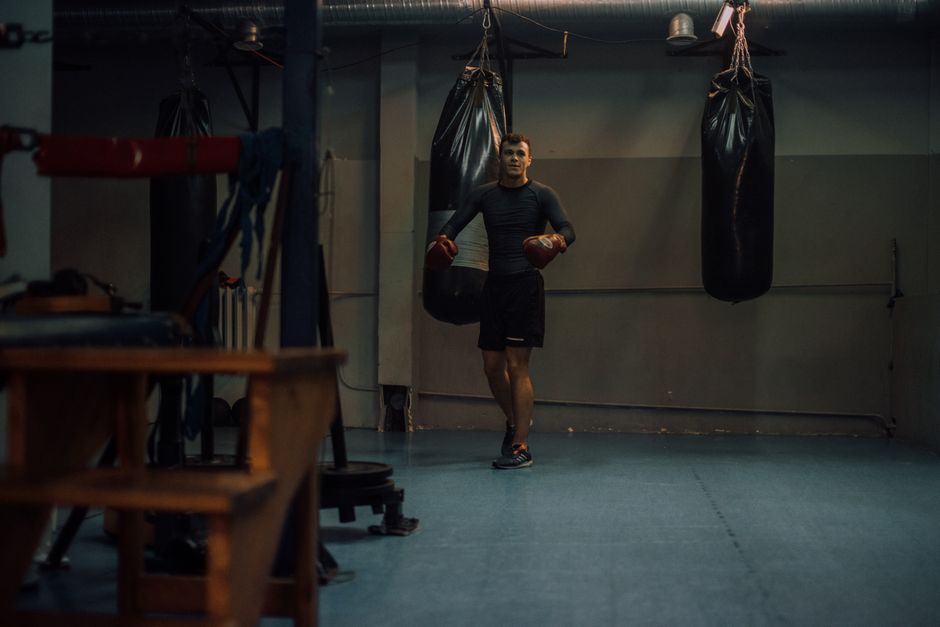
If you are right-handed, you should stand in boxing with your left foot forward and your right foot back. This is called an orthodox stance, and it is the standard stance for right-handed boxers. It places your stronger right hand behind your body, which allows you to generate more power in your rear-hand punches while keeping your weaker left hand in front for jabs and defense.
What Is the Orthodox Stance?
The orthodox stance is the most common fighting stance in boxing. A right-handed boxer places the left foot about shoulder-width apart and slightly ahead of the right foot. The right foot stays behind the body at roughly a 45-degree angle.
Your lead hand (left) sits higher, usually around cheek level, to jab and protect your face. Your rear hand (right) rests near your jaw, ready to throw power shots. Your chin stays tucked toward your chest, and your elbows remain close to your ribs to protect your body.
This stance is not random. It positions your stronger hand further from your opponent, which increases the distance your punch travels. More distance means more time to build speed and force before impact.
How To Stand In Boxing If You Are Right Handed: Foot Position
Your feet create the foundation for everything else in boxing. Start by standing with your feet shoulder-width apart. Your left foot points straight ahead toward your opponent. Your right foot points slightly outward, about 45 degrees to the right.
Your weight should sit evenly between both feet, with a slight bend in both knees. If your legs are locked straight, you cannot pivot or move quickly. If your weight leans too far forward, you will lose balance when you throw punches.
Keep your heels slightly lifted off the ground. This is not a full sprint position, but staying on the balls of your feet lets you push off in any direction. A flat-footed boxer gets caught standing still.
The distance between your feet matters. Too narrow and you lose stability. Too wide and you cannot move your feet quickly. Most coaches recommend a stance where you can comfortably take a small step forward without crossing your feet.
Hand Position and Guard
Your left hand in the orthodox stance acts as your lead hand. It does most of the jabbing and sets up your power shots. Keep it in front of your face, roughly at eye level. Your palm faces inward toward your opponent.
Your right hand guards your chin. It sits closer to your face than your left hand. This is your power hand, and it also protects the right side of your jaw. When you throw a right cross, this hand travels straight from your chin toward your target.
Both elbows stay down and close to your torso. Raised elbows leave your ribs exposed to body shots. Your chin stays tucked down toward your chest. Looking over the top of your guard exposes your jaw to straight punches.
Your shoulders should be relaxed, not shrugged up near your ears. Tension in your shoulders slows down your punches and drains your energy faster.





Why Right-Handed Boxers Fight With Their Left Foot Forward
Many beginners assume a right-handed person should lead with the right side. Boxing works differently. The stance is built around the mechanics of throwing powerful punches, not around which hand you use to write.
Your rear hand produces more power because your hips and torso rotate into the punch. When you throw a right cross, your right foot pushes off the ground, your hips rotate to the left, and your shoulders follow. This chain of movement transfers energy from the ground through your body into your fist.
Your lead hand cannot generate this same rotation because it is already in front of your body. It has less distance to travel and less room for your hips to rotate into the shot. That is why the jab is a speed and range-finding tool rather than a knockout punch.
This stance also keeps your liver protected. Your liver sits on the right side of your body. By keeping your right side further back, you make it harder for an opponent to reach it with a straight punch.
Common Stance Mistakes To Avoid
Beginners frequently stand with their feet in a straight line, as if walking on a tightrope. This narrow base makes you unstable. If someone pushes you, you will fall sideways. Your rear foot should be offset to the side, not directly behind your front foot.
Another common mistake is standing too square to the opponent. If both shoulders face forward, you expose more of your body to punches and lose the benefit of the angled stance. Your lead shoulder should point toward your opponent, with your rear shoulder angled away.
Some boxers shift their weight too far onto the back foot, thinking this makes them safer. This actually reduces your punching power and makes it harder to move forward. Your weight should stay centered so you can attack or retreat without shifting your feet first.
Dropping the rear hand is another frequent error. When you throw a jab, your right hand may drift away from your chin. Keep it glued to your face unless it is actively throwing a punch. A dropped rear hand leaves your chin wide open for a counter right hand from your opponent.
How To Check If Your Stance Is Correct
Stand in your stance and look down at your feet. Your left foot should be forward and your right foot back. Draw an imaginary line from your rear heel to your front heel. That line should point toward your opponent.
Check your balance by having someone push gently on your chest and back. If you can absorb the push without taking a step, your base is solid. If you stumble, widen your stance slightly or bend your knees more.
Throw a few slow jabs without moving your feet. Your left hand should extend fully without causing you to lean forward. If you lunge, you are reaching instead of punching. A proper punch comes from rotating your body, not from stretching your arm.
Practice throwing a slow right cross. Your rear heel should lift off the ground as your hips rotate. If your foot stays flat and your body stays square, you are not using your hips properly.
How To Adapt If You Are Right-Handed But Prefer Southpaw
Some right-handed boxers choose to fight southpaw, with their right foot forward. This is not wrong, but it requires understanding what you are giving up and gaining.
A right-handed southpaw leads with their dominant hand. Your jabs will be stronger, but your power hand is now in the rear position and is your weaker hand. This creates an unusual dynamic that some boxers use to their advantage.
Fighting southpaw as a right-handed person can confuse orthodox opponents who are used to facing left-handed fighters. However, most coaches recommend learning orthodox first if you are naturally right-handed. The orthodox stance aligns with your natural power hand in the rear position, which is where knockout power comes from.
If you are a beginner, start orthodox. Train in that stance until the footwork feels automatic. Only consider switching if you have a specific reason and you work with a coach who can help you build the stance correctly.
Drills To Build A Solid Stance
Shadowboxing in front of a mirror is one of the best ways to check your form. Throw slow punches and watch your foot position. Your feet should stay in the same relative position throughout your combinations.
Practice stepping forward and backward without crossing your feet. Your lead foot moves first when you step forward. Your rear foot moves first when you step back. This keeps your stance intact while you move.
Stand in your stance and practice pivoting on your front foot. This movement is essential for throwing hooks and for turning to face opponents who move around you. Keep your weight centered and your hands up while you pivot.
Work with a heavy bag to feel how your stance affects your power. Throw a right cross from a proper stance, then throw one while standing square. The difference in power will be immediately obvious.
Frequently Asked Questions
What is the boxing stance called for right-handed people?
The orthodox stance is the standard boxing stance for right-handed fighters. It places the left foot forward and the right foot back.
Should a right-handed boxer lead with their right hand?
No, a right-handed boxer should lead with their left hand in the orthodox stance. Your right hand stays in the rear position where it can generate more power.
Why do right-handed boxers stand with their left foot forward?
Standing with the left foot forward positions your stronger right hand in the rear. This allows your hips and torso to rotate into right-hand punches, producing significantly more power.
Can a right-handed person fight southpaw?
Yes, some right-handed boxers fight southpaw with their right foot forward, but this is less common. It puts your weaker hand in the power position, so most coaches recommend orthodox for right-handed beginners.
