
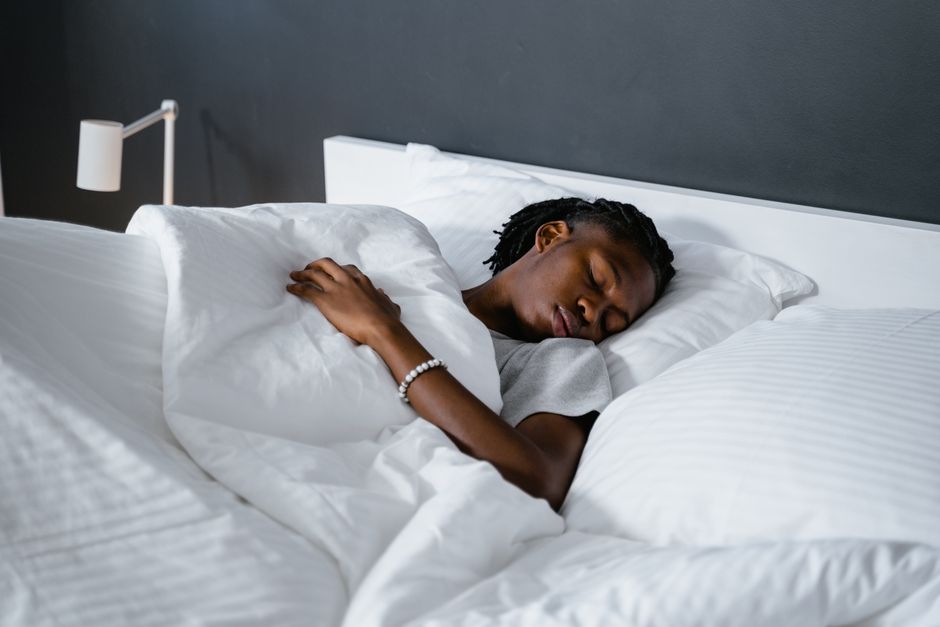
Most people who struggle to fall asleep are not doing anything wrong on purpose. They are fighting their own biology without knowing it. Falling asleep faster comes down to a handful of things: lowering core body temperature, dimming light, quieting mental arousal, and keeping a consistent sleep-wake schedule. The tips below are the ones with real evidence behind them. Some popular advice is not on this list because the research does not support it.
How To Sleep Faster At Night 10 Proven Tips
Sleep onset is not something you force. It is something your body does when the conditions allow it. Each of these tips works on a different part of that process.
1. Keep a consistent wake time
Your wake time anchors your circadian rhythm more than your bedtime does. Waking at the same time every day — including weekends — helps set the internal clock that tells your brain when to feel sleepy. Sleep specialists generally treat a fixed wake time as the foundation of sleep hygiene, and it is often the first thing recommended in clinical settings.
This is the tip people skip because it feels less satisfying than a bedtime ritual. It is also the one with the strongest physiological basis.
2. Lower your core body temperature
Sleep onset is tied to a drop in core body temperature. Your body naturally cools in the evening, and that cooling helps trigger sleepiness. A warm shower or bath about one to two hours before bed can actually help — the subsequent cooling as your body releases heat is what matters, not the warmth itself.
A cool, dark bedroom supports this. Most sleep guidance points to a room temperature that feels cool rather than warm, though individual comfort varies and no single number works for everyone.
3. Get bright light early in the day
Morning light exposure helps set your circadian rhythm. Getting outside or near a bright window within an hour or so of waking signals to your brain that the day has started. That signal makes it easier to feel sleepy at the right time later.
Evening light does the opposite. Bright overhead lights and screens close to bedtime can delay melatonin release. Dimming lights in the last hour or two before bed is a reasonable step, though the evidence on screen use specifically is more mixed than headlines suggest.
4. Get out of bed if you are not sleeping
Lying awake in bed teaches your brain to associate the bed with frustration and alertness. If you have been awake for what feels like a long stretch, getting up and doing something quiet and dim until you feel sleepy can help break that association.
This approach is a core part of cognitive behavioral therapy for insomnia, known as CBT-I. CBT-I is widely considered the first-line treatment for chronic insomnia, and it outperforms sleep medication over the long term in most studies.
5. Use a wind-down period
Your brain does not switch from active to asleep instantly. A wind-down period of quiet activity — reading, light stretching, calm music — gives your nervous system time to shift. The length that works varies by person. The point is consistency, not duration.
6. Limit caffeine after early afternoon
Caffeine has a half-life of roughly five to six hours in most adults, meaning a significant amount is still in your system many hours after your last cup. Individual metabolism varies widely, and some people clear it much faster or slower than others.
For people who are sensitive, an afternoon coffee can still be affecting sleep onset at bedtime. If you are trying to fall asleep faster, cutting caffeine after early afternoon is a reasonable experiment.
7. Be careful with alcohol
Alcohol can make you feel drowsy, which is why many people believe it helps sleep. It does not help sleep quality. Alcohol tends to fragment sleep in the second half of the night and can increase awakenings. It may shorten the time it takes to fall asleep initially, but the tradeoff is usually worse sleep overall.
8. Manage mental arousal before bed
Racing thoughts are one of the most common reasons people cannot fall asleep. Writing down what is on your mind — a to-do list, worries, tomorrow’s tasks — before getting into bed can reduce the mental load that keeps you alert. Some research suggests that externalizing thoughts this way shortens sleep onset for people who tend to ruminate.
If your mind is busy at bedtime, this is often more useful than any supplement.
9. Keep the bedroom dark and quiet
Light and noise both interfere with sleep onset. Blackout curtains, an eye mask, or earplugs can help if your environment is not naturally dark or quiet. This is straightforward and well supported.
10. Get regular physical activity
Regular exercise is associated with better sleep in general. The relationship is well established, though the exact mechanisms are still being studied. Timing matters for some people — vigorous exercise close to bedtime can be stimulating for some and not others. If you are unsure, earlier in the day is the safer bet.
What Actually Happens When You Fall Asleep
Falling asleep is an active process, not a passive one. Your brain shifts into sleep through a series of physiological changes, and understanding them makes the tips above make more sense.
Two systems drive sleepiness. The first is your circadian rhythm, an internal clock that runs on roughly a 24-hour cycle and is set mainly by light exposure. The second is sleep pressure, which builds the longer you are awake and is influenced by a chemical called adenosine. When both align, sleep comes easily. When they are out of sync — from irregular schedules, late light exposure, or daytime napping — sleep onset gets harder.
Melatonin is released in the evening as light fades. It signals to the body that night has come, but it does not force sleep on its own. This is why melatonin supplements do not reliably knock people out. They can shift timing, but they are not a sedative.
Why Some Popular Sleep Tips Do Not Work
A few widely shared ideas do not hold up well.
- Counting sheep. Some research suggests it is less effective than imagining a calm, familiar scene. The mental task matters.
- Melatonin as a sleep aid. It can help shift sleep timing, but evidence for it as a fast-acting sleep inducer is limited.
- Staying in bed and trying harder. Effort tends to increase arousal. This is the opposite of what helps.
- Nightcaps. Alcohol may speed sleep onset slightly but worsens sleep quality overall.
The pattern here is that sleep responds to conditions, not willpower.





When Trouble Falling Asleep Is More Than a Bad Night
Occasional difficulty falling asleep is normal. Chronic insomnia is different. It is generally defined as difficulty falling asleep or staying asleep that occurs at least three nights a week for at least three months and causes daytime problems.
If that describes you, the evidence points to CBT-I as the first-line treatment, not medication. CBT-I is a structured program that addresses the thoughts and behaviors that keep insomnia going. It is typically delivered by a trained clinician, and it is more effective than sleep medication over the long term for most people with chronic insomnia.
Other conditions can also interfere with sleep onset, including sleep apnea, restless legs syndrome, anxiety, and depression. These are not things to self-diagnose. If sleep problems are persistent or affecting your daily life, a clinician is the right next step.
How Long Should It Take to Fall Asleep?
For most healthy adults, falling asleep takes somewhere in the range of 10 to 20 minutes. This is a general reference, not a strict rule. Consistently taking much longer, or feeling like you are fighting sleep every night, is worth paying attention to.
If you fall asleep in under five minutes most nights, that can actually be a sign of significant sleep deprivation rather than good sleep health. It is a less obvious signal that people often miss.
Frequently Asked Questions
What is the fastest way to fall asleep at night?
Lowering core body temperature and reducing mental arousal are the two most direct levers. A cool room, dim light, and a short wind-down period support both.
Does melatonin help you fall asleep faster?
Melatonin primarily helps shift sleep timing rather than acting as a fast sleep inducer. Evidence for it as a quick sleep aid is limited.
Why can’t I fall asleep even when I’m tired?
Feeling tired and being able to sleep are not the same thing. Mental arousal, irregular schedules, caffeine, and light exposure can all block sleep onset even when you feel exhausted.
How long should it take to fall asleep?
For most healthy adults, about 10 to 20 minutes is typical. Consistently taking much longer may point to an underlying sleep issue worth discussing with a clinician.
