
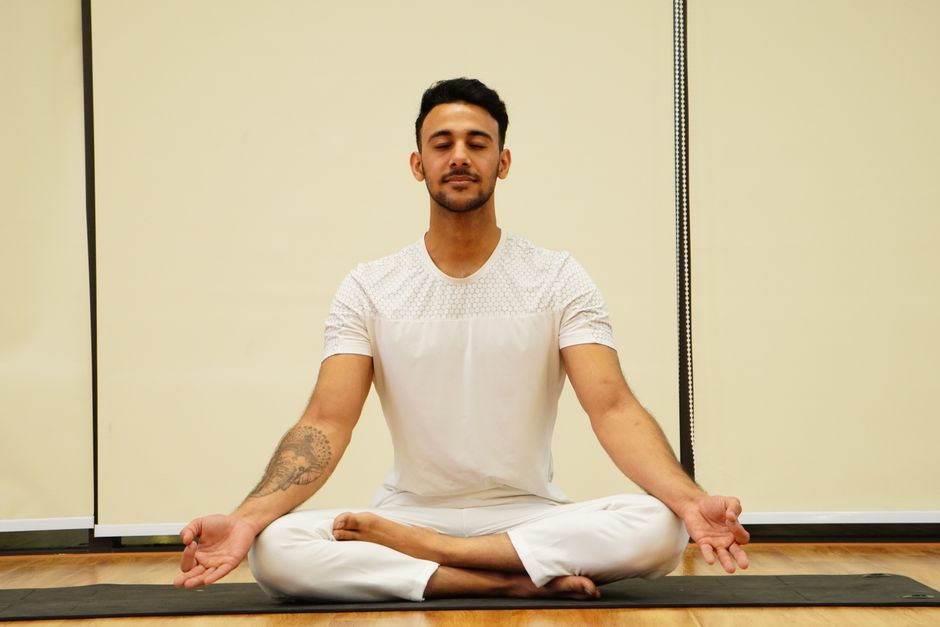
Meditation posture comes down to one simple rule: your spine should be straight and comfortable enough that you stop thinking about your body entirely. What that looks like varies wildly from person to person. A 65-year-old with knee replacements will not sit the same way as a 25-year-old yoga teacher. And that is completely fine. The goal is not to look like a statue. The goal is to find a position that lets your mind settle while your body stays quiet.
What Is the Best Meditation Posture for Beginners?
If you have never meditated before, do not try to sit cross-legged on the floor. Most beginners try this, feel pain within five minutes, and assume they are bad at meditation. They are not bad at meditation. They are just in a position that does not work for their body.
The best beginner posture is sitting upright in a sturdy chair. Place both feet flat on the floor. Keep your knees at a 90-degree angle. Rest your hands on your thighs or in your lap. Your spine should be straight but not rigid. Imagine a string gently pulling the crown of your head toward the ceiling. This position requires no flexibility, no special equipment, and no prior experience.
Research shows that sitting in a chair produces the same meditation benefits as sitting on a cushion. A 2015 study in the journal Frontiers in Psychology found that posture itself had no significant effect on meditation outcomes when comfort was controlled for. What mattered was consistency. People who meditated regularly got better results regardless of whether they sat on a chair, a cushion, or a bench.
How Should Experienced Meditators Sit?
If you have been meditating for a while and want to move to the floor, there are several options. The classic cross-legged position is called Sukhasana in yoga. It works well if your hips are open enough to let your knees rest comfortably below your hips. If your knees rise higher than your hips, your lower back will round, and you will feel it within ten minutes.
A kneeling bench, sometimes called a seiza bench, is a strong alternative. You kneel on a cushion or mat and sit back on a small slanted bench. This keeps your spine naturally straight without putting pressure on your knees or ankles. Many experienced meditators prefer this because it requires less hip flexibility than cross-legged sitting.
Another option is sitting on a meditation cushion, or zafu, with your knees supported by blankets or bolsters. The key is that both knees touch the ground. If one knee floats in the air, your pelvis tilts, and your spine follows. That tilt creates tension that pulls your attention away from your breath. As of 2026, current research suggests that hip mobility is the single biggest physical factor determining whether someone can sit comfortably on the floor for more than fifteen minutes.
What About Lying Down or Other Positions?
Lying down is a valid meditation posture, but it comes with a warning. Most people fall asleep when they lie down to meditate. This is not a failure of discipline. It is biology. Your brain associates the horizontal position with sleep. If you are already tired, lying down will likely put you to sleep within a few minutes.
That said, lying down works well for people with chronic pain, back injuries, or conditions that make sitting difficult. The body scan meditation popularized by Jon Kabat-Zinn is traditionally done lying down. If you choose this position, place a thin pillow under your head and another under your knees to support your lower back. Keep your arms at your sides, palms up.
Standing meditation is another option, though it is less common in Western practice. It comes from traditions like Qigong and walking meditation. Standing requires more physical effort than sitting, so it works best for shorter sessions. Some people find it easier to stay alert while standing. Others find it distracting. Try it once or twice to see which camp you fall into.





What Does the Research Say About Posture and Meditation?
| Posture Type | Attention Quality | Physical Comfort | Best For |
|---|---|---|---|
| Chair sitting | High | High | Beginners, back pain, long sessions |
| Cross-legged (floor) | High | Moderate | Experienced, flexible hips |
| Kneeling bench | High | High | Floor sitting without hip strain |
| Lying down | Moderate | Very high | Pain conditions, body scans |
| Standing | Moderate | Low | Short sessions, alertness issues |
Studies have found that posture affects meditation primarily through two mechanisms: alertness and comfort. If you are too comfortable, you get sleepy. If you are uncomfortable, you get distracted. The sweet spot is a position that requires just enough muscular engagement to keep you awake but not enough to cause pain. This is why the classic advice to sit with a straight spine persists. It is not spiritual. It is practical. A straight spine requires minimal effort to maintain and keeps your nervous system in a state of relaxed alertness.
Some people report that certain postures make them feel more grounded or focused. This is widely claimed though strong evidence is limited. What research does show is that consistency of practice matters far more than posture. A person who meditates for ten minutes every day in a chair will see more benefit than someone who meditates for an hour once a week in a perfect lotus position.
How To Sit For Meditation Postures For Every Level: Practical Steps
Here is the simplest way to find your posture. Start by sitting in a chair. Set a timer for five minutes. Close your eyes and breathe normally. Pay attention to where you feel tension. Your shoulders might be tight. Your jaw might be clenched. Your lower back might ache. Adjust accordingly. Over time, your body will tell you what works.
Once five minutes in a chair feels easy, try a kneeling bench or a cushion on the floor. Start with five minutes again. Do not push through sharp pain. Dull muscle ache is normal as your body adjusts. Sharp joint pain is a sign to stop and try a different position. Your knees and hips are not meant to bend in ways they do not want to bend.
- Keep your spine straight but not locked. A slight natural curve in your lower back is fine.
- Place your hands wherever they feel natural. On your knees, in your lap, or cupped together.
- Relax your jaw. Most people hold tension in their jaw without realizing it.
- Let your gaze soften or close your eyes completely. Do not force your eyes shut.
- If your mind wanders to your body, just notice it and gently return to your breath.
A common mistake is trying to hold a perfect posture for the entire session. Real meditation involves small adjustments. Shift your weight. Straighten your spine. Scratch an itch. These movements are not failures. They are part of the practice. The idea that you must sit completely still is a myth that keeps people from starting.
What Posture Myths Should You Ignore?
The most persistent myth is that you must sit in full lotus to meditate properly. Full lotus is an advanced yoga posture that requires years of hip opening. Very few people can do it comfortably. The Buddha is often depicted in lotus, but he also taught his students to sit on chairs and benches. The posture is not the point.
Another myth is that you must sit with your hands in a specific mudra. Mudras are hand gestures used in some traditions. They can be meaningful for some practitioners. But they are not required. Your hands can rest anywhere. Do not let the idea of a “correct” hand position stop you from starting your practice.
Some people claim that meditating lying down is not real meditation. This is false. Lying down is a valid posture used in clinical settings for decades. The Mindfulness-Based Stress Reduction program, which has more research behind it than almost any other meditation protocol, includes lying down as a standard position. What matters is that you are present and aware, not how your body is arranged.
Finally, ignore anyone who tells you that discomfort is necessary for progress. Pain is not a virtue. If a posture causes pain, change it. Your meditation practice should not require you to endure physical suffering. That is not discipline. That is stubbornness dressed up as spirituality.
Frequently Asked Questions About How To Sit For Meditation Postures For Every Level
Can I meditate lying down if I have back pain?
Yes, lying down is an excellent option for back pain. Place a thin pillow under your head and another under your knees to support your lower back.
How long should I sit in one position before switching?
Start with five minutes in any new position. If you feel sharp pain, switch immediately. If you feel mild discomfort, try to sit with it for a few more minutes before adjusting.
Do I need a special cushion to meditate on the floor?
No, but a cushion or folded blanket under your hips can make floor sitting much more comfortable by tilting your pelvis forward. A firm cushion works better than a soft one.
Is it okay to move during meditation?
Yes, small movements are normal and fine. Shift your weight, straighten your spine, or scratch an itch. The goal is not stillness but awareness of your experience.
