
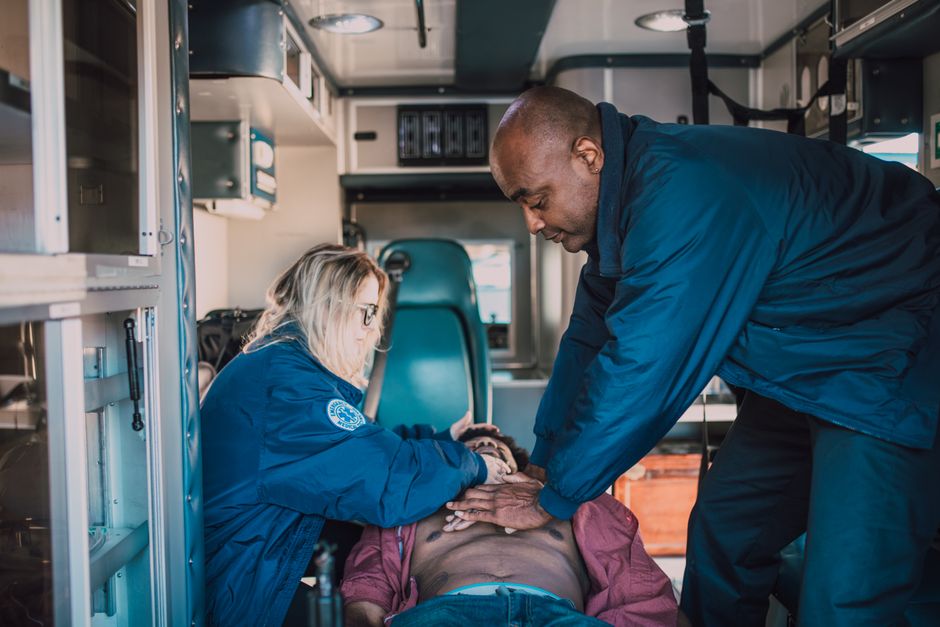
Cardiac arrest is when the heart suddenly stops pumping blood. The person collapses, stops breathing normally, and is unresponsive. Every minute without CPR and a defibrillator lowers their chance of survival by about 10 percent. Your immediate action is the difference between life and death. Call 911, start CPR immediately, and use an AED as soon as one is available.
What Is Cardiac Arrest and How Is It Different From a Heart Attack?
Cardiac arrest is an electrical problem. The heart’s rhythm becomes chaotic or stops entirely, so blood no longer flows to the brain and other organs. A heart attack is a circulation problem. A blocked artery stops blood from reaching the heart muscle itself.
A heart attack can trigger cardiac arrest, but they are not the same event. During cardiac arrest, the person is not just having chest pain. They are unconscious, not breathing, and have no pulse. This distinction matters because the response is different. Cardiac arrest requires CPR and a shock from an AED. A heart attack requires emergency medical care but the person is usually awake and breathing.
How To Save Someone From Cardiac Arrest Cpr Aed: The First Steps
The first step is recognizing cardiac arrest. Check if the person is responsive. Tap their shoulders and shout. If they do not respond, check for normal breathing. Gasping or irregular breathing is not normal breathing. If the person is unresponsive and not breathing normally, assume cardiac arrest.
Call 911 immediately or have someone else call while you start CPR. Put the phone on speaker if you are alone so the dispatcher can guide you. Then begin chest compressions right away. Do not waste time checking for a pulse unless you are a trained healthcare professional. Bystanders should start compressions based on unresponsiveness and abnormal breathing alone.
How To Perform Hands-Only CPR Correctly
Hands-only CPR is CPR without rescue breaths. It is recommended for untrained bystanders because it is simpler and just as effective in the first few minutes of cardiac arrest. The American Heart Association recommends pushing hard and fast in the center of the chest.
Place the heel of one hand on the center of the person’s chest, right between the nipples. Place your other hand on top and interlock your fingers. Keep your arms straight and position your shoulders directly over your hands. Push down at least 2 inches in an adult, but no more than 2.4 inches. Let the chest fully recoil between compressions. Do not lean on the chest.
Compress at a rate of 100 to 120 compressions per minute. That is the same tempo as the song “Stayin’ Alive” by the Bee Gees. Continue compressions without stopping until an AED arrives, EMS takes over, or the person shows signs of life. If you become exhausted and someone else is available, switch every 2 minutes to keep the compressions effective.




When and How To Use an AED
An AED, or automated external defibrillator, is a portable device that analyzes the heart’s rhythm and delivers an electric shock if needed. It is designed for untrained bystanders. The device gives voice prompts that tell you exactly what to do.
Turn on the AED as soon as it arrives. Expose the person’s chest and wipe it dry if wet. Attach the adhesive pads to the bare chest as shown in the diagrams on the pads. One pad goes on the upper right chest, the other on the lower left side. The AED will analyze the heart rhythm. Make sure no one is touching the person during the analysis.
If the AED says a shock is advised, shout “clear” and make sure nobody is touching the person. Press the shock button. Immediately resume CPR, starting with chest compressions. The AED will re-analyze the rhythm every 2 minutes. If no shock is advised, continue CPR until EMS arrives.
What To Do If You Are Alone With No AED Nearby
If you are alone, call 911 first, then start CPR. Do not leave the person to search for an AED unless the AED is visibly within a few steps. In most public places, someone else can locate the AED while you perform compressions. Send a specific person to find one and tell them to bring it back.
Continue hands-only CPR until help arrives. Do not stop unless the person starts breathing normally, an AED is ready to analyze, or EMS takes over. Compressions are physically demanding. If you cannot maintain the proper depth and rate, your compressions lose effectiveness. If another bystander is present, rotate every 2 minutes to maintain quality.
Should You Give Rescue Breaths?
Rescue breaths are part of traditional CPR. For trained rescuers, the recommended sequence is 30 chest compressions followed by 2 rescue breaths. For untrained bystanders, hands-only CPR is strongly encouraged because it removes hesitation and improves the likelihood that someone will act.
If you are trained and willing to give rescue breaths, tilt the head back, lift the chin, pinch the nose, and give 2 breaths over 1 second each. Watch for the chest to rise. If the chest does not rise, reposition the head and try again. Return to compressions immediately. Each breath should take about 1 second. Do not pause compressions for more than 10 seconds.
For cardiac arrest caused by a respiratory problem, such as drowning or drug overdose, rescue breaths are especially important. The heart has stopped because the body ran out of oxygen. In these cases, compressions alone are less effective. If you witnessed a sudden collapse in an adult, the cause is likely cardiac and hands-only CPR is sufficient.
Common Mistakes That Reduce Survival Chances
The most common mistake is doing nothing at all. Fear of hurting someone or doing CPR incorrectly stops many bystanders from acting. The reality is that a person in cardiac arrest is clinically dead. You cannot make them worse. Even imperfect CPR is far better than no CPR.
Another common mistake is stopping compressions too often. Every time you stop, blood flow stops. Minimize interruptions. Only stop for the AED analysis, to switch rescuers, or when EMS arrives. Some rescuers also compress too slowly or too shallowly. Push hard and fast. Let the chest fully recoil between each compression so the heart can refill with blood.
People also waste time checking for a pulse. Pulse checks are unreliable for lay rescuers and delay compressions. If the person is unresponsive and not breathing normally, start CPR. Do not spend time trying to find a pulse you may not be able to feel.
What Happens After the AED Delivers a Shock
The shock does not restart the heart. It stops the chaotic rhythm so the heart’s natural pacemaker can resume a normal rhythm. After the shock, the heart may or may not restart on its own. This is why CPR continues immediately after the shock.
CPR after a shock keeps blood flowing to the brain and heart while the heart tries to re-establish a normal rhythm. The AED will guide you through this process. It will re-analyze every 2 minutes and tell you whether another shock is needed. Continue following the prompts until EMS arrives.
Why Bystander Action Matters More Than Anything Else
Survival from cardiac arrest depends on the chain of survival. The first links in that chain are immediate recognition, early CPR, and rapid defibrillation. Emergency medical services cannot reach most cardiac arrest victims in time. The average EMS response time in the United States is around 7 to 10 minutes. Brain damage begins within 4 to 6 minutes without oxygen.
Bystander CPR doubles or triples the chance of survival. An AED used within 3 to 5 minutes of collapse can push survival rates above 50 percent in some studies. This is why public access defibrillators are placed in airports, malls, gyms, and schools. The device is designed for people with no medical training to use.
Your willingness to act is the single biggest factor in whether someone survives. The steps are simple: call 911, push hard and fast in the center of the chest, and use an AED if one is available. Do not wait for someone else to step in. If you are standing there, you are the one who can save their life.
Frequently Asked Questions
Do I need to give rescue breaths during CPR?
No, if you are untrained, perform hands-only CPR with continuous chest compressions. If you are trained and comfortable, give 30 compressions followed by 2 rescue breaths.
Can I hurt someone by performing CPR?
You can break ribs, but a person in cardiac arrest is already dying and broken ribs heal. The greater harm is doing nothing at all.
How long should I continue CPR?
Continue until the person shows signs of life, an AED is ready to analyze, EMS arrives and takes over, or you are physically unable to continue.
What if the AED tells me not to shock?
Follow the device instructions and immediately resume CPR. No shock is needed when the heart rhythm does not require one, but compressions must continue.
