
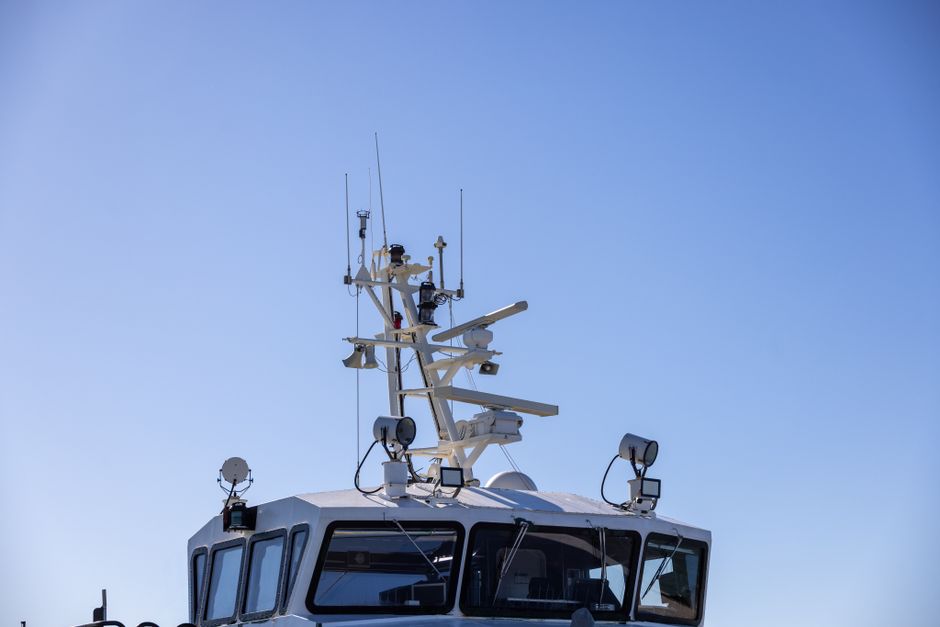
Marine radar shows you a map of everything that reflects your radio pulse — other vessels, land, buoys, and rain — and how far away it sits. Reading it well comes down to three habits: tuning the receiver properly, understanding what each control actually does to the picture, and using the display to track another vessel’s bearing over time rather than trusting a single sweep. This guide explains how radar works, what the controls change, and where it can mislead you.
What Does Marine Radar Actually Show You?
Radar sends out a short pulse of radio energy and listens for the echo. The time it takes for the echo to return sets the distance. The direction the antenna was pointing sets the bearing. That is the whole system.
What comes back is not a photograph. It is a map of reflectivity. Metal hulls, rocky shorelines, and large buildings return strong echoes. Fiberglass hulls, wooden boats, and small buoys return weak ones. Flat calm water returns almost nothing. Rain returns a lot.
This matters because the display shows you what reflects, not what exists. A small wooden skiff may barely appear. A wave crest in rough seas can appear as a solid block of clutter. A glass-smooth swell can hide a steel-hulled fishing boat behind it.
Radar is a supplement to your eyes, your ears, and your AIS receiver — not a replacement for any of them. AIS broadcasts a vessel’s identity and position, but only if that vessel is transmitting and equipped. Radar sees vessels that have no AIS at all. Neither one sees everything.
How To Read Marine Radar And Avoid Collisions: The Core Method
The single most useful skill in collision avoidance is watching how another contact’s bearing changes over time. A vessel that holds a steady bearing while getting closer is on a collision course with you.
This is the classic constant bearing, decreasing range rule. It works because if two vessels maintain the same relative angle to each other while the distance shrinks, their paths must intersect. It does not matter what the other vessel is doing or whether anyone is watching. The geometry is the geometry.
Here is how to apply it:
- Pick a contact that concerns you and note its bearing on the display.
- Wait. Depending on your speed and the closing speed, a minute or two is often enough to see a trend.
- Check the bearing again. If it has shifted noticeably left or right, you will pass clear.
- If the bearing is essentially unchanged and the range is dropping, you are on a collision course.
On a traditional radar display oriented with your bow at the top, a contact drifting toward the center of the screen while holding its angle is the warning sign. On a north-up display with a chart overlay, the same logic applies — track the bearing line, not the screen position.
Take early, substantial action. A small course change made early is far easier for the other vessel to see than a large change made late. This is also the general direction of the international collision regulations, which call for action taken in ample time and large enough to be readily apparent to another vessel observing visually or by radar.
What Do the Radar Controls Actually Change?
Every control on a radar set alters the picture in a specific way. Knowing which one does what is the difference between a clean display and one you cannot trust.
Gain controls receiver sensitivity. Too low and weak targets vanish. Too high and the screen fills with speckled noise. The usual method is to raise gain until a light speckle appears across the screen, then back off slightly.
Sea clutter (sometimes called STC) suppresses returns from nearby waves. It works on the closest range first. Use the minimum that clears the near-field noise, because it also suppresses small real targets at short range.
Rain clutter (FTC or differentiation) breaks up the soft, extended returns from precipitation. It helps you see through rain, but it also thins out genuine small targets inside the rain cell.
Range sets how much distance the screen covers. Short ranges give detail. Long ranges give warning time. Most operators switch between them rather than staying on one setting.
VRM and EBL — variable range marker and electronic bearing line — are measuring tools. The VRM gives you a distance to a target. The EBL gives you a bearing. Together they let you take the repeat readings that the constant bearing method requires.
There is no universal setting. Conditions change, and the controls need to change with them.




Why Radar Sometimes Fails to Show a Real Boat
Radar shadows and blind spots are real and they cause collisions. The most common cause is a large object blocking the beam.
Your own mast, a radar reflector mounted badly, or a tall structure on your own vessel can cast a shadow sector where nothing appears. On a sailboat heeling under sail, the mast can block a wedge of the horizon. That wedge moves as the boat moves.
Other causes of missing targets:
- Low antenna height, which limits how far you can see over the curve of the earth and behind waves.
- Small, low-reflectivity targets such as wooden or fiberglass boats with no reflector.
- Targets hidden inside rain clutter that the rain control has suppressed.
- Sea clutter settings that are too aggressive for the conditions.
Radar horizon is a hard physical limit. The higher the antenna, the farther it can see, but a low target like a small boat disappears behind the curve of the water at a surprisingly short distance. A tall ship sees over that curve; a kayak does not.
This is why you keep a visual watch alongside the radar. The regulations require it, and the physics explains why.
What Is ARPA and Can You Rely On It?
ARPA — automatic radar plotting aid — is a function that tracks contacts automatically and calculates their course, speed, and closest point of approach. It removes the manual plotting work.
ARPA is genuinely useful, and it is also only as good as the echoes it is tracking. If a target is weak, intermittent, or lost in clutter, the tracking can drop it or produce an unreliable vector. The system will usually flag a lost target, but you have to be watching for that flag.
Treat ARPA vectors as a helpful estimate, not a guarantee. Verify anything that looks close with the manual bearing-and-range method. The two should agree. When they do not, trust your own measurements and slow down.
Not all radar sets have ARPA, and the quality of tracking varies. On busy water with many contacts, ARPA can also become cluttered and harder to interpret than a clean raw display.
How Do You Set Up Radar for Night and Fog?
Reduced visibility is when radar earns its place, and it is also when setup errors cost the most.
Start with a clean display. Tune gain, sea, and rain for the actual conditions rather than leaving yesterday’s settings in place. Use a shorter range than you would in clear daylight so you can resolve close contacts, and switch to longer ranges periodically to scan for fast-approaching traffic.
Dim the display so your night vision survives. A bright screen in a dark wheelhouse blinds you to the world outside the window.
Post a dedicated lookout if you can. The person watching the radar should not also be steering, navigating, and handling the radio. In fog, sound signals and listening matter as much as the screen. Radar does not hear a foghorn, and a foghorn can tell you about a vessel your radar has missed.
Reduce speed. Lower speed buys time to interpret what you are seeing, and it shortens your stopping distance. The collision regulations call for a safe speed appropriate to the conditions, and restricted visibility is explicitly one of those conditions.
The Limits You Should Never Forget
Radar is a tool with a known failure profile, and the failures are predictable.
It cannot see what does not reflect well. It cannot see through a shadow cast by your own vessel. It cannot see a small boat hidden behind a wave. It cannot tell you whether the other vessel has anyone on watch.
The constant bearing, decreasing range check catches the situations radar alone can miss, because it relies on geometry rather than on the quality of an echo. Combine it with a visual watch, an AIS receiver if you have one, sound signals in fog, and a speed that gives you time to react.
No single instrument keeps you clear of collisions. The habit of cross-checking several sources, early and often, does.
Frequently Asked Questions
What does it mean when a radar target holds a steady bearing?
A steady bearing with decreasing range means you are on a collision course with that vessel. Take early, substantial action to change the bearing before the distance closes.
Can marine radar see every boat?
No. Radar only shows objects that reflect its pulse well enough to appear, so small wooden or fiberglass boats, low targets behind waves, and anything in a shadow sector can be missed. Keep a visual watch alongside the screen.
What is the difference between sea clutter and rain clutter controls?
Sea clutter suppresses returns from nearby waves and works mainly on the closest ranges, while rain clutter breaks up the soft returns from precipitation. Both can hide small real targets if set too aggressively.
Is ARPA more reliable than plotting by hand?
ARPA automates tracking but depends on steady, clear echoes and can drop weak or intermittent targets. Verify anything close with your own bearing and range readings rather than relying on the vectors alone.
