
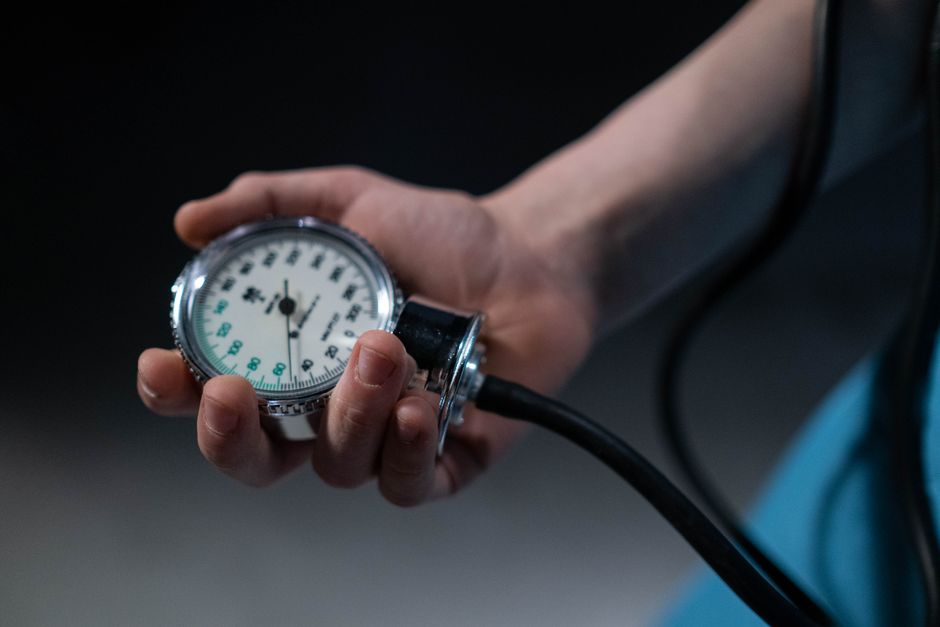
Hospital vital signs monitors display continuous streams of numbers, waveforms, and alarm states that can look overwhelming at first glance. The monitor is not a diagnosis machine — it is a display of measurements taken by sensors attached to the patient. Learning which numbers matter, what their normal ranges are, and why alarms sound gives you a way to follow what is happening instead of just watching lights blink.
What Does A Hospital Vitals Monitor Actually Measure?
A standard bedside monitor tracks five core measurements, often called the “vitals.” Each one comes from a different sensor, and each tells the clinical team something different about how the body is functioning.
- Heart rate (HR): beats per minute, usually shown from the ECG tracing.
- Blood pressure (BP): systolic over diastolic, in millimeters of mercury (mmHg).
- Respiratory rate (RR): breaths per minute.
- Oxygen saturation (SpO2): the percentage of hemoglobin carrying oxygen, measured by a pulse oximeter.
- Temperature: body temperature, usually in Fahrenheit in US hospitals.
Many monitors also show additional values like end-tidal CO2 (EtCO2) for patients on breathing support, or a continuous ECG waveform. The number of displayed values depends on the patient’s condition and where they are being cared for. A general floor patient may have fewer sensors than someone in intensive care.
What Do The Normal Ranges Look Like?
Normal adult ranges are well established in clinical practice. Values outside these ranges do not automatically mean something is wrong — they mean the clinical team needs to look at the whole picture.
For a resting adult:
- Heart rate: 60 to 100 beats per minute
- Blood pressure: a systolic under 120 and diastolic under 80 is considered normal; hypertension is generally defined as 130/80 mmHg or higher
- Respiratory rate: 12 to 20 breaths per minute
- Oxygen saturation: 95% or higher on room air for most adults
- Body temperature: roughly 97°F to 99°F (36.1°C to 37.2°C)
These are reference ranges, not rigid rules. Athletes often run lower resting heart rates. Older adults may have different baselines. Someone with chronic lung disease may have a normal SpO2 below 95%. The team caring for the patient knows their baseline and interprets the number against it.
How Do You Read The Numbers On The Screen?
Most monitors display values in a consistent layout, though brands vary. Once you recognize the pattern, the screen becomes readable.
The largest number on the screen is usually the heart rate, because it changes fastest and is the most watched. Next to it is typically the SpO2 reading, often with a small waveform underneath showing the pulse. Blood pressure is usually shown as two numbers separated by a slash, and often with a small notation of when it was last taken if the cuff is not continuous. Respiratory rate is usually smaller and may be derived from the ECG or from a chest sensor. Temperature is often shown in a smaller corner of the screen.
Color coding is common but not universal. Many monitors use green for ECG and heart rate, blue for SpO2, white or red for blood pressure, and yellow for other parameters. Do not rely on color alone — read the labels.





What Do The Waveforms Mean?
The moving lines on the screen are called waveforms. They are not decoration — they show the shape of a physiological signal over time.
The ECG waveform shows the electrical activity of the heart. A normal tracing has a repeating pattern of a small bump, a sharp spike, and a rounded wave. The sharp spike corresponds to the heartbeat. Changes in the shape or rhythm of this tracing are one of the main things clinical staff watch for.
The pulse oximeter waveform (often called a plethysmograph) rises and falls with each pulse. It is useful because it confirms the SpO2 reading is picking up a real pulse and not artifact from movement.
The respiratory waveform, when displayed, shows the rise and fall of the chest or the flow of air. On some monitors it is a smooth wave; on others it is a numerical value only.
A flat line, a wandering line, or a line that suddenly looks different from before is information. It may mean the sensor moved, the patient moved, or something has changed physiologically. The monitor cannot tell the difference — that is what the clinical team is for.
Why Do Monitors Alarm So Often?
Alarm fatigue is a recognized patient safety concern in hospitals, and it exists for a reason: monitors alarm frequently, and many alarms are not clinically meaningful.
Alarms typically fall into two categories. A limit alarm sounds when a value crosses a threshold set by the clinical team — for example, heart rate above 120 or SpO2 below 90%. A technical alarm sounds when the monitor loses a signal, a lead comes loose, or a sensor is not reading properly.
False alarms are common. Movement, poor sensor contact, low battery on a telemetry pack, and even certain medical devices nearby can trigger them. Hospitals have worked for years on strategies to reduce nuisance alarms without suppressing real ones. When you hear an alarm, the response is the same: a nurse or clinician checks the patient and the monitor together. The alarm is a prompt to look, not a diagnosis.
What Is A “Normal” Reading For A Specific Patient?
This is one of the most misunderstood points about vital signs. Normal ranges are population ranges. They are not the same as a specific patient’s normal.
A person with well-controlled hypertension may run a systolic of 140 at home and feel fine. A person with severe lung disease may have a baseline SpO2 of 88% and be stable. A young athlete may have a resting heart rate in the 40s. If the clinical team is treating the number instead of the patient, that is a problem — but good teams treat the patient, using the number as one data point among many.
If you are a family member watching the monitor, the most useful question is not “what is normal?” but “what is normal for this patient, and has anything changed?” That is the question the clinical team is already asking.
How Should You Use The Monitor As A Family Member?
The monitor is not a substitute for asking questions. It is a tool that can help you ask better ones.
You can watch for trends rather than single readings. A heart rate that has been 70 all day and is now 110 is more meaningful than a heart rate of 110 in someone who has been running high all along. You can note when a value changes and how long it stays changed. You can ask the nurse what the alarm thresholds are set to and why.
What you should not do is interpret a single number as a diagnosis. A low SpO2 reading may be accurate, or it may be artifact from cold fingers or movement. A high heart rate may be pain, fever, anxiety, or something more serious. The monitor shows the number; the clinical team interprets it.
If something on the screen concerns you, say so. Nurses and doctors would rather answer a question than miss a change. You are not expected to read the monitor like a clinician — you are expected to be another set of eyes.
What About The Numbers That Are Not On The Screen?
Some important clinical information never appears on the bedside monitor. Level of consciousness, pain, urine output, skin color, and how the patient feels are all part of the assessment. A patient can have perfect vital signs on the screen and still be deteriorating. A patient can have alarming numbers and be stable.
This is why monitors are described in clinical training as one part of the assessment, not the whole of it. The monitor watches continuously when a human cannot. The human interprets what the monitor cannot.
Frequently Asked Questions
What is a normal heart rate on a hospital monitor?
For most resting adults, 60 to 100 beats per minute is considered normal. Athletes and some healthy adults run lower, and a patient’s baseline matters more than the population range.
What does SpO2 mean on a vitals monitor?
SpO2 is the estimated percentage of hemoglobin in the blood that is carrying oxygen, measured by a pulse oximeter. For most healthy adults on room air, 95% or higher is typical, though people with chronic lung conditions may have a lower baseline.
Why does the monitor alarm so often?
Many alarms are triggered by movement, loose sensors, or values that briefly cross a set threshold without indicating a real problem. Hospitals work to reduce nuisance alarms, but the response is always to check the patient and the monitor together.
Can I trust the numbers on the monitor?
The numbers are measurements, not diagnoses, and they can be affected by sensor placement, movement, and other factors. The clinical team interprets them alongside how the patient looks and feels.
