
Aglaonema, often called Chinese evergreen, is one of the most forgiving houseplants you can own. It also happens to be one of the easiest to multiply. You can propagate aglaonema two ways: by rooting stem cuttings in water or soil, or by dividing a mature plant at the roots. Both methods work reliably when done with clean tools and a little patience. Division is faster and gives you a plant that is already established. Cuttings take longer but let you produce several new plants from one stem.
How To Propagate Aglaonema Cuttings Division?
These are two separate methods, and it helps to understand what each one actually does before you start.
Cuttings means you cut a piece of stem that contains at least one node — the small bump where a leaf or aerial root attaches — and encourage it to grow its own roots. The new plant is a clone of the parent.
Division means you take a plant that has already grown into a clump of several stems and separate it into two or more pieces, each with its own roots. Nothing is cut from the top. You are simply splitting what is already there.
Division is the safer route if you want a guaranteed result. You are working with existing roots, so the new plants have a head start. Cuttings are better if your plant has a single stem, or if you want more plants than division alone would give you.
Whichever route you choose, the timing matters less than you might think. Aglaonema grows slowly compared to many houseplants. It does not have a dramatic active growing season the way some tropicals do. In most homes, spring and early summer are still the best windows because light levels are higher and the plant is putting out new growth. But aglaonema can be propagated at other times of year too, it just tends to root more slowly.
What Tools And Conditions Do You Need?
You do not need much, but a few basics make a real difference.
- A clean, sharp knife or pair of pruners. Dull tools crush stem tissue and create a larger wound that is more likely to rot.
- A clean work surface and clean hands.
- A rooting container — a glass of water or a small pot with drainage holes.
- Potting mix that drains well. A standard indoor mix with added perlite works. Heavy, waterlogged soil is the most common reason cuttings fail.
- Indirect light and room temperature. Aglaonema tolerates low light as a houseplant, but rooting happens faster in bright, indirect light.
One thing worth knowing: aglaonema sap contains calcium oxalate crystals. It is not dangerous to touch for most people, but it can irritate skin and is toxic if chewed or swallowed. Keep the plant and any cuttings away from pets and small children, and wash your hands after handling cut stems. If you have sensitive skin, gloves are a reasonable precaution.
How Do You Take Stem Cuttings From Aglaonema?
Look at your plant and find a stem with visible nodes. A node is the slightly raised ring or bump along the stem where leaves emerge. Roots will only form from a node, never from a smooth section of stem between nodes. This is the single most common mistake people make. If your cutting has no node, it will not root.
Using your clean knife, cut the stem just below a node. A cutting of a few inches with at least one node and ideally one or two leaves is a good size. You can take several cuttings from a long stem, as long as each piece has its own node.
From there you have two options.
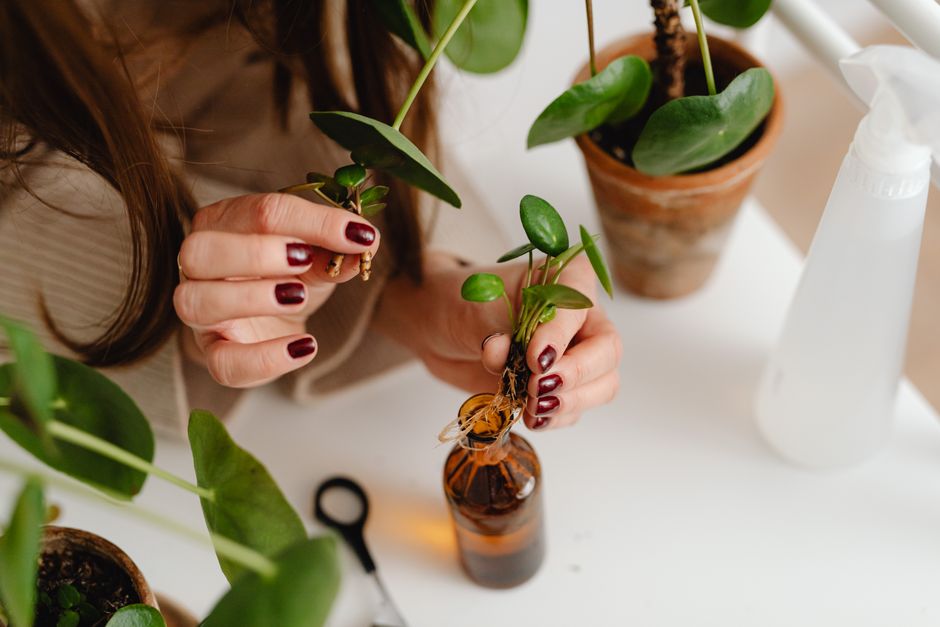
Rooting in water. Place the cutting in a glass of clean water so the node is submerged but the leaves are above the waterline. Leaves left underwater tend to rot. Change the water every few days to keep it from going cloudy. Roots usually begin to appear within a few weeks, though aglaonema can be slow and it may take longer. Once roots are a couple of inches long, move the cutting to soil.
Rooting directly in soil. Push the cut end into moist potting mix so the node is buried. Keep the mix lightly moist, not soaked. A plastic bag over the pot can hold humidity, but open it now and then for airflow. This method skips the transplant step, but you cannot see the roots forming, so you have to trust the process.
Either way, do not tug on the cutting to check for roots. You will break the fragile new roots. Wait for new leaf growth as your signal that the plant has taken hold.





How Do You Divide An Aglaonema Plant?
Division works best on a plant that has clearly become a clump — several stems growing from the same pot, often with roots filling the container. If your aglaonema is a single stem, division is not an option. Take cuttings instead.
Start by watering the plant a day or two before. Moist soil holds the root ball together and makes the roots less brittle. Then gently slide the plant out of its pot. If it is stuck, run a knife around the inside edge of the pot.
Once the root ball is out, look for natural gaps between the stems. Aglaonema often separates fairly easily along these lines. Use your hands to tease the root ball apart. If the roots are tightly tangled, a clean knife can cut straight down through the root mass, dividing it into sections.
Each new section needs its own roots and at least one stem with leaves. A piece with no roots will struggle. Pot each division into fresh, well-draining mix at the same depth the plant was growing before. Water it in, then let the soil settle.
Expect some transplant shock. The divisions may droop or lose a leaf or two in the first week or so. This is normal. Keep them out of direct sun and water sparingly until you see new growth.
What Goes Wrong And How Do You Avoid It?
Most propagation failures come down to a few predictable problems.
Rotting cuttings. This usually means the cutting sat in stagnant water too long, or the soil stayed too wet. Change water regularly, and let soil dry slightly between waterings.
No roots forming. The most likely cause is a cutting with no node. Check that each piece has one. Low light and cool temperatures also slow rooting considerably.
Yellowing leaves after division. Some leaf loss is expected. If it continues past the first couple of weeks, the plant may be overwatered or sitting in light that is too strong.
Divided sections that never recover. This often means a section was separated without enough roots to support its leaves. Next time, keep more roots with each piece, or remove a leaf or two to reduce demand on the roots.
Aglaonema is not a fast plant. New growth from a cutting can take weeks or months to appear. That slowness is not a sign of failure. It is just how this plant grows.
Water Or Soil For Rooting Cuttings?
Both work. Water lets you watch the roots develop, which many people find reassuring, and it is easy to monitor. The downside is that water roots are structurally different from soil roots and can be damaged during the move to soil.
Soil rooting avoids that transition. The cutting develops the type of roots it will actually use, and there is no shock when you pot it up. The trade-off is that you cannot see what is happening underground.
If you are new to propagating, water rooting is a fine place to start because you get clear feedback. Once you are comfortable, rooting directly in soil tends to produce a sturdier plant with less fuss.
How Long Until You Have A New Plant?
Division gives you a new plant immediately, though it needs a few weeks to settle in and resume normal growth. Cuttings take longer. Roots may begin forming within a few weeks, but a cutting typically needs several months to become a well-rooted, established plant. Aglaonema’s slow growth rate is the main reason.
There is no way to speed this up dramatically. Warmth, bright indirect light, and consistent moisture help, but they will not turn a slow plant into a fast one. Patience is genuinely part of the process here.
Frequently Asked Questions
Can you propagate aglaonema from just a leaf?
No. Aglaonema needs a piece of stem with a node to produce roots. A leaf alone will not grow into a new plant.
How long do aglaonema cuttings take to root?
Roots often begin to appear within a few weeks, but aglaonema is a slow grower and the timing varies. A cutting can take several months to become a fully established plant.
Is it better to propagate aglaonema in water or soil?
Both methods work reliably. Water lets you see the roots forming, while soil avoids the shock of moving a cutting from water into potting mix.
Is aglaonema toxic to pets and people?
Aglaonema contains calcium oxalate crystals and is toxic if chewed or swallowed, so keep it away from pets and small children. It can also irritate skin, so wash your hands after handling cut stems.
