
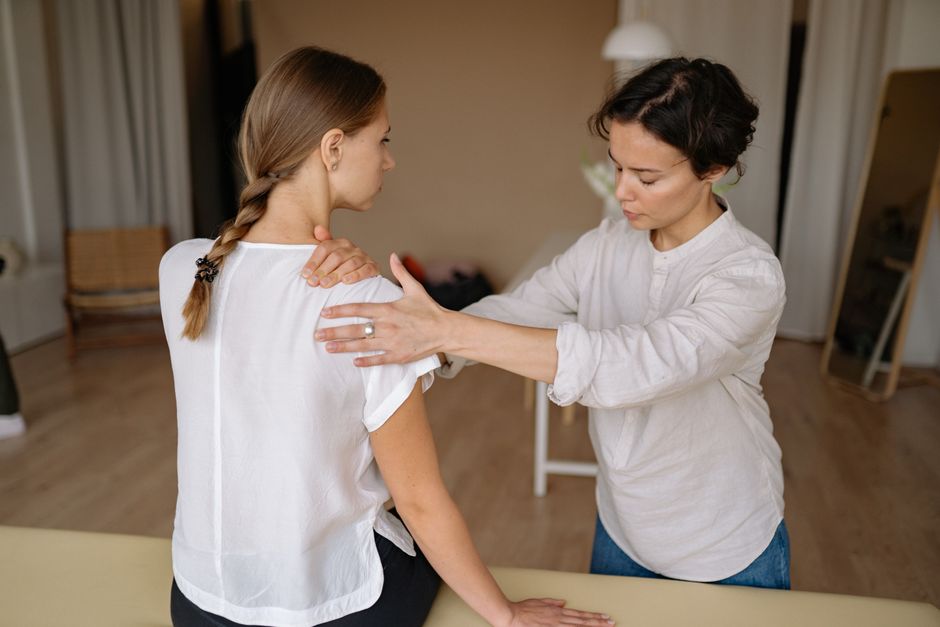
You can sometimes get a satisfying pop in your back by moving gently through specific positions that create a small amount of controlled spinal movement. The most common methods involve lying on your back, kneeling, or using a chair to create a stretch that lets the joints release on their own. You cannot force a pop, and trying to yank or twist your spine hard can cause injury. The goal is to create the right conditions and let your body do the rest.
That cracking sound is not your bones snapping back into place. It is gas releasing from the fluid inside your spinal joints. Understanding what is actually happening helps you do this safely.
What Actually Happens When Your Back Pops?
The pop is called a cavitation. Each spinal joint is surrounded by a capsule filled with synovial fluid. That fluid contains dissolved gases, mostly nitrogen and carbon dioxide. When the joint is stretched, pressure inside the capsule drops. The gases form a bubble and then collapse, which makes the popping sound.
This is the same mechanism behind knuckle cracking. Once a joint has popped, it usually will not pop again right away because the gases need time to dissolve back into the fluid. That is why a second attempt often produces nothing.
The relief many people feel after a pop is real but short-lived. It comes from a brief stretch of the joint capsule and surrounding muscles, not from your spine being “realigned.” If you have chronic pain, popping alone will not fix the underlying cause.
How To Pop Your Back By Yourself Safely
These positions use your own body weight and gentle movement to create traction. None of them require a partner or equipment. Move slowly and stop if you feel sharp pain.
Lying Knee Twist
Lie on your back with your knees bent and feet flat on the floor. Slowly let both knees fall to one side while keeping your shoulders flat. Hold for a few seconds. Breathe out and let gravity do the work. Return to center and repeat on the other side. This creates a gentle rotation through the lower spine.
Kneeling Back Extension
Start on your hands and knees. Slowly sit back toward your heels while keeping your hands stretched forward. You will feel a stretch through your mid and lower back. Hold for 20 to 30 seconds. Some people get a release in the upper back with this position.
Chair Twist
Sit upright in a sturdy chair with feet flat on the floor. Cross your arms over your chest. Gently rotate your upper body to one side as far as comfortable. Hold for a few seconds, then return to center and rotate the other way. This targets the thoracic spine, the section of your back that attaches to your ribs.
Cat-Cow Movement
On your hands and knees, alternate between arching your back up toward the ceiling and letting it sag toward the floor. Move slowly with your breath. This does not always produce a pop, but it mobilizes the spine and can relieve stiffness.
Why You Should Not Force a Pop
Forcing a pop means pushing past the point where your body naturally stops. That is when injuries happen. Aggressive twisting or having someone walk on your back can strain muscles, irritate joints, and in rare cases cause more serious damage.
Signs you should stop immediately include sharp pain, numbness or tingling that travels down a leg, weakness, or a pop followed by sudden severe pain. These are not normal responses and need medical attention.
Some people should not attempt self-manipulation at all. This includes anyone with osteoporosis, a recent spinal fracture, spinal cancer, or an active infection in the spine. If you have had spinal surgery, ask your surgeon before trying any of these movements.
There is also a practical limit to what popping can do. A single cavitation does not correct a disc herniation or fix scoliosis. If your goal is pain relief, the movement itself may help more than the pop. Muscle relaxation and improved circulation from gentle motion can ease discomfort even when nothing cracks.





When To See a Professional Instead
If you have tried gentle self-mobilization for a few days and your pain is not improving, or if it is getting worse, see a doctor or physical therapist. They can assess whether your pain is coming from muscles, joints, discs, or nerves. Each of those needs a different approach.
Physical therapists often teach people how to move in ways that reduce pain over time. That is different from chasing a pop. Research on spinal manipulation shows it can help some people with acute low back pain, but the evidence for chronic pain is mixed and the effects are usually modest.
Chiropractors and osteopaths perform spinal manipulation as a treatment. If you choose to see one, look for a licensed practitioner and tell them about any health conditions you have. Some clinicians recommend avoiding high-velocity neck manipulation because of a rare risk of artery injury, though the evidence on this risk is still debated.
What Does Not Work
Some popular methods for popping your back are not worth the risk. Having a friend stomp or walk on your back can cause rib fractures or spinal injury. Using a chair or doorframe to aggressively twist your spine can strain muscles and ligaments.
Back-cracking devices sold online have not been shown in clinical trials to treat back pain. They may feel good in the moment, but no study has confirmed they provide lasting relief or correct spinal alignment.
Claims that a specific pop “puts a vertebra back in place” are not accurate. Vertebrae do not slip out of position the way many people imagine. What feels like a misalignment is usually a joint that is stiff or a muscle that is tight.
How Often Is It Safe To Pop Your Back?
There is no official guideline on how often you can safely pop your own back. The general principle is that if it feels good and relieves tension without pain, occasional gentle popping is unlikely to cause harm. If you feel the need to do it many times a day, that is a sign something else is going on.
Frequent self-manipulation can become a habit that provides brief relief without addressing the cause of your discomfort. If you find yourself constantly twisting to get a pop, it may be worth looking at your posture, activity level, and stress, all of which affect back tension.
Other Ways To Relieve Back Tension
Movement is often more effective than popping for lasting relief. Walking, swimming, and gentle stretching keep the spine mobile and the surrounding muscles strong. Staying in one position for long periods tends to make stiffness worse.
Heat can relax tight muscles. A warm shower or heating pad applied for 15 to 20 minutes may ease discomfort. Cold packs can help if there is inflammation from a recent strain.
Strengthening your core and back muscles supports your spine and reduces the frequency of stiffness. A physical therapist can recommend exercises suited to your specific situation. This is not as quick as a pop, but it addresses the reason your back feels tight in the first place.
Stress also plays a role. Muscle tension in the back often increases when people are anxious or sitting tense for hours. Relaxation techniques, better sleep, and regular breaks from sitting can make a difference.
Frequently Asked Questions
Can you pop your own back by yourself?
Yes, many people can produce a pop using gentle movements like a knee twist or chair rotation. The key is to move slowly and let the joint release on its own rather than forcing it.
Is it bad to crack your back every day?
Occasional gentle popping is unlikely to cause harm, but needing to do it many times a day suggests an underlying issue. Frequent self-manipulation can become a habit that masks the real cause of your discomfort.
Why does my back pop but not feel better?
A pop only releases gas from a joint capsule and does not fix the source of pain. If your back still hurts after popping, the issue may be muscular, disc-related, or nerve-related and needs a different approach.
When should I not try to pop my back?
Do not attempt it if you have osteoporosis, a recent spinal fracture, spinal cancer, or a spine infection. Stop immediately if you feel sharp pain, numbness, or weakness in your legs.
