
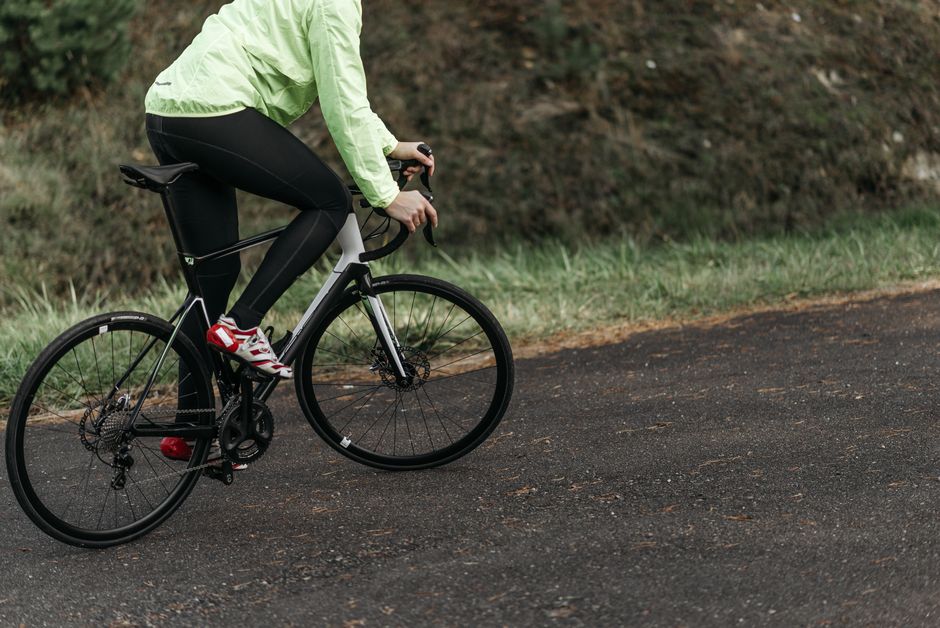
Getting your saddle height right is one of the most important adjustments you can make on a bike. When it is correct, you pedal efficiently and avoid unnecessary strain. When it is wrong, you risk knee pain, hip discomfort, and a less powerful ride. The right way to measure saddle height starts with a simple formula based on your inseam length, and you can do it at home in under ten minutes.
Why Does Saddle Height Matter So Much?
Your saddle height directly controls how your legs move through each pedal stroke. If the saddle is too low, your knees bend too much. This forces your quadriceps to work harder than they should and can lead to anterior knee pain. Research published in the Journal of Sports Sciences found that a saddle set too low increases the compressive forces behind the kneecap.
If the saddle is too high, you will rock your hips side to side to reach the pedal. This wastes energy and can irritate your lower back and hamstrings. The correct height allows a slight bend in your knee at the bottom of the pedal stroke, usually between 25 and 35 degrees. This range keeps your joints safe and your power output high.
Many cyclists spend years riding with a poorly adjusted saddle because they never took the time to measure it. A 2021 survey in Cycling Weekly reported that nearly 60 percent of recreational riders had their saddle height set incorrectly. You can skip that statistic by doing one careful measurement.
How To Measure Saddle Height The Right Way
There is a widely accepted method called the LeMond formula. It was developed by the late cycling legend Greg LeMond and is still used by bike fitters today. The formula is simple: multiply your inseam length in centimeters by 0.883. The result is the distance from the center of your bottom bracket to the top of your saddle.
To get your inseam, stand against a wall in your bare feet with your legs about six inches apart. Place a book between your legs, spine up, and pull it up firmly against your crotch. Have someone measure from the top of the book straight down to the floor. Do this three times and take the average.
Once you have that number, measure from the center of your bottom bracket — the bolt where your crank arms attach — straight up to the top of your saddle along the seat tube. Adjust your saddle post until that distance matches your calculated number. This gives you a starting point that works for most people.
Some bike fitters now use a slightly different multiplier of 0.885 for recreational riders and 0.895 for competitive riders. The difference is small — about 2 to 4 millimeters. Start with 0.883 and adjust from there based on feel.
What Does Research Say About Saddle Height Formulas?
The LeMond formula is not perfect, but it is the best starting point we have. A study in the Journal of Strength and Conditioning Research compared five different formulas for calculating saddle height. They found that the LeMond formula produced a height that fell within the ideal knee angle range for most riders. No formula worked for everyone, but the LeMond formula was the most consistent.
Another method is the Holmes formula, which uses a multiplier of 0.87. This produces a slightly lower saddle. Some riders prefer this because it takes pressure off the lower back. The difference is usually only 5 to 10 millimeters, which is within the range of normal adjustment anyway.
The most accurate method is to use a goniometer — a tool that measures joint angles — while someone watches you pedal on a stationary trainer. You want your knee angle at the bottom of the stroke to be between 25 and 35 degrees. This is the gold standard. But most people do not have a goniometer or a friend willing to stare at their knee for ten minutes. The formula gets you close enough to start riding comfortably.





How Do You Know If Your Saddle Height Is Wrong?
Your body will tell you. The most common sign of a saddle that is too low is pain in the front of your knee, especially around the kneecap. This happens because your quadriceps are overloaded. If your saddle is too high, you may feel pain behind your knee or in your hamstrings. You might also notice your hips rocking from side to side as you pedal.
Numbness in your feet or toes can also indicate a saddle height problem. When the saddle is too high, you point your toes to reach the pedal, which compresses nerves in your foot. When it is too low, you may feel pressure on the ball of your foot because you are pushing down at an awkward angle.
Lower back pain after a ride is another clue. A saddle that is too high forces your pelvis to tilt forward to compensate. This puts your lower back in a stretched and unstable position. If you have lower back pain that goes away after a few days off the bike, your saddle height is worth checking.
Can Saddle Height Affect Your Cycling Performance?
Yes, and the effect is measurable. A study in Medicine & Science in Sports & Exercise had cyclists ride at the same power output with different saddle heights. When the saddle was set 5 percent too low, oxygen consumption increased by 4 percent. That means the riders had to work harder to produce the same power. When the saddle was 5 percent too high, the increase was smaller but still present.
Power output also changes. A properly adjusted saddle allows you to recruit your glutes and hamstrings more effectively. When the saddle is too low, your quads do most of the work. Your glutes and hamstrings are stronger and more fatigue-resistant, so you want them engaged. The right saddle height lets that happen naturally.
For time trialists and triathletes, saddle height is even more critical because you hold an aerodynamic position for a long time. A saddle that is even a few millimeters off can cause discomfort that forces you to sit up, which increases drag. Getting it right keeps you comfortable and aerodynamic.
Common Mistakes When Adjusting Saddle Height
The biggest mistake people make is using the heel method. You may have heard that if you sit on the saddle and put your heel on the pedal at the bottom of the stroke, your leg should be straight. This method is not accurate. Your leg length from heel to hip is different from your leg length from the ball of your foot to your hip. The heel method typically sets the saddle too low by 10 to 20 millimeters.
Another mistake is making big adjustments. Saddle height changes should be small — 2 to 3 millimeters at a time. If you move the saddle up or down by a centimeter, you will likely overshoot the correct height and end up with a different problem. Make one small change, ride for 15 minutes, and assess how it feels.
Finally, do not forget that saddle height interacts with saddle fore-aft position and handlebar height. If you change your saddle height significantly, you may also need to adjust your saddle forward or backward to keep your knee over the pedal spindle. A bike fit is a system, not a single number.
| Measurement Method | Formula or Tool | Accuracy |
|---|---|---|
| LeMond Formula | Inseam x 0.883 | Good starting point |
| Holmes Formula | Inseam x 0.87 | Slightly lower saddle |
| Goniometer | Measures knee angle | Most accurate |
| Heel Method | Heel on pedal, leg straight | Not recommended |
What To Do If You Still Have Discomfort After Adjusting
If you set your saddle height using the LeMond formula and you still have pain, do not assume the formula is wrong. Check your saddle fore-aft position first. If your saddle is too far forward, you will feel pressure on your hands and front knee pain. If it is too far back, you may feel lower back strain and difficulty reaching the handlebars.
Your cleat position also matters. If your cleats are positioned incorrectly on your cycling shoes, you can get knee pain even with a perfect saddle height. The cleat should be positioned so the ball of your foot is directly over the pedal axle. A simple check is to stand on the floor and look at where the widest part of your foot falls — that is roughly where the cleat should sit.
If you have tried all of these adjustments and still have pain, consider seeing a professional bike fitter. They use tools like motion capture and pressure mapping that are not available at home. A good bike fit costs between $150 and $300 and can save you from months of discomfort. For most riders, though, the formula method combined with small adjustments is enough to get a comfortable and efficient position.
Frequently Asked Questions
How do I measure my inseam for saddle height?
Stand barefoot against a wall and pull a book firmly up between your legs. Measure from the top of the book to the floor and take the average of three measurements.
What is the correct knee angle for cycling?
The ideal knee angle at the bottom of the pedal stroke is between 25 and 35 degrees of flexion. This range balances power and joint safety.
Can saddle height cause lower back pain?
Yes, a saddle that is too high forces your hips to rock and your pelvis to tilt forward, which strains the lower back muscles.
Should I use the heel method to set saddle height?
No, the heel method is not accurate and usually sets the saddle too low. Use the LeMond formula or a goniometer instead.
