
Strong hands for fighting come from three things: grip strength, wrist stability, and the ability to absorb force without buckling. You build them with progressive resistance training, direct grip work, and controlled impact practice — not by punching a wall or squeezing a stress ball all day. Muscle and tendon adapt to load over weeks and months, so the process is gradual and the recovery matters as much as the work.
What Actually Makes A Hand Strong?
Hand strength is not one quality. It is a stack of separate capacities that often get trained as if they were the same thing.
Crushing strength is the force your fingers and palm can close with. It comes mostly from the forearm flexors and the small muscles inside the hand itself. Pinch strength is the force between thumb and fingers. Wrist stability is the ability to keep the wrist from collapsing when force travels through it. Bone and tendon resilience is the slowest to develop and the most important for anyone who plans to strike something.
These qualities respond to different kinds of training. A heavy deadlift builds crushing grip. A thick-handled dumbbell builds pinch and finger strength. A push-up on your fingertips builds wrist stability under load. None of them fully substitutes for the others.
There is one more factor people miss: the hand is the end of a chain that runs through the wrist, forearm, elbow, and shoulder. A hand that is strong in isolation but attached to an unstable wrist will fail the moment it meets resistance. Training the whole chain is not optional.
How To Make Your Hands Stronger For Fighting
The most effective approach combines general strength training, dedicated grip work, and progressive exposure to impact. Each serves a different purpose and none replaces the others.
Start with the basics. Pulling movements like rows, pull-ups, and deadlift variations load the hands heavily while training the rest of the body. If you can hold a heavy bar without straps, your grip is already developing. Straps have their place for maximum strength work, but using them on every set means your hands never get the stimulus.
Add direct grip work two to three times per week. Options that are well established in strength training include:
- Farmer’s carries with heavy dumbbells or kettlebells
- Dead hangs from a pull-up bar, progressing from short holds to longer ones
- Plate pinches holding two smooth plates together with the fingertips
- Towel or thick-grip hangs to challenge the fingers in a more open position
Then address the wrist. Wrist curls, reverse wrist curls, and rotation work with a light weight or band build the muscles that stabilize the joint. These are small muscles and they respond to moderate loads and higher repetitions, not maximum weight.
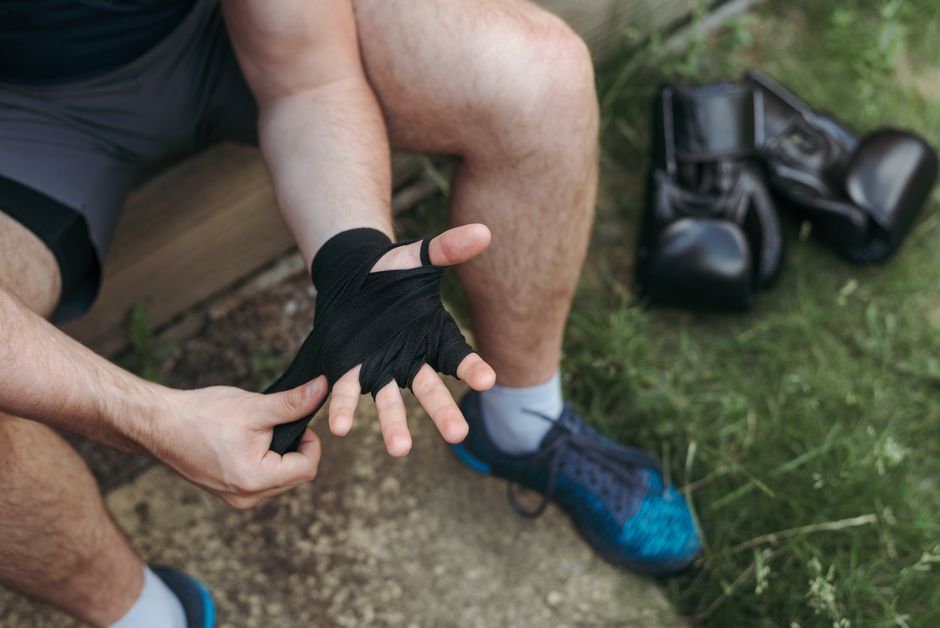
Impact practice comes last and should be gradual. Hitting a heavy bag with wrapped hands teaches the hand to tolerate force. The wraps matter — they support the wrist and the small bones of the hand while the tissues adapt. Skipping wraps early on is a common way to end up with a hand injury that sets training back by months.
Why Punching Hard Surfaces Does Not Work
Conditioning the knuckles by striking walls, boards, or other hard objects is one of the most persistent myths in martial arts training. It does not make the hand stronger in any useful way, and it carries real risk.
What actually happens when you hit a hard surface repeatedly is microtrauma to the skin, the periosteum (the tissue covering bone), and the small bones of the hand. Some of this heals. Some of it does not. Over time, this can produce thickened skin and, in some cases, changes to the bone. It does not reliably produce a stronger grip, a more stable wrist, or a more effective strike.
The bones of the hand — particularly the metacarpals and the small bones near the knuckles — are thin and not designed to absorb repeated high-force impact without support. The most common injury from this kind of training is a fracture, often of the fifth metacarpal, the bone connected to the pinky. That injury typically happens when someone strikes something harder than they expected.
If you want to hit things, hit a bag. Use wraps. Build up gradually. That approach develops the same qualities without the fracture risk.





Does Grip Strength Training Actually Transfer To Fighting?
Grip strength is one of the better-studied physical qualities in sports science, and the general finding is that it correlates with overall strength and with performance in sports that require holding, pulling, or controlling an opponent.
What the research does not show is that grip training alone makes someone a better fighter. Fighting requires timing, technique, conditioning, and the ability to generate force from the ground up. A strong grip is a supporting quality, not a substitute for skill.
Where grip strength clearly matters is in grappling. Controlling a wrist, holding a collar tie, or maintaining a grip on a gi or an opponent’s limb all depend on it. In striking arts, the role is smaller but still present — a stable wrist transmits force more efficiently and is less likely to be injured on impact.
Some studies suggest that grip strength is also a general marker of health, correlating with outcomes like bone density and overall mortality in older adults. That is a correlation, not proof that training grip extends life. It does suggest that hand strength is worth maintaining as you age, independent of any fighting goal.
How Long Does It Take To Build Stronger Hands?
Noticeable improvement in grip strength typically shows up within four to eight weeks of consistent training. Tendons and ligaments adapt more slowly than muscle, often taking several months to catch up.
This gap is why hand injuries are common in people who progress too fast. The muscles can handle more load before the connective tissue is ready. If you can suddenly grip much more than you could a month ago, that does not mean your tendons have kept pace.
Bone adaptation is slower still. If impact training is part of your routine, the timeline for the bones and joints to tolerate repeated force is measured in months, not weeks. This is one of the reasons experienced coaches progress impact work slowly and use wraps for a long time.
A reasonable expectation: meaningful grip gains in six to twelve weeks, meaningful wrist stability in three to six months, and meaningful impact tolerance over a similar or longer period. Individual variation is large, and these are general patterns rather than guarantees.
What About Hand Strength For Older Adults?
Hand strength declines with age, and the decline accelerates after middle age if nothing is done to counter it. This matters for far more than fighting — it affects the ability to open jars, carry groceries, and catch yourself during a fall.
Resistance training works for older adults. Studies consistently show that grip strength improves with training in this population, though the gains tend to be smaller than in younger people. The training does not need to be extreme. Farmer’s carries with moderate weight, dead hangs (with a spotter or a low bar), and simple squeezing exercises all produce measurable improvements.
One caution: if you have arthritis, prior hand injuries, or nerve conditions like carpal tunnel syndrome, the approach changes. Gripping exercises can aggravate some of these conditions. A doctor or physical therapist can help identify what is safe for your specific situation. This is not a case where pushing through pain is wise.
What Should You Avoid?
Several common practices are more likely to cause harm than progress.
- Striking hard surfaces without protection
- Training grip every day without recovery time
- Using maximum effort on grip work before the tendons have adapted
- Ignoring wrist pain, which often signals an overuse problem
- Relying on grip trainers alone while skipping the rest of the chain
Pain that persists beyond a few days, swelling, numbness, or a loss of grip strength that does not recover with rest are all reasons to see a doctor. Hand injuries that are ignored tend to get worse, not better.
Do You Need Equipment?
No. A pull-up bar, a pair of dumbbells, and a towel cover most of what you need. A heavy bag and hand wraps are useful if impact training is part of your goal.
Grip trainers — the spring-loaded kind you squeeze — have a place, but they train a narrow range of motion and mostly build crushing strength in the fingers. They are not a substitute for loaded carries, hangs, or any movement that challenges the hand under real force. If you already have one, use it as a supplement, not a foundation.
Chalk helps on any pulling movement. It reduces slipping and lets you hold more weight, which means more grip stimulus. It is not a shortcut — it is a way to train the hand closer to its actual capacity.
Frequently Asked Questions
How long does it take to make your hands stronger for fighting?
Most people see noticeable grip improvements in four to eight weeks of consistent training. Tendons, ligaments, and bones adapt more slowly, often over several months.
Does punching a wall make your hands stronger?
No. It causes microtrauma to the skin and bones without building useful strength, and it commonly leads to fractures of the hand. Using a heavy bag with wraps is the safer and more effective option.
Can you build hand strength without equipment?
Yes. Dead hangs from a bar, towel hangs, and bodyweight movements like fingertip push-ups develop grip and wrist stability without any special equipment. A pull-up bar is the most useful single tool.
Is grip strength important for fighting?
It matters most in grappling, where controlling an opponent depends on holding and pulling. In striking, wrist stability plays a larger role than raw grip, since a stable wrist transmits force more efficiently.
