
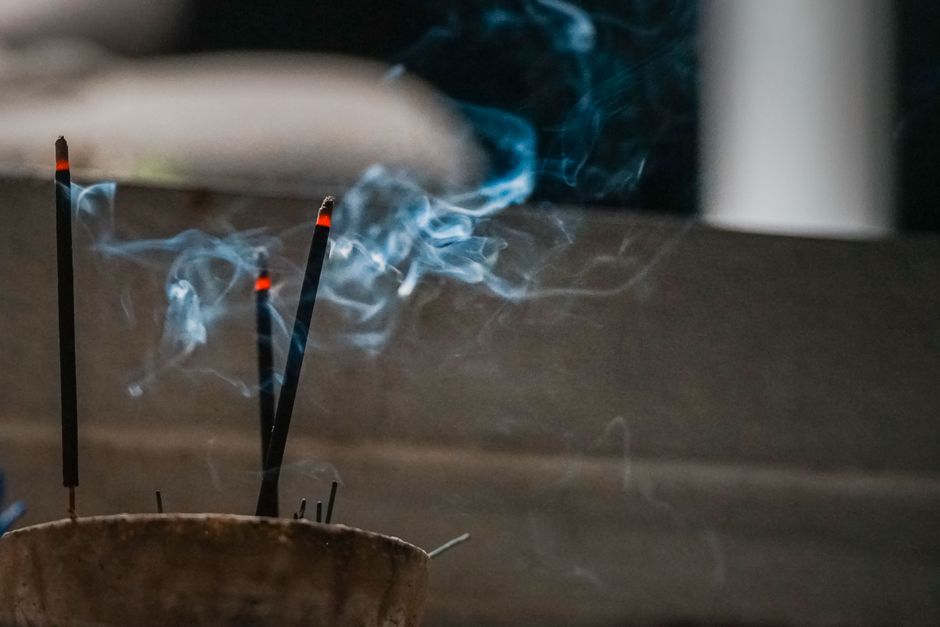
Incense smoke rises because hot air does. The fix is to stop the smoke from rising in the first place, then give it somewhere to go. In practice that means four things: reduce how much smoke the stick or cone produces, block the upward airflow that carries it, pull the air sideways or downward with a fan or open window, and keep the room from trapping what is left. Doing all four in order works far better than doing any one of them alone.
How To Make Incense Smoke Go Down Step By Step
Work through these steps in order. Each one removes a different part of the problem, and skipping ahead usually means fighting the same smoke twice.
- Step 1 — Cut the smoke at the source. Use one stick or one cone instead of several. Break a stick in half if the room is small. Less burning material means less smoke to manage, and this is the single most effective step.
- Step 2 — Give the smoke a shorter path. Move the burner off the floor and away from the center of the room. Smoke that has less distance to travel before it reaches an exit has less chance to spread.
- Step 3 — Create a cross-breeze. Open a window on one side of the room and a door or window on the other. Air moving horizontally carries smoke out sideways instead of letting it climb to the ceiling.
- Step 4 — Point a fan toward the exit, not the room. Place a small fan so it blows from behind the incense toward the open window. A fan aimed at the room just stirs the smoke around.
- Step 5 — Stop the ceiling from catching it. Ceiling fans push smoke back down into the room. Turn them off while incense is burning.
- Step 6 — Clear what settles. After the incense goes out, ventilate for a few more minutes. Fine particles linger in the air well after the visible smoke is gone.
Why Does Incense Smoke Rise Instead of Falling?
Smoke rises because it is warmer and less dense than the air around it. That is basic physics, not a property of incense.
When you light a stick, the burning tip heats the air directly above it. Warm air expands, becomes lighter, and floats upward. The visible smoke particles ride along with that rising current. As the smoke moves away from the heat source, it cools. Once it cools to room temperature, it stops climbing and starts to drift with whatever air movement exists in the room.
This is why smoke behaves differently depending on where you burn it. Near a cold window in winter, the smoke may drop once it cools. In a warm room with still air, it climbs straight to the ceiling and spreads out in a layer. You are not doing anything wrong. You are watching normal air movement.
One detail that surprises people: the visible smoke is only part of what you are breathing. Incense produces both visible smoke and fine particles too small to see. Those particles follow the same airflow but stay suspended longer.
Does Incense Smoke Actually Cause Health Problems?
Burning incense releases fine particulate matter, the same category of tiny particles found in wood smoke and traffic exhaust. Research has consistently linked indoor particulate exposure to respiratory irritation, and incense smoke is a recognized source of it indoors.
What that means in practice depends on how much and how often. Occasional burning in a ventilated room is a very different exposure than daily burning in a closed bedroom for hours. Studies of long-term, frequent incense burning in enclosed spaces have reported associations with respiratory symptoms and, in some research, with lung function changes. These studies are observational. They show associations, not proof that incense alone caused the outcomes, because people who burn incense frequently may differ in other ways.
The honest position: the evidence that incense smoke contains harmful particles is solid. The evidence about exactly how much exposure causes what level of harm in a typical home is less settled. Ventilation reduces exposure regardless, which is why the steps above matter beyond just keeping the room clear.
People with asthma, COPD, or other lung conditions may notice irritation at lower exposures. If smoke triggers coughing, wheezing, or shortness of breath, that is a signal to ventilate more or burn less — not a sign to push through.




Which Incense Types Produce Less Smoke?
Smoke output varies a lot by product, and the difference is bigger than most people expect.
| Type | Typical smoke level | Notes |
|---|---|---|
| Traditional stick incense | High | Bamboo core plus coated material burns together |
| Cone incense | High | Dense material, often burns hotter and faster |
| Coil incense | Moderate to high | Long burn time means prolonged smoke output |
| Resin on charcoal | High | Charcoal tablet itself produces significant smoke |
| Low-smoke or smokeless sticks | Low | Formulated to reduce visible smoke; particles are still released |
| Electric or ultrasonic diffusers | None | No combustion, so no smoke particles |
If smoke is the main concern, the most effective change is switching away from combustion entirely. An electric warmer or diffuser delivers scent without burning anything. That eliminates the smoke problem rather than managing it.
Be cautious with “smokeless” labels. Less visible smoke does not mean no particles. Some low-smoke products still release fine particulate matter, just in smaller amounts. The reduction is real but rarely complete.
Does Room Size and Airflow Change How Much Smoke You Get?
Yes, and this is where most people underestimate the effect. A small closed bathroom will fill with smoke from one stick. A large room with two open windows may barely show any.
Airflow matters more than room size. A small room with a strong cross-breeze clears faster than a large room with still air. What you want is air that moves through the space and leaves, not air that circulates in place.
Watch for dead zones. Corners, alcoves, and spaces under furniture collect smoke because air there barely moves. If you burn incense near a wall, smoke tends to travel up that wall and stain or scent it over time. Moving the burner a foot or two away from the wall often makes a visible difference.
Temperature plays a role too. Warm rooms keep smoke aloft longer. Cooler rooms let it settle faster. Neither is better or worse for your health — it just changes where the smoke ends up.
What About Air Purifiers and Other Tools?
An air purifier with a HEPA filter can remove fine particles from indoor air, including those from incense. HEPA filters are rated to capture very small particles, and this is a well-established function of the technology.
What a purifier does not do is stop smoke from being produced or keep it from spreading through the room in the first place. It reduces what is already airborne. Think of it as cleanup, not prevention. Used alongside ventilation, it helps. Used instead of ventilation, it works harder and less well.
Other tools worth knowing about:
- Range hood or exhaust fan. If you burn incense near a kitchen or bathroom exhaust, it pulls air out directly. This is often more effective than a purifier.
- Window fans set to exhaust. These push air out rather than pulling it in, which is what you want when clearing smoke.
- Activated carbon filters. These can reduce odors but are not designed to capture particles the way HEPA filters are.
- Air quality monitors. These can show you whether particle levels actually drop when you ventilate. Useful if you want to confirm your setup works rather than assuming it does.
One thing that does not work: covering the incense or capping the burner to “trap” smoke. That usually puts the flame out or creates incomplete combustion, which can produce more irritating byproducts, not fewer.
Is There a Way to Burn Incense With Almost No Smoke?
The only way to burn incense with no smoke is to not burn it. Combustion produces smoke. That is not a limitation you can engineer around with a better technique.
What you can do is get close to zero smoke by choosing a non-combustion method. Electric incense warmers heat resin or oil without burning it. Ultrasonic diffusers disperse essential oils without heat. Neither produces smoke particles because nothing is combusting.
If you want the ritual of burning something, low-smoke stick formulations and smaller amounts of material are the practical middle ground. They reduce smoke meaningfully without eliminating it.
For anyone with a lung condition, or anyone burning incense in a small space regularly, the non-combustion options are worth considering seriously. The scent experience is different, but the air quality difference is real.
Frequently Asked Questions
Does opening a window make incense smoke go down?
Opening a window creates airflow that carries smoke out sideways instead of letting it rise and spread. It does not make smoke fall, but it removes it from the room faster than still air does.
Why does my incense smoke go straight up to the ceiling?
Warm air rises, and the heat from the burning tip lifts smoke with it. This is normal physics and happens with any burning material, not just incense.
Are low-smoke incense sticks actually safer?
They produce less visible smoke, but most still release fine particles when burned. Less smoke generally means less exposure, but “low-smoke” does not mean smoke-free.
Can a fan make incense smoke go down?
A fan aimed downward can push smoke toward the floor, but this usually spreads it around the room rather than removing it. A fan pointed toward an open window clears smoke more effectively.
