
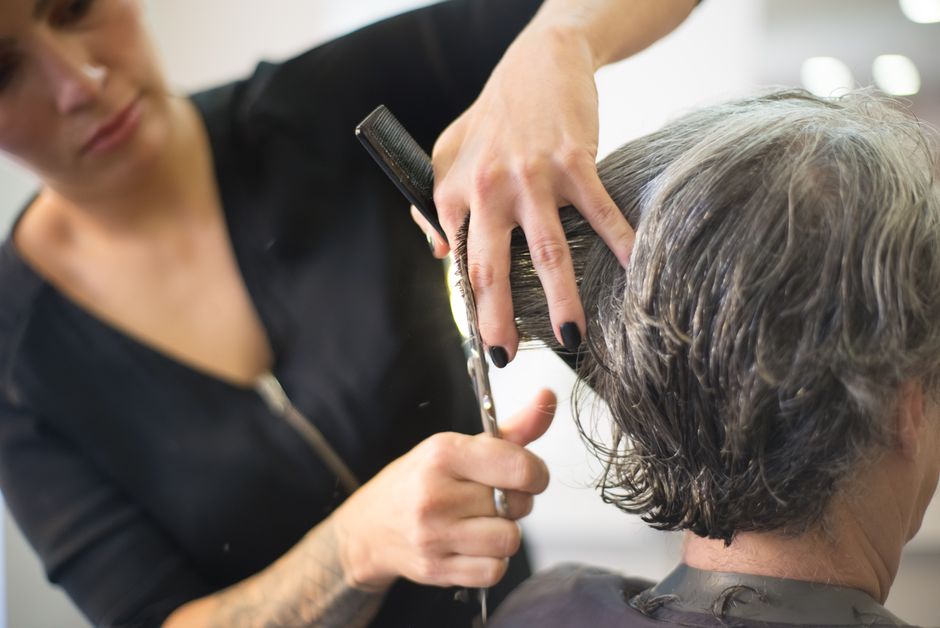
Getting your hair to look even on both sides is one of the most frustrating parts of home haircuts and daily styling. Most people notice asymmetry only after they walk away from the mirror. The truth is that achieving symmetrical hair comes down to three things: cutting technique, styling habits, and knowing what your hair naturally does. You do not need professional training to get better results. You just need to understand where asymmetry comes from and how to work with it instead of against it.
What Causes Hair to Look Uneven After a Cut or Style?
Hair asymmetry usually starts with how you hold your head and body while cutting. If you tilt your head to one side while trimming, the hair on that side will be shorter. The same happens if you hold scissors at a different angle on each side. Most people do this without noticing.
Natural hair growth patterns also play a big role. The hair on one side of your head may grow in a different direction or have a different wave pattern than the other side. According to research published in the International Journal of Trichology, hair whorls and growth directions vary significantly between the left and right sides of the scalp in most people. This means even a perfectly even cut can look uneven because the hair falls differently.
Your dominant hand adds another layer of asymmetry. Right-handed people tend to cut more aggressively on the left side because they have better control reaching across. Left-handed people do the opposite. This is well documented in barber training materials from the National Association of Barber Boards of America.
How To Make Hair Symmetrical Cuts Style Habits Work Together
Cutting and styling are not separate tasks when it comes to symmetry. They work together. A good cut makes styling easier. Good styling habits can hide small cutting mistakes. But neither can fix a bad version of the other.
Start with cutting technique. Always cut hair when it is dry and styled the way you normally wear it. Wet hair stretches and shrinks as it dries, and that changes length. The American Academy of Dermatology recommends cutting dry hair for home trims because wet cutting leads to uneven results for non-professionals.
Use multiple mirrors to check both sides from different angles. A single mirror gives you a reversed image of yourself, which tricks your brain into seeing symmetry that is not there. Two mirrors at right angles give you a true view. This is a standard technique used in professional salons and barbershops.
For styling, develop a routine that applies the same amount of heat, product, and tension to both sides. If you always start styling on your right side, that side gets more heat and manipulation. It will lie differently than the left side. Alternate which side you start with each time you style.
What Does Research Say About Hair Symmetry and Perception?
Research in visual perception shows that people detect asymmetry in faces and hair faster than they notice symmetry. A 2018 study in Symmetry journal found that the human brain processes asymmetrical features as potential threats or abnormalities. This is why uneven hair bothers you more than it bothers someone looking at you from across the room.
The same study found that most people overestimate how noticeable their own asymmetry is. What looks like a quarter-inch difference to you in the mirror may be invisible to someone standing three feet away. This matters because it means small imperfections are not worth obsessing over.
There is no clinical research on specific home haircut methods for symmetry. Most of what exists comes from barbering and cosmetology textbooks, not medical studies. The principles in those textbooks are based on geometry and visual balance, not biology. They are reliable but not scientifically tested in controlled trials.




What Are the Most Common Mistakes People Make?
The biggest mistake is cutting hair wet and then judging the result dry. Wet hair appears longer and heavier. When it dries, it springs up and reveals unevenness that was hidden. This is the number one reason home haircuts look bad.
Another common error is cutting straight across when the hairline is not straight. Your natural hairline dips and curves. Cutting a straight line across a curved hairline creates a visible uneven edge. Professional stylists cut following the hairline, not against it.
Here are the most frequent mistakes people make when trying to cut their own hair evenly:
- Cutting without sectioning the hair first — you lose track of what you have already trimmed
- Using dull scissors that pull hair instead of cutting cleanly — this creates jagged uneven ends
- Trusting a single mirror — you see a reversed image that hides asymmetry
- Cutting too much off at once — you cannot put hair back
- Ignoring your natural part — cutting hair on one side of the part differently than the other
Styling mistakes matter too. Using too much product on one side weighs that side down. Pointing a blow dryer from one direction only pushes hair to the opposite side. These small daily habits add up to noticeable asymmetry over time.
How to Check Hair Symmetry at Home Without Professional Tools
You do not need expensive equipment to check if your hair is even. A simple method is to pull sections of hair from both sides forward over your shoulders and compare the ends at eye level. This works for straight and wavy hair. For curly hair, pull the curls straight without stretching them.
Another method is to take a photo from directly behind your head. Hold your phone at eye level with the back camera facing your head. The front camera reverses the image, which again tricks your brain. A back camera photo gives you the true view that other people see.
You can also use a wall mirror with a hand mirror. Stand with your back to the wall mirror and hold the hand mirror in front of you. Look over your shoulder into the wall mirror to see the back of your head. This gives you a more accurate view than twisting your neck to look in a single mirror.
Here is a simple comparison of checking methods and their accuracy:
| Method | Accuracy | What It Shows |
|---|---|---|
| Single bathroom mirror | Low | Reversed image, hides asymmetry |
| Two mirrors at right angle | High | True view of both sides |
| Back camera photo | Very high | What others actually see |
| Pulling hair forward over shoulders | Moderate | Length comparison only |
| Hand mirror with wall mirror | High | Back of head view |
What Styling Habits Actually Improve Perceived Symmetry?
Part placement changes how symmetrical your hair looks more than any other styling choice. A center part shows asymmetry most clearly because it divides the hair into two equal halves that the brain compares directly. Side parts hide asymmetry because the eye does not compare equal sections.
Blow drying technique matters. Always dry hair in the direction you want it to fall. Point the nozzle downward to smooth the cuticle. If you dry one side pointing up and the other side pointing down, the hair will reflect light differently and look uneven even if the lengths are identical.
Texturizing products can help. A small amount of sea salt spray or texturizing paste gives hair more body and hides small length differences. The texture breaks up the visual line that makes asymmetry obvious. This is widely recommended by stylists though there is no formal research on it.
Heat styling should be even on both sides. If you curl or straighten one side more thoroughly than the other, that side will hold its shape differently. Count passes with your flat iron or curling wand. Do the same number on each side. This sounds excessive but it makes a real difference.
Frequently Asked Questions
Frequently Asked Questions
Can I fix uneven hair without cutting it again?
Yes, you can use styling to hide minor asymmetry. Change your part, add texture with product, or use heat to redirect hair.
How often should I trim my hair to keep it symmetrical?
Every 6 to 8 weeks for most hair types. Curly hair can go longer because shrinkage hides small unevenness.
Should I cut my hair wet or dry for better symmetry?
Cut it dry and styled the way you normally wear it. Wet cutting leads to uneven results when the hair dries and shrinks.
Does sleeping on one side cause hair asymmetry?
Yes, sleeping on the same side every night flattens that side of your hair. Alternate sides or use a silk pillowcase.
