
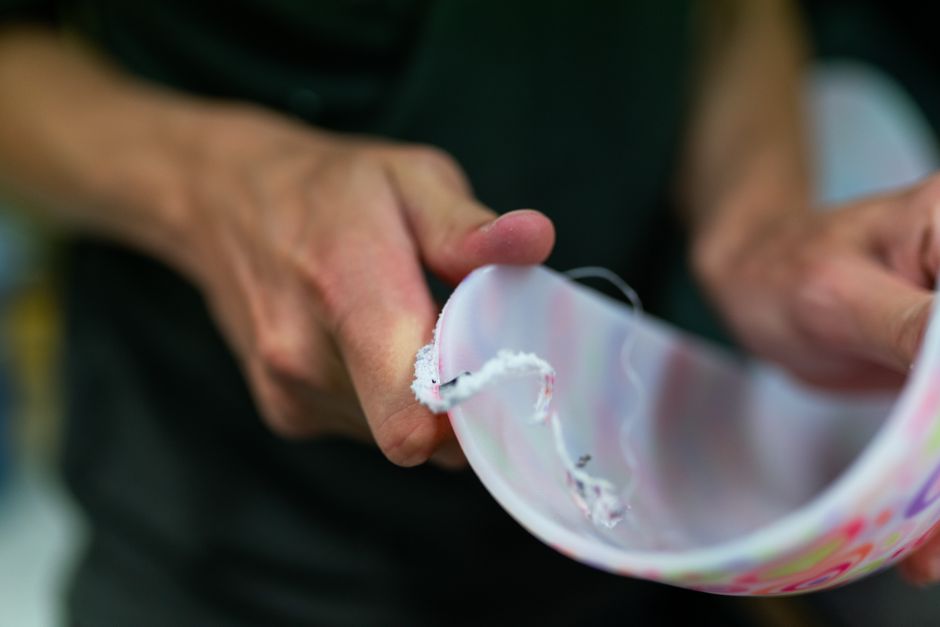
Making a mold for glass casting with the lost wax method starts with a wax model of the object you want. You build a refractory mold around that wax, melt the wax out, and pour molten glass into the empty space it leaves behind. The wax is “lost” because it is destroyed in the process. The mold is the part that survives.
This is the same basic process used for bronze casting for thousands of years. Glass behaves differently from metal in ways that matter, so the mold materials and the firing schedule change. Understanding those differences is most of the work.
What Is the Lost Wax Process and Why Use It for Glass?
Lost wax casting is a method for turning a model into a hollow cavity inside a heat-resistant mold. You invest the model in a plaster-like material, remove the model, and fill the cavity with your final material.
The reason glass artists use it is simple. Glass cannot be carved or welded the way metal can. If you want a glass object with fine detail, undercuts, or an organic shape, you need a one-piece mold that captures that shape and can then be broken away. Lost wax does exactly that.
There are two broad approaches in glass. Kiln casting means filling the mold with glass and firing the whole thing in a kiln, letting gravity pull the glass into the cavity. Ladle casting means pouring molten glass from a furnace into the mold. Kiln casting is far more common in studio settings because it does not require a glass furnace.
One clarification that trips people up: lost wax and lost foam are not the same thing. Lost foam uses a polystyrene model that vaporizes when metal or glass is poured. Lost wax uses a wax model that is melted or burned out before the pour. The mold-making steps differ.
What Materials Do You Need to Make the Mold?
The mold itself is made from a refractory investment. Refractory means it can take high heat without breaking down. Investment means it is poured as a slurry and sets around the model.
Most glass casting investment is a gypsum-based material, often a mix of plaster and silica. The silica gives it strength and heat resistance. The plaster holds it together. Some formulas add other refractory fillers.
You will also need:
- Wax for the model, either sheet wax, carving wax, or a poured wax
- A container or “flask” to hold the investment, often a metal or plastic cylinder
- A scale for measuring investment by weight, not volume
- Distilled or clean water
- A kiln that can reach casting temperatures and hold them steadily
- Glass compatible with your intended result, usually in frit, billet, or chunk form
Investment is almost always mixed by weight ratio, not by eye. The manufacturer’s ratio matters. Too much water makes a weak mold that can crack or erode. Too little makes a thick slurry that traps air bubbles against the wax.
You cannot substitute ordinary plaster of Paris for casting investment. Plaster alone does not have the heat resistance or strength for a glass firing, and it can fail during the pour or the kiln cycle.
How To Make A Mold For Glass Casting Lost Wax: Step by Step
The sequence matters. Skipping a step usually shows up later as a bubble, a crack, or a failed surface.
Step 1: Make the wax model. Carve, build, or pour your wax into the shape you want the final glass to be. Because glass shrinks as it cools, the finished piece will be slightly smaller than the wax model. For most kiln-casting work this shrinkage is small, but for precise work you need to account for it. The exact percentage depends on the glass you use and how it is fired, so check the technical data for your specific glass rather than assuming a number.
Step 2: Attach the sprue and vents. A sprue is a wax rod that connects your model to the top of the mold. When the wax melts out, the sprue becomes the channel the glass flows through. Vents are thinner wax rods that let air escape as glass enters. Without vents, trapped air can block the glass or leave bubbles.
Step 3: Set the model in the flask. Position the wax so the sprue points up and the glass can flow into all parts of the cavity. Keep the model away from the flask walls. Investment needs to surround it evenly.
Step 4: Mix and pour the investment. Mix the investment and water according to the manufacturer’s ratio. Pour it slowly down the inside of the flask so it flows around the model rather than dumping air onto it. Vibration or gentle tapping helps bubbles rise. Let it set fully, which usually takes a period of hours, not minutes. Follow the product’s stated cure time.
Step 5: Remove the wax. This is the “lost” part. You can steam the wax out, or you can fire the mold in a kiln so the wax melts and burns away. The kiln method is more common in glass because you need to fire the mold anyway. Heat slowly at first. Wax expands before it melts, and heating too fast can crack the mold.
Step 6: Fire the mold. Once the wax is gone, you raise the mold to a higher temperature to burn out any carbon residue and strengthen the investment. A mold with leftover wax or carbon can react with the glass and cause bubbles or discoloration.
Step 7: Fill with glass. For kiln casting, you place glass into the sprue or on top of the mold and fire until it melts and flows down into the cavity. For ladle casting, you pour molten glass directly into the mold.
Step 8: Cool slowly. This step is where many pieces fail. Glass that cools too fast builds up internal stress and can crack. The mold and glass need to cool gradually through the temperature range where stress forms. The exact schedule depends on the thickness of the piece and the glass type.
Step 9: Break out the mold. Once cool, you break the investment away from the glass. This destroys the mold, which is expected. Each lost wax mold produces one casting.





Why Does the Cooling Schedule Matter So Much?
Glass is not a solid in the same way metal is. It is a supercooled liquid that becomes rigid as it cools, and its internal structure keeps rearranging across a range of temperatures rather than at one melting point.
When glass cools unevenly, the outside solidifies while the inside is still contracting. That mismatch creates internal stress. If the stress is high enough, the piece cracks, sometimes hours later or even days later.
To manage this, casters anneal the glass. Annealing means holding the piece at a specific temperature long enough for the stress to relax, then cooling very slowly through the critical range. The temperatures and times come from the glass manufacturer’s data for that specific glass. There is no universal schedule, because different glasses have different working ranges.
This is the single biggest difference from metal casting. Metal castings can often be cooled faster. Glass rewards patience and punishes shortcuts.
What Are the Most Common Mistakes?
Most failures trace back to a handful of avoidable problems.
- Air bubbles in the investment. Pouring too fast or not vibrating the flask traps bubbles against the wax. Those bubbles become bumps on the finished glass.
- Heating the mold too fast during wax removal. Wax expands before it melts. A fast ramp can crack the mold or force wax into the investment.
- Incomplete burn-out. Leftover carbon reacts with glass and causes bubbles and cloudiness.
- Wrong water ratio. Guessing instead of weighing weakens the mold.
- Skipping or rushing the anneal. This is the most common cause of cracked finished pieces.
- Using incompatible glass. Mixing glasses with different expansion rates in one casting usually leads to cracks.
One point worth stating plainly: this process has a real learning curve, and early pieces often fail. That is normal, not a sign you did something fundamentally wrong.
Kiln Casting vs. Ladle Casting: What Is the Difference?
Both use a lost wax mold. The difference is how the glass gets into the cavity.
| Factor | Kiln Casting | Ladle Casting |
|---|---|---|
| How glass enters | Melts in place and flows down by gravity | Poured molten from a furnace |
| Equipment needed | Kiln | Glass furnace and ladle |
| Studio setting | Common for small studios | Usually larger studios |
| Mold temperature | Mold fired and filled hot in the kiln | Mold often preheated separately |
| Control | Slower, more gradual | Faster, more immediate |
Kiln casting is more accessible for beginners because it does not require a furnace that runs continuously. Ladle casting allows larger and faster production but demands more equipment and more heat management skill.
Is Lost Wax Casting Safe to Do at Home?
It can be done in a home studio, but it involves real hazards that need real precautions. This is not a craft with no risks.
Respiratory hazards are the main concern. Dry investment powder contains fine silica, and breathing silica dust is a documented health risk. Mix investment in a well-ventilated area or outdoors, and wear a properly fitted respirator rated for fine particulates. Do not rely on a simple dust mask.
Burning wax produces smoke and fumes. Wax removal should happen with ventilation or in a kiln vented to the outside.
Kilns reach high temperatures and the molds themselves stay hot for a long time. Heat-resistant gloves and eye protection matter. Molten glass and hot molds cause severe burns.
If you are working with lead-containing glass, additional precautions apply, and some of these materials are restricted in various jurisdictions. Check local rules before working with them.
None of this makes the process impossible at home. It makes proper ventilation, a respirator, and safe handling non-negotiable.
Frequently Asked Questions
Can you reuse a lost wax mold for glass casting?
No. The mold is broken away to release the finished glass, so each mold produces only one casting. This is the defining feature of the lost wax method.
What wax is best for lost wax glass casting?
Any wax that holds fine detail and melts cleanly can work, including carving wax, sheet wax, and pourable wax. The best choice depends on how you plan to shape the model and how much detail you need.
Why did my glass casting crack after it cooled?
Cracking almost always points to stress from cooling too fast or an incomplete anneal. Glass must be held at the right temperature and cooled slowly through its critical range using the schedule for that specific glass.
Can you do lost wax glass casting without a kiln?
You still need a kiln to burn out the wax and fire the mold, even if you pour molten glass separately. There is no reliable way to complete the process without controlled high heat.
