
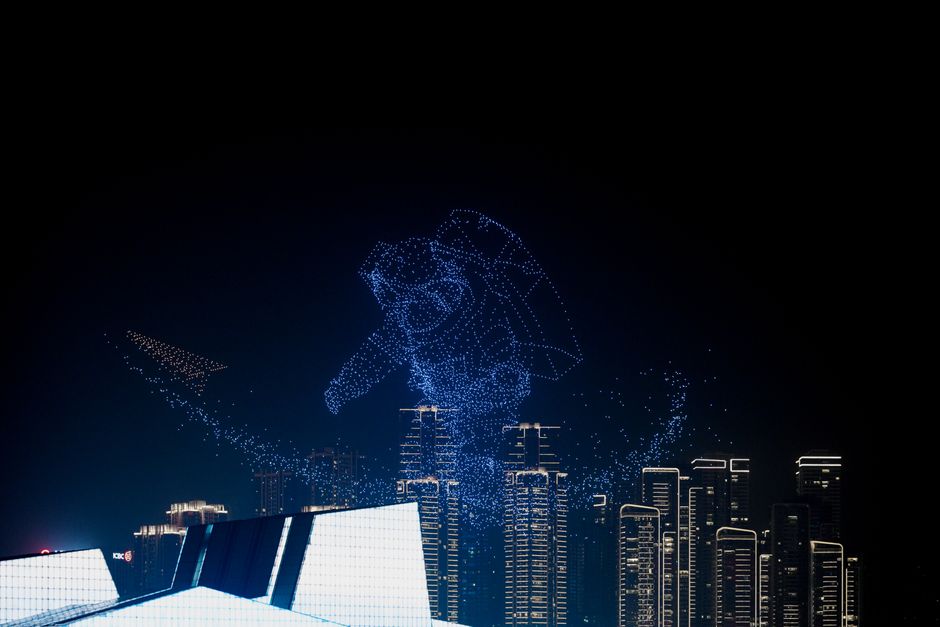
Building a drone show from scratch is a complex process that combines creative design, technical engineering, and strict safety planning. It starts with a clear concept and a story you want to tell in the sky. From there, you need the right software, a certified pilot team, FAA approval, and enough drones to create a meaningful display. The entire process typically takes weeks or months of planning before a single drone lifts off.
What Do You Need to Start a Drone Show?
You need more than drones and a good idea. A professional drone show requires a full production team and specific equipment. The core components include the drones themselves, a ground control station, specialized show software, and a crew trained in both aviation and entertainment.
The drones used in shows are not consumer models. They are lightweight quadcopters with bright LED lights, usually rated for a lifespan of around 200 flight hours. Each drone weighs about the same as a bag of sugar. They are designed to fly in tight formation with centimeter-level accuracy using GPS and real-time kinematic positioning.
Your team needs a licensed remote pilot in command. Most countries require this person to hold a commercial drone pilot certificate. You also need visual observers, a safety officer, and a technical crew to manage the software and hardware. This is not a solo project.
How Does Drone Show Software Work?
The software is the brain of the operation. It converts your 3D animation into flight paths for every single drone. You design the show as a series of frames, similar to a stop-motion movie. Each frame is a 3D position for every drone in the fleet.
Professional show software uses swarm algorithms to calculate safe paths. It ensures drones do not collide with each other. It also checks that every drone can physically reach its next position in the time allowed. The software accounts for battery life, wind speed, and the maximum speed of each drone.
Most show software exports a flight plan file that the ground station uploads to each drone wirelessly before takeoff. Once the show starts, the drones fly autonomously. The pilot monitors the fleet but does not manually control individual aircraft.
How Do You Design the Show Creative?
Every drone show starts with a story. You cannot simply place random shapes in the sky and expect an audience to connect with it. The creative process begins with a script or a storyboard that outlines the sequence of images and animations.
Animators build the show in 3D animation software first. They create formations like a logo, a heart, or a character. They animate these formations moving through space and time. The animation timeline directly translates to the drone flight timeline.
Sound and music matter more than most people expect. A drone show without synchronized music feels flat. The choreography of the drones should match the rhythm and emotional beats of the soundtrack. Professional shows often design the entire animation around a specific piece of music.
Color is another critical design element. Each drone can display millions of colors, but the brightness and visibility depend on the sky conditions. Dark, overcast skies make colors pop. Bright daylight washes out the LEDs almost completely. Most shows happen at night for this reason.





What Are the FAA Rules and Safety Requirements?
In the United States, the Federal Aviation Administration regulates all drone shows. You cannot launch a swarm of drones without explicit FAA approval. The process requires a waiver under Part 107 of the FAA regulations, specifically for operations over people and beyond visual line of sight.
You must submit a detailed safety plan to the FAA at least 30 days before the event. This plan includes the flight area, drone specifications, pilot credentials, and emergency procedures. The FAA reviews each application individually. Approval is not guaranteed.
Safety buffers are non-negotiable. The flight area must be clear of people, buildings, and aircraft. You need a designated launch zone and a recovery zone in case drones fail mid-flight. The FAA typically requires a safety perimeter of at least 100 feet from the audience, though this can vary based on the specific waiver.
Every drone has a failsafe mechanism. If a drone loses GPS signal or battery power, it should land immediately in a safe zone. Some systems trigger a parachute. Others simply cut power and drop. Your safety plan must account for every possible failure scenario.
How Much Does a Drone Show Cost?
A professional drone show is not cheap. The cost depends heavily on the number of drones and the complexity of the animation. A small show with 100 drones might cost around $50,000. A large show with 1,000 drones can exceed $300,000.
These prices include the drone fleet, the crew, the software licensing, insurance, and the FAA waiver process. They do not include travel expenses or venue fees. Some companies offer drone shows as a service, which means you rent everything rather than buying it.
Buying your own fleet is possible but rarely practical for a single event. A single show drone costs between $1,500 and $3,000. You also need spare drones, replacement batteries, charging infrastructure, and a storage facility. Most organizations hire a professional drone show company instead of building their own operation.
What Is the Timeline from Concept to Launch?
Do not expect to plan a drone show in a week. A realistic timeline is 8 to 12 weeks from initial concept to launch day. This timeline assumes you already have the drone fleet and crew in place.
Week one and two are for creative development. You finalize the story, the music, and the basic animation. Week three through six are for technical animation. The 3D artists refine every formation and movement. They run simulations to check for collisions and timing issues.
Week seven and eight are for the FAA waiver and site planning. You submit the application, coordinate with the venue, and finalize the safety plan. Week nine and ten are for testing. You run small-scale test flights with a handful of drones to validate the software and hardware.
The final two weeks are for full rehearsals. You fly the complete show, usually at a low altitude or with a reduced drone count. You fix any issues that appear. Launch day itself is not the time to discover problems.
Can You Run a Drone Show Without a Professional Team?
No. The technical and legal barriers are too high for an individual or a small business without specialized experience. The FAA requires a licensed pilot in command for any commercial drone operation. Flying a swarm of 100 or more drones without proper certification is illegal.
Software licensing is another barrier. Professional show software is expensive and often requires a subscription. The animation tools are complex and require months of training to use effectively. A mistake in the animation can cause drones to collide mid-air.
Insurance is the final hurdle. A drone show carries significant liability. If a drone falls into a crowd, the consequences are severe. Insurance companies require proof of training, safety protocols, and FAA approval before they will issue a policy. Without insurance, no venue will host your show.
What Happens If a Drone Fails Mid-Show?
Drone failures are rare but they happen. The show software monitors every aircraft in real time. If a drone deviates from its path or loses communication, the system flags it immediately.
Most professional systems have a “kill switch” that grounds the entire fleet safely. The show stops, and all drones land in their designated safe zones. This is a controlled shutdown, not a crash.
Individual drone failures are handled by the failsafe mechanisms built into each aircraft. A drone that loses GPS will hover and then land. A drone with low battery will return to the launch zone. The safety perimeter exists specifically to protect the audience if these failsafes fail.
What Is the Future of Drone Shows?
Drone shows are replacing traditional fireworks in many cities. They are quieter, produce no smoke, and can be reused. Fireworks are a one-time explosion. Drones can fly the same show every night for a week.
Technology is improving rapidly. Newer drones have longer battery life and brighter LEDs. Software is becoming more automated, reducing the need for manual animation. Some companies are experimenting with drone shows that carry small speakers, allowing each drone to emit sound synchronized with the music.
Regulations are also evolving. The FAA is developing a framework for routine drone operations over people, which would simplify the waiver process. This could make drone shows more accessible to smaller events and venues. The cost is still likely to remain high, but the barrier to entry is slowly lowering.
Frequently Asked Questions
How many drones do you need for a basic show?
You need at least 50 to 100 drones to create recognizable shapes and animations. Fewer than 50 drones limits you to simple patterns that may not read clearly from the ground.
Can you fly a drone show in the rain?
Most professional show drones are not fully waterproof, so rain can damage them. Most shows are postponed or canceled if precipitation is forecast, and wind speeds above 20 mph also ground the fleet.
Do drone shows replace fireworks entirely?
No, but they are increasingly used alongside or instead of fireworks in many cities. Drone shows are quieter and reusable, but fireworks still offer a brightness and scale that LEDs cannot fully match.
How long does a typical drone show last?
Most professional drone shows run between 8 and 15 minutes. Battery life limits the flight time, so longer shows require mid-show battery swaps or a larger fleet of drones.
