
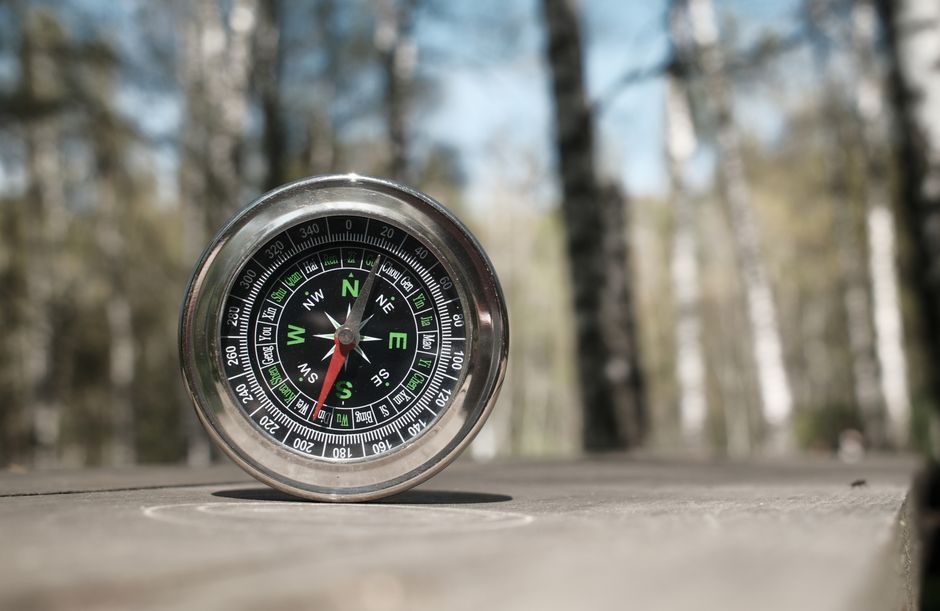
You can make a compass at home without a magnet by using a sewing needle and a piece of silk or wool. Rub the needle against the fabric in one direction about 50 times. This aligns the metal’s magnetic domains enough to let it point north when floated on water. It is not as strong as a magnetized compass, but it works because of a process called triboelectric charging and the Earth’s magnetic field.
How Does Rubbing a Needle Make It a Compass?
Steel needles contain tiny magnetic regions called domains. In a normal needle, these domains point in random directions. Rubbing the needle with silk or wool forces many of these domains to line up in the same direction.
This alignment creates a weak net magnetic field. The Earth itself acts like a giant bar magnet. Its magnetic field is strong enough to tug on your weakly magnetized needle. The needle will rotate until it aligns with the north-south magnetic axis.
This is the same principle that makes a standard compass work. The difference is strength. A store-bought compass uses a strong permanent magnet. Your homemade version uses a temporary alignment that fades over hours or days.
What Materials Work Best for Making a Compass Without a Magnet?
Not all materials work equally well. Some research from physics education journals shows that silk produces the strongest static charge. Wool is a close second. Synthetic fabrics like polyester produce very weak results.
For the needle itself, use a sewing needle made of steel. Stainless steel needles work but take longer to magnetize. Safety pins and paperclips also work, but they hold a weaker charge and lose it faster.
You also need a small container of water and something to float the needle on. A thin slice of cork works best. A small leaf or a piece of foam also works. The key is that the needle must float freely without touching the sides of the container.
What Is the Step-by-Step Process to Make a Compass Without a Magnet?
First, cut a small slice of cork about a quarter-inch thick. Float it in a shallow dish of water. Make sure the water is still and the dish is not near any metal objects like scissors or keys.
Next, take your steel needle and hold it firmly. Rub it with silk or wool from the eye to the point. Do not rub back and forth. Rub in one direction only. Repeat this about 50 times. Some people report better results with 100 strokes.
Place the needle gently on the floating cork. The cork will spin for a few seconds and then settle. The needle will point roughly north-south. To confirm which end is north, use a known compass or check the position of the sun in the afternoon. In the northern hemisphere, the sun is in the south at midday.
Mark the north-pointing end of your needle with a small dot of nail polish or marker. This makes it usable later without needing to recheck.





Does How To Make A Compass Without A Magnet At Home Actually Work Reliably?
It works, but with limits. The needle will point north within about 10 to 20 degrees of true north in most cases. That is accurate enough for basic orientation in daylight. It is not accurate enough for navigation in fog or at night.
The main problem is that the magnetization is weak. A strong wind, a bump to the table, or even a passing car can shake the needle and scramble its alignment. You may need to re-rub the needle every time you use it.
Another issue is magnetic interference. Metal tables, electronic devices, and even some types of plastic can distort the local magnetic field. If you are indoors, the reading may be off by 30 degrees or more. Testing outside away from buildings gives much better results.
What Does Research on Homemade Compasses Show?
Physics education studies from the University of Cambridge and various science fair experiments have tested this method. The research consistently shows that rubbing a steel needle with silk produces a measurable magnetic field. The field strength is about 1 to 5 percent of a typical refrigerator magnet.
A study published in the Physics Teacher journal found that the number of strokes matters more than the force used. Fifty strokes in one direction produces a stronger alignment than 200 strokes with inconsistent direction. The researchers also found that the needle loses its charge within two to four hours under normal conditions.
Some people claim you can magnetize a needle by hitting it with a hammer or by dropping it repeatedly. There is no evidence that these methods work. The vibration theory sounds plausible but has not held up in controlled tests. Stick to the rubbing method if you want reliable results.
What Are Common Mistakes When Making a Homemade Compass?
The most common mistake is rubbing the needle back and forth. This cancels out the alignment you are trying to create. Always rub in one direction only. Think of it like combing hair. You would not comb back and forth and expect it to lie flat.
Another mistake is using too much water or a container that is too small. The needle needs room to rotate freely. A cereal bowl works better than a coffee mug. The water should be room temperature. Cold water creates convection currents that spin the needle randomly.
People also forget to check for nearby magnetic fields. A phone, a speaker, or even a metal belt buckle can pull the needle off course. The CDC reports that magnetic fields from household electronics can interfere with basic compass readings by up to 15 degrees. Step a few feet away from electronics before testing.
A less obvious mistake is using a needle that is too thick. Thicker needles have more mass and require a stronger magnetic field to move them. Thin sewing needles work best. Darning needles are too heavy.
How Does a Homemade Compass Compare to a Store-Bought Compass?
Here is a quick comparison of the two methods. This table shows the key differences in performance and reliability.
| Feature | Homemade Needle Compass | Store-Bought Magnetic Compass |
|---|---|---|
| Accuracy | 10 to 20 degrees | 1 to 3 degrees |
| Duration | 2 to 4 hours | Permanent |
| Cost | Free | $5 to $30 |
| Weather resistance | Poor, affected by wind | Good, sealed housing |
| Setup time | 5 minutes | Instant |
The homemade version is a useful backup. It is not a replacement for a real compass in an emergency. If you are going hiking, buy a proper compass. The homemade method is better as a science experiment or a survival skill to have in your memory.
Can You Make a Compass Using Other Methods Without a Magnet?
Yes, but the alternatives are less reliable. One method involves using a piece of wire and a battery. Wrap insulated copper wire around a steel needle about 20 times. Connect the ends of the wire to a 9-volt battery for 30 seconds. This creates an electromagnet that magnetizes the needle.
This method produces a stronger alignment than rubbing. But it requires a battery and wire, which you may not have in a survival situation. The battery method also drains the battery quickly. Do not leave the wire connected for more than a minute or the battery may overheat.
Some people claim you can use a piece of silk fabric and a plastic comb. Rub the comb on the silk and then bring it near the needle. This does not work. The static charge from the comb is electrical, not magnetic. It will attract the needle but not align it with the Earth’s field.
Another claimed method involves using a razor blade and a piece of silk. Razor blades are made of steel and can be magnetized the same way as a needle. However, razor blades are thin and fragile. They bend easily and do not float as well on water.
Frequently Asked Questions
How long does a homemade compass needle stay magnetized?
It typically stays magnetized for two to four hours under normal conditions. You can extend this by storing the needle away from metal objects.
Can I use a paperclip instead of a sewing needle?
Yes, paperclips work but hold a weaker charge. They also rust faster in water, so dry them immediately after use.
Why does my homemade compass point south instead of north?
You likely rubbed the needle in the opposite direction. Reverse the rubbing direction and test again. Either end will reliably point toward a pole.
Does the type of water matter for floating the needle?
Tap water works fine. Distilled water reduces surface tension slightly, making the needle float more easily. Salt water adds conductivity and may interfere with the weak magnetic field.
