
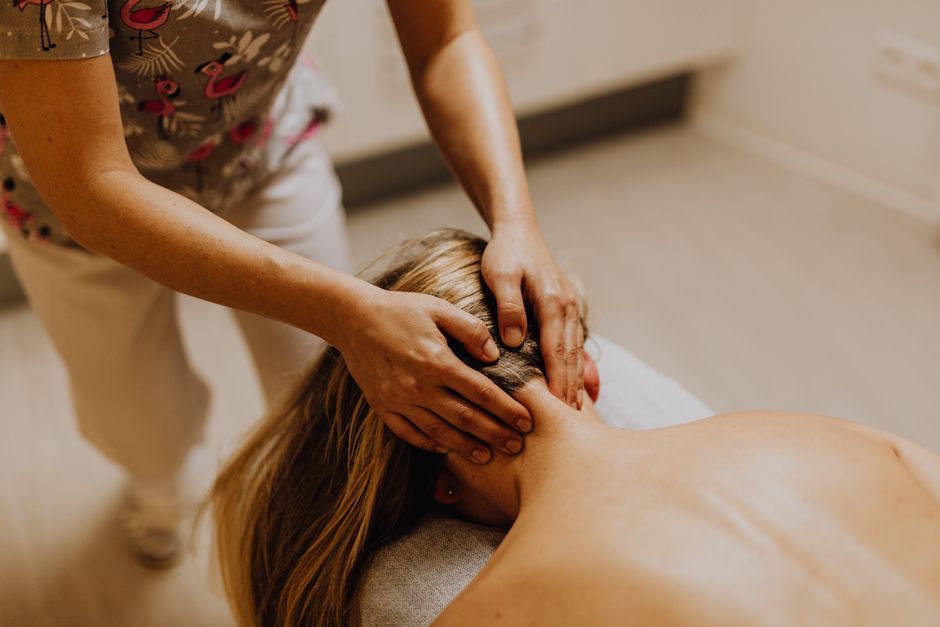
Neck pain often comes from poor posture, not from the bones being “out of place.” The idea of “lining up” your neck yourself is appealing, but it requires care. You can improve your neck alignment through specific stretches and posture corrections at home, without any forceful cracking or manipulation.
Why Does My Neck Feel Out of Alignment?
Your neck has a natural forward curve. This curve acts like a spring, absorbing the weight of your head. Your head weighs about 10 to 12 pounds. For every inch your head moves forward, the weight on your neck muscles roughly doubles.
This is why you feel tightness and strain. The muscles at the back of your neck work overtime to hold your head up. Over time, this strain makes the muscles feel knotted and stiff. This stiffness is often mistaken for a bone being out of place.
The feeling of being “crooked” is usually muscle tension, not a structural problem. Your vertebrae are held in place by strong ligaments. They rarely move out of position on their own. What changes is the muscle tension around them, which alters how your neck moves and feels.
How To Line Up The Back Of Your Neck Yourself
The safest way to address neck alignment is by releasing tension and resetting your posture. You are not forcing bones back into place. You are teaching your muscles to relax and your head to sit properly over your shoulders.
Start with a simple chin tuck. Sit or stand tall. Keep your eyes level. Gently pull your head straight back, as if you are making a double chin. Hold for 5 seconds. You should feel a stretch at the base of your skull and the top of your neck. Repeat this 10 times.
This exercise targets the deep neck flexor muscles. These muscles weaken when you spend hours looking at a screen. Strengthening them helps pull your head back into a neutral position. Do this several times a day, especially after long periods of sitting.
Simple Stretches To Release Neck Tension
Stretching helps when muscle tightness is pulling your head to one side. Move slowly and gently. Never force a stretch or push into pain.
Try the levator scapulae stretch. This muscle runs from the top of your neck down to your shoulder blade. It gets very tight with poor posture. Sit tall. Turn your head 45 degrees to one side. Then tuck your chin toward your armpit. Place your hand on the back of your head for a gentle pull. Hold for 30 seconds. Repeat on the other side.
Another effective stretch targets the upper trapezius. This muscle sits on top of your shoulders. Tilt your ear toward your shoulder. Keep your opposite shoulder down. Hold for 30 seconds. You should feel a stretch along the side of your neck, not pain.
Perform these stretches twice daily. Consistency matters more than intensity. A gentle daily routine will do more for your neck than an aggressive session once a week.





Posture Habits That Prevent Neck Problems
Stretching helps in the moment. Changing your habits prevents the problem from returning. The most important habit is your screen position.
Your screen should be at eye level. If you look down at a laptop or phone for hours, your neck is in a constant forward position. Raise your monitor with books or a stand. Hold your phone up to your face instead of bending your neck down to it.
Check your workstation setup. Your chair should support your lower back. Your feet should rest flat on the floor. Your elbows should be at a 90-degree angle when typing. These adjustments keep your spine in a neutral position.
Take frequent breaks. The 20-20-20 rule is easy to remember. Every 20 minutes, look at something 20 feet away for 20 seconds. This gives your neck muscles a break from holding a static position.
When To See A Professional
Self-care works for everyday muscle tension. Some symptoms require professional evaluation. Do not ignore these warning signs.
See a doctor if you have neck pain that follows an injury or fall. Seek immediate care if neck pain comes with numbness, tingling, or weakness in your arms or hands. These symptoms can indicate nerve involvement that needs proper diagnosis.
Also seek help if your pain is severe, lasts more than a week, or interferes with sleep. If you have a fever along with neck stiffness, seek medical attention promptly. This combination can indicate a serious infection.
Some people see chiropractors for neck adjustments. This is a personal choice. Research on spinal manipulation for neck pain shows mixed results. Some people find it helpful. Others do not. If you choose this route, be honest with the practitioner about your symptoms and history.
What Not To Do When Your Neck Feels Off
Several popular habits can make neck problems worse. Knowing what to avoid is as important as knowing what to do.
Do not crack your own neck forcefully. The urge to twist or pull until you hear a pop is strong. This habit can strain ligaments and muscles. Over time, repeated self-cracking may increase joint instability.
Do not use a foam roller or hard object directly on your neck. These tools are designed for larger muscle groups like the back or thighs. Your neck has delicate structures including arteries and nerves. Applying hard pressure here carries real risk.
Avoid sleeping on your stomach. This position forces your neck to rotate for hours. Side sleeping with a supportive pillow or back sleeping with a small pillow under your neck is better. Your pillow should keep your head level with your spine, not propped up at an angle.
Neck Pain Relief Products: What Works
The market is full of products claiming to fix neck alignment. Most do not live up to their promises. Some basic tools can help as part of a broader routine.
A cervical traction device can provide temporary relief for some people. These inflatable devices fit around your neck and gently stretch it. Some studies suggest they reduce pain for certain types of neck discomfort. The evidence is not strong enough to recommend them universally. If you try one, start with low pressure and limit use to 10 minutes.
Heat therapy is a simple and effective option. A warm compress or heating pad relaxes tight muscles and improves blood flow. Use heat for 15 to 20 minutes before stretching. This can make your stretches more effective.
Cold therapy helps if your neck feels inflamed or you have a recent injury. Apply an ice pack wrapped in a thin towel for 15 minutes. Do not apply ice directly to your skin.
Be skeptical of products promising to “realign” your spine. No pillow, brace, or device can permanently change your spinal alignment. These products may provide comfort, but they are not corrective tools.
Neck Exercises For Long-Term Strength
Building strength in your neck and upper back supports good posture. Strong muscles hold your head in a healthy position with less effort.
Shoulder blade squeezes are a good starting point. Sit or stand tall. Squeeze your shoulder blades together as if holding a pencil between them. Hold for 5 seconds. Repeat 10 times. This strengthens the muscles that pull your shoulders back and down.
Isometric neck exercises build strength without movement. Place your palm on your forehead. Push your head forward against your hand, but do not let your head move. Hold for 5 seconds. Repeat on each side of your head. These exercises strengthen the neck muscles safely.
Perform these exercises every other day. Give your muscles time to recover between sessions. If any exercise increases your pain, stop and consult a professional.
Frequently Asked Questions
Can I realign my own neck safely?
You can improve neck alignment through posture correction and stretching. Forceful self-manipulation or cracking is not recommended and carries risk of injury.
How long does it take to fix forward head posture?
Most people notice improvement within a few weeks of consistent stretching and posture correction. Full correction can take several months because you are retraining muscle habits that developed over years.
Is it dangerous to crack my neck myself?
Occasional gentle cracking is unlikely to cause serious harm, but habitual forceful cracking can strain ligaments. There is a small risk of injuring blood vessels in the neck, so moderation is important.
What pillow is best for neck alignment?
A pillow that keeps your head level with your spine works best. Side sleepers typically need a firmer, thicker pillow, while back sleepers need a thinner one. Memory foam or contour pillows help some people but not everyone.
