
A sagging lower face is not a single problem. It is the result of several changes happening at once — skin losing elasticity, fat pads shifting downward, and the jawline losing structural support. How you lift it depends on which of those changes is driving the sag. Exercises can strengthen the muscles you control. Facelifts address the tissue layers you cannot exercise. Most people need to understand both to make a sensible decision.
Why Does The Lower Face Sag In The First Place?
Three separate tissue layers change with age, and they change at different rates.
The skin thins and loses collagen and elastin — the proteins that let it snap back. The fat that once sat high on the cheeks descends and flattens. And the underlying support structures, including the facial bones and the ligaments that anchor soft tissue, lose volume and firmness. Research using imaging has shown that facial bones actually remodel with age, which changes the foundation everything else rests on.
This matters because it explains why no single treatment fixes everything. A cream works on the surface. Exercise works on muscle. A facelift repositions deeper tissue. They are not competing options — they operate on different layers.
One detail worth knowing: the jowls and the “marionette lines” that frame the mouth are usually caused by descended fat and weakened ligament support, not by weak muscles. That distinction shapes what actually works.
Can Face Exercises Actually Lift Your Lower Face?
Facial muscles can be trained, and some research suggests targeted exercise may improve firmness and fullness. But the evidence is smaller and shorter-term than most people assume.
A handful of small studies have looked at facial exercise programs over roughly 8 to 20 weeks. Some reported improvements in cheek fullness and skin firmness as judged by dermatologists. These studies were small, and longer-term results are not well established. No large trial has confirmed that exercise reverses sagging or replaces a surgical lift.
What exercise can reasonably do:
- Strengthen the muscles around the mouth and jaw
- Possibly improve muscle tone and, in some studies, skin firmness
- Cost nothing and carry low risk when done gently
What it cannot do:
- Reposition descended fat pads
- Restore lost bone or ligament support
- Rebuild collagen at a level comparable to in-office treatments
If you want to try it, the honest framing is this: it is a low-risk habit that may modestly improve tone. It is not a substitute for procedures that work on deeper tissue. And be careful with aggressive jaw or neck movements — forceful stretching can strain the jaw joint in some people.
Do Face Yoga And Facial Massage Really Work?
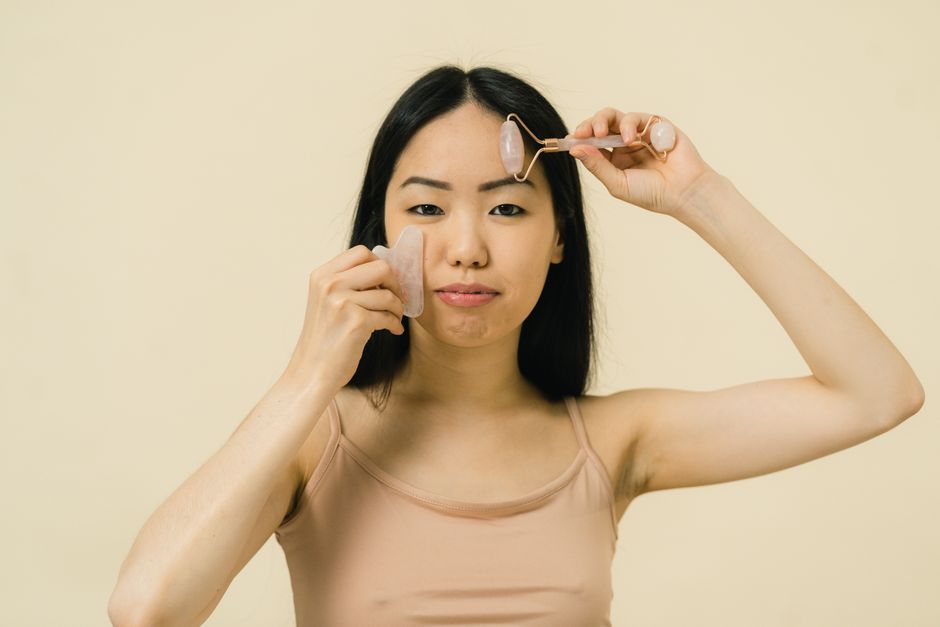
Face yoga and massage are popular, but the evidence is thin. Massage may briefly reduce puffiness by moving fluid, which can make the face look temporarily sharper. That effect fades within hours.
Face yoga overlaps with facial exercise — it involves controlled muscle contractions and stretches. Some small studies suggest benefits similar to facial exercise, with the same limitations: small samples and short follow-up. Claims that massage “sculpts” the jawline or “melts” fat are not supported by clinical evidence. Fat does not break down from rubbing.
There is a real risk worth naming. Repeated forceful stretching of the skin is not obviously helpful for elasticity, and some clinicians caution that aggressive manipulation could theoretically stress already-weakened tissue. Gentle is the operative word.





What About Creams, Serums, And At-Home Devices?
Topical products work on the skin’s surface, so their reach is limited. Ingredients like retinoids have the strongest evidence for improving skin texture and fine lines over time. But no topical cream has been shown to lift descended fat or rebuild the deeper support structures that cause jowls.
At-home devices that use microcurrent or radiofrequency are marketed for firming. Some small studies suggest microcurrent may temporarily improve muscle tone and appearance, but results are short-lived and the evidence base is limited. Radiofrequency devices aim to stimulate collagen, and some evidence supports skin tightening with professional-grade versions — but at-home devices deliver far less energy, and their effect on true sagging is not well established.
The pattern here is consistent. These tools may improve the look of the skin’s surface. They do not address the structural changes underneath.
What Do In-Office Treatments Offer For A Sagging Lower Face?
Non-surgical in-office options sit between creams and surgery. Their effectiveness varies by treatment and by how much sagging is present.
Energy-based devices — radiofrequency, ultrasound, and certain lasers — aim to heat deeper skin layers and stimulate collagen remodeling. Some are cleared for lifting the brow or tightening the neck and jawline. Results are gradual and modest, typically appearing over weeks to months, and they work best for mild to moderate laxity rather than significant sagging.
Injectable fillers can restore volume in the cheeks and jawline, which can indirectly improve the appearance of sagging by rebuilding support. This is a change in contour, not a true lift. Neuromodulators like botulinum toxin relax specific muscles and can soften lines, but they do not lift descended tissue.
The key limitation: none of these reposition the deeper fat and tissue layers the way surgery does. They can improve appearance, but the effect is generally smaller and less durable.
When Is A Facelift The Right Answer?
A facelift is the most effective option for significant lower-face sagging, and it is the only approach that repositions the deeper tissue. It is also surgery, with real recovery time and real risks.
A modern facelift does not just pull skin. Surgeons reposition the underlying muscle and tissue layer — the SMAS — and remove excess skin. This is why results look more natural than the tight, pulled appearance associated with older techniques. Results typically last many years, though no facelift stops aging.
Risks are those of any surgery plus some specific to the face: bleeding, infection, poor wound healing, nerve injury that can affect movement, and changes in skin sensation. Rarely, nerve injury can be longer lasting. Choosing a board-certified plastic surgeon with facial surgery experience is one of the strongest factors in reducing risk.
It is not for everyone. People with mild sagging may get enough improvement from non-surgical options. People with significant medical problems may not be good surgical candidates. And expectations matter — a facelift improves the lower face and neck, but it does not change skin quality or reverse all signs of aging.
How Do These Options Compare?
| Approach | What It Targets | Typical Durability | Best For |
|---|---|---|---|
| Facial exercise / face yoga | Muscle tone | Ongoing while practiced | Mild changes, low-risk habit |
| Creams / serums | Skin surface | Ongoing while used | Texture and fine lines |
| At-home devices | Skin and superficial muscle | Short-term, variable | Mild firming |
| In-office energy devices | Deeper skin, collagen | Months to a few years | Mild to moderate laxity |
| Fillers / injectables | Volume and specific muscles | Months | Contour and line softening |
| Facelift | Deeper tissue and skin | Many years | Significant sagging |
Read this table as a map, not a ranking. The right choice depends on how much sagging you have, what is causing it, your health, your budget, and how much downtime you can accept.
How To Choose What Is Right For You
Start by identifying what bothers you most. Is it skin texture, loss of cheek volume, jowls, or a loose neck? Each points toward a different approach.
A practical way to think about it:
- If the issue is mostly skin surface, start with proven topical ingredients and sun protection.
- If it is mild laxity, non-surgical in-office treatments may be reasonable.
- If it is clear sagging with jowls, only surgery repositions the deeper tissue.
Be skeptical of any product or program that promises surgical-level lifting without surgery. The biology does not support it. And be cautious with anyone — whether selling a cream or a procedure — who guarantees a specific result. Individual outcomes vary.
A consultation with a board-certified dermatologist or plastic surgeon is the most reliable way to match your specific anatomy to the right option. That conversation, not a marketing claim, is what should guide the decision.
Frequently Asked Questions
Can face exercises really lift sagging jowls?
Exercise can strengthen facial muscles and some small studies suggest modest improvements in firmness, but it cannot reposition descended fat or restore structural support. Jowls are usually caused by those deeper changes, which exercise does not address.
How long do facelift results last?
Results typically last many years, though no facelift stops the aging process. Durability varies by technique, skin quality, and individual factors.
Are at-home microcurrent devices worth it for lifting the lower face?
Some small studies suggest temporary improvements in muscle tone and appearance, but results are short-lived and evidence is limited. They do not address the deeper tissue changes that cause significant sagging.
What is the most effective way to lift a sagging lower face?
For significant sagging, a facelift is the most effective option because it is the only approach that repositions the deeper tissue layers. For mild changes, non-surgical treatments and skincare may be enough.
