
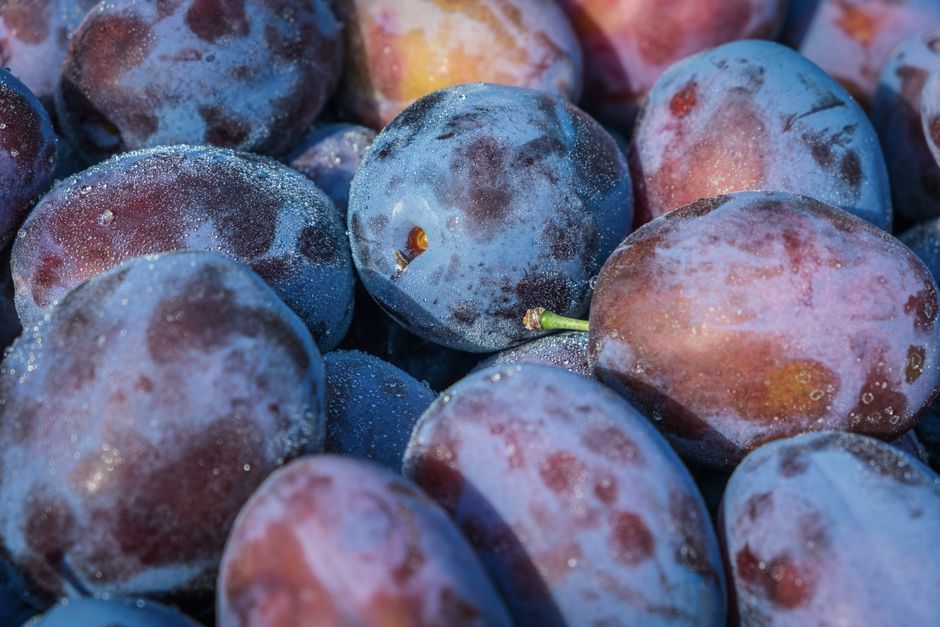
Juicing plums is straightforward: wash ripe plums, cut them open, remove the pits, and press the fruit through a juicer or blend it and strain the pulp. Plums are soft and watery, so most home juicers handle them with little trouble. The one step you cannot skip is pitting. Plum pits contain compounds that release cyanide when crushed, so they never go through the juicer.
What you get is a tart-sweet juice that varies a lot depending on the plum variety. Black plums, red plums, and green plums all taste different and juice differently. The process stays the same.
What Equipment Do You Need to Juice Plums?
A standard electric juicer works well for plums. You do not need a special machine.
Three setups cover almost every home kitchen:
- Electric juicer: Fastest option. Feed pitted plum halves into the chute. Soft fruit passes through quickly, so work in small batches.
- Blender plus strainer: Blend pitted plums until smooth, then pour the puree through a fine mesh strainer or nut milk bag. Press with a spoon to extract more liquid. This method gives you more control over texture.
- Manual citrus press or potato ricer: Works for very ripe, soft plums. Slower, but no electricity needed and easy to clean.
A few practical notes. Plums are high in pectin, a natural gelling compound. Juice made in a blender tends to be thicker and can separate as it sits. Stir before drinking. If you use an electric juicer, the juice may come out slightly frothy. That settles within a few minutes.
Hard, underripe plums do not juice well in any machine. They clog blades and yield little liquid. Let them ripen on the counter first.
How To Juice Plums Step by Step
The process takes about ten minutes for a small batch.
- Rinse the plums under cool running water. Rub the skin gently to remove surface residue.
- Cut each plum in half along the natural seam, following the indentation around the fruit.
- Twist the halves apart. The pit usually stays in one half.
- Pull the pit out with your fingers or a small spoon. Check for any broken pit fragments and remove them.
- Cut the pitted halves into pieces that fit your juicer chute or blender.
- Juice or blend. If blending, strain through a fine mesh strainer or nut milk bag.
- Drink fresh or refrigerate promptly.
Leave the skins on. Plum skin carries most of the fiber and a large share of the fruit’s polyphenol content, including anthocyanins, the pigments responsible for red and purple colors. Peeling removes much of what makes plum juice more than sugar water.
One clarification worth making: plum juice and prune juice are not the same product. Prunes are dried plums, usually of specific varieties, and prune juice has a well-documented laxative effect driven partly by sorbitol and fiber content. Fresh plum juice contains far less sorbitol and does not carry the same effect. If you are juicing plums expecting prune juice’s digestive action, you will likely be disappointed.
Do You Need to Remove Plum Pits Before Juicing?
Yes. Always pit plums before juicing. This is not optional.
Plum pits, like the pits of cherries, apricots, peaches, and bitter almonds, contain amygdalin. When the pit is crushed or chewed, amygdalin breaks down and releases hydrogen cyanide. Small accidental exposures from a single swallowed pit are generally not dangerous because the intact pit passes through. Crushed pits are a different matter. A juicer or blender will crush them, and that is exactly the scenario to avoid.
The amounts involved in a few pits are small, but there is no reason to take the risk when pitting takes seconds. This is standard food safety guidance, not a fringe concern.
If a pit cracks during cutting and fragments get into the fruit, discard those pieces. Do not blend them.





Which Plums Make the Best Juice?
Sweet, ripe plums make the best juice. Variety matters less than ripeness.
Japanese-type plums, which include most of the large red, black, and yellow plums sold in US grocery stores, are generally juicy and sweet. European-type plums, the group that includes prunes and many tart cooking varieties, tend to be firmer and more acidic. Both work. European types often need a touch of sweetness added after juicing.
Ripeness signs to look for:
- The fruit gives slightly when pressed near the stem end
- The skin has a dull bloom rather than a tight shine
- The plum smells sweet at room temperature
Firm plums will ripen on the counter in a few days. A paper bag speeds this up. Refrigeration slows ripening once the fruit is ready.
Sour or unripe plums are not wasted, though. They make a sharp juice that works well diluted with water and lightly sweetened, similar to how tart cherry or cranberry juice is handled.
How Long Does Fresh Plum Juice Last?
Fresh plum juice keeps about three to four days in the refrigerator in a sealed container. That is general food safety guidance for fresh unpasteurized fruit juice, not a plum-specific rule.
Home juicing does not pasteurize anything. Whatever microorganisms were on the fruit skin go into the juice. Washing the plums first reduces this, but it does not sterilize them. Keep the juice cold, keep it covered, and use it within a few days.
Signs the juice has turned: a sour or fermented smell, visible bubbles, or a fizzy taste. Discard it if any of those appear.
Freezing extends storage considerably. Pour the juice into ice cube trays or freezer-safe containers, leaving headspace for expansion. Frozen plum juice holds quality for several months. Thaw in the refrigerator, not on the counter.
People with weakened immune systems, young children, older adults, and pregnant women face higher risk from unpasteurized juice. For these groups, commercially pasteurized plum juice is the safer choice. This is standard public health guidance for all fresh juices, not a judgment about plums specifically.
Is Plum Juice Nutritious?
Plum juice provides vitamins, minerals, and plant compounds, but juicing removes most of the fiber.
A whole plum is roughly 30 calories and supplies fiber, vitamin C, vitamin K, and potassium, along with polyphenol antioxidants. When you juice a plum and strain out the pulp, you keep the water, sugars, vitamins, and many of the soluble compounds. You lose most of the fiber.
That loss matters. Fiber slows sugar absorption and supports digestive health. Juice without fiber delivers its sugar faster. A glass of plum juice made from several plums can carry a meaningful sugar load in a small volume that is easy to drink quickly.
This does not make plum juice unhealthy. It makes it something to drink in moderation rather than treat as a fiber supplement. Keeping some pulp in the juice, or blending rather than straining, preserves more of the fiber.
One honest limitation: most research on plum polyphenols has studied dried plums and plum extract, not fresh home-pressed juice. It is reasonable to expect that some beneficial compounds survive juicing, but specific health claims about fresh plum juice are not well supported by human trials. Treat it as a pleasant, moderately nutritious drink, not a therapeutic one.
Can You Juice Plums With Other Fruits?
Yes, and plums blend well with several fruits.
Good pairings include apples for sweetness and body, pears for a softer flavor, berries for color and tartness, and ginger or lemon for brightness. Plums are moderately acidic on their own, so a sweet fruit base usually balances them.
Two things to keep in mind. First, mixing fruits adds their sugars too, so the total sugar in a glass climbs quickly. Second, if you add other stone fruits like cherries, peaches, or apricots, pit them all. The same amygdalin concern applies to every stone fruit pit.
There is no fixed recipe worth following strictly. Start with a two-to-one ratio of plum to other fruit and adjust to taste.
Frequently Asked Questions
Can you juice plums with the skin on?
Yes, and you should. Plum skins carry fiber and polyphenol antioxidants, including the anthocyanin pigments that give red and purple plums their color. Leaving the skin on keeps more of the fruit’s nutritional value in the juice.
Do you have to remove plum pits before juicing?
Yes, always. Plum pits contain amygdalin, which releases hydrogen cyanide when crushed, and a juicer or blender will crush them. Pitting takes only seconds and removes the risk entirely.
How long does homemade plum juice last in the fridge?
About three to four days in a sealed container, based on general food safety guidance for fresh unpasteurized juice. Discard it sooner if it smells sour, tastes fizzy, or shows visible bubbles.
Is plum juice the same as prune juice?
No. Prune juice is made from dried plums and has a well-documented laxative effect linked to its sorbitol and fiber content. Fresh plum juice contains far less sorbitol and does not produce the same digestive effect.
