
Balance is something most people take for granted until it starts to slip. A stumble on uneven pavement, a wobble when reaching for a high shelf, or a moment of dizziness after standing up too fast. These small events are early warnings. The good news is that balance is a skill, not a fixed trait. You can train it at any age. The most effective approach combines strength training for the legs and core, specific balance exercises that challenge your stability, and daily habits that keep your sensory systems sharp. Here is how to increase balance with practical, evidence-based tips.
Why Balance Declines With Age
Balance is not controlled by one single part of the body. It is a coordination between three systems: your vision, your inner ear (vestibular system), and the sensors in your muscles and joints (proprioception). Your brain takes information from all three and makes split-second adjustments to keep you upright.
As you age, all three systems become less reliable. Vision sharpness drops. The hair cells in the inner ear that detect movement and position slowly diminish. Muscle mass and joint flexibility decrease, which means your body has less physical capacity to correct a wobble. This is why older adults fall more often. But the decline is not inevitable. Training can slow it, and in many cases, reverse it.
How To Increase Balance With Simple Exercises
The most direct way to improve balance is to practice being off-balance in a controlled setting. Start with exercises that are challenging but safe. Hold onto a counter or chair back if you need support. The goal is to progress to doing them without support over several weeks.
Single-leg stance is the foundation. Stand on one foot with your knee slightly bent. Hold for 30 seconds, then switch sides. If this is too easy, close your eyes. If that is too easy, stand on a folded towel or a balance pad. The key is progressive difficulty. Your brain only adapts when the task is slightly harder than what you can currently do.
Heel-to-toe walk is another effective drill. Place one foot directly in front of the other, touching heel to toe, and walk in a straight line for about 20 steps. This mimics the field sobriety test for a reason. It heavily challenges your vestibular system and forces your core to stabilize your pelvis.
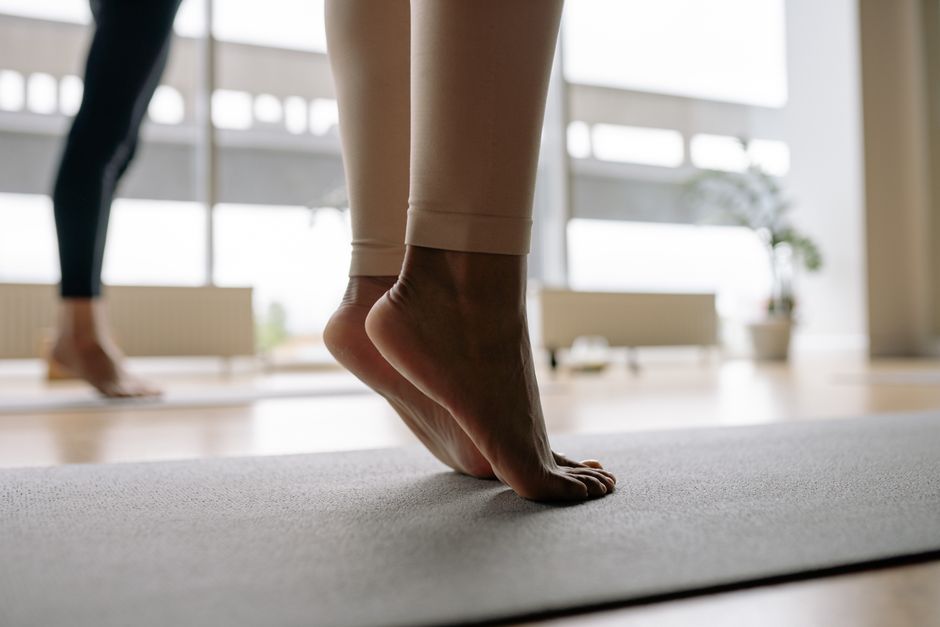
Weight shifts are a gentler starting point. Stand with your feet shoulder-width apart. Shift your weight onto your right foot and lift your left heel slightly off the floor. Hold for 10 seconds, then switch. This builds the ankle strength and hip control that underpin everyday balance.
Strength Training Is Balance Training
Balance exercises alone are not enough. You also need strength. Weak leg muscles cannot hold your body upright when you trip or step on an uneven surface. The muscles that matter most for balance are the glutes, quadriceps, hamstrings, calves, and the deep core muscles that connect your pelvis and spine.
Squats are the single most valuable exercise for balance. They strengthen the quadriceps and glutes, which are the primary muscles that keep you from falling forward when you stumble. Sit-to-stand from a chair is the beginner version. Full squats with good form are the advanced version. Aim to do some form of squat every day, even if it is just five repetitions.
Calf raises strengthen the muscles that control your ankle. The ankle is the first joint that responds when you start to tip. Strong calves give your brain a wider margin of error. Stand on the edge of a step, lower your heels below the step level, then push up onto your toes. This also improves ankle flexibility, which declines sharply with age and is a major fall risk factor.
Core work matters more than most people realize. Your core is not just your abdominal muscles. It includes the muscles along your spine, your pelvic floor, and your obliques. Planks, bird-dogs, and side planks are effective choices. A strong core keeps your torso upright and transfers force between your upper and lower body when you move.





How Your Vision And Inner Ear Affect Balance
Most balance training focuses on muscles, but the sensory systems deserve attention too. Your vision is the dominant input for balance. When you close your eyes, your balance gets noticeably worse. This is normal. But you can train your brain to rely less on vision and more on your inner ear and joint sensors.
Practice standing on one leg with your eyes closed, but only do this near a wall or counter. This forces your vestibular system and proprioception to take over. Over time, your brain becomes better at using these non-visual inputs, which matters because vision often degrades in dim lighting. Many falls happen at night when someone gets up to use the bathroom.
The inner ear also needs stimulation. Gentle head movements, such as slowly turning your head side to side while standing, help maintain vestibular function. If you experience dizziness or vertigo, do not attempt these exercises without consulting a healthcare provider. Some inner ear conditions require specific repositioning maneuvers that should be performed by a professional.
Daily Habits That Protect Your Balance
Exercise is the core of balance improvement, but daily habits can either support or undermine your progress. The way you move throughout the day matters as much as your dedicated training time.
Stand up from a chair without using your hands. This is a simple test and a daily exercise. If you cannot do it, your leg strength needs work. If you can, do it every time you get up. This builds functional strength in the exact pattern you use dozens of times per day.
Walk on different surfaces. Your balance system adapts to the ground beneath your feet. Walking on grass, sand, gravel, or a foam mat challenges your ankle stability in ways that flat sidewalks do not. If you usually walk on pavement, add a few minutes on uneven terrain when possible.
Pay attention to your footwear. Thick, cushioned soles reduce the sensory feedback from your feet. Your brain gets less information about the ground. This is why balance trainers often recommend barefoot training or minimalist shoes. For everyday walking, shoes with thinner soles and a wider toe box allow your feet to feel the ground more accurately.
Manage your medications. Many common medications, including blood pressure drugs, sleep aids, and antidepressants, can cause dizziness or lightheadedness. If you notice balance problems after starting a new medication, discuss it with your doctor. Do not stop taking a prescribed medication on your own.
When To See A Doctor About Balance Problems
Occasional wobbles are normal. Frequent falls, persistent dizziness, or a feeling that the room is spinning are not. These symptoms can indicate an underlying condition that needs medical evaluation.
See a healthcare provider if you have:
- Two or more falls in a six-month period
- Dizziness or vertigo that lasts more than a few minutes
- Numbness or tingling in your feet
- A sudden loss of balance, which can be a sign of a stroke or other serious condition
- Balance problems that appeared after starting a new medication
A doctor can assess whether your balance issues stem from a neurological condition, an inner ear disorder, or simple deconditioning. Physical therapy is often the next step. A physical therapist can design a personalized balance program that targets your specific weaknesses, which is more effective than a generic exercise routine.
The Role Of Yoga And Tai Chi
Yoga and tai chi are not just gentle exercise classes. They are structured balance training systems that have been studied extensively. Research consistently shows that both practices improve balance and reduce fall risk in older adults.
Tai chi is particularly effective because it involves slow, continuous weight shifting and requires constant adjustments to maintain stability. It also strengthens the ankles and knees through its characteristic semi-squat positions. Many community centers offer tai chi classes specifically designed for fall prevention.
Yoga improves balance through standing poses like tree pose and warrior III, which require single-leg stability and core engagement. The emphasis on breathing and body awareness also trains the mind-body connection that underlies good balance. Both practices have the added benefit of improving flexibility, which reduces the risk of injury when you do stumble.
How Long Does It Take To See Improvement
Balance improvements follow a predictable timeline, but the exact pace varies by individual. Some people notice better stability within two weeks of consistent training. Significant improvement typically takes eight to twelve weeks. This is because balance training requires the brain to build new neural pathways, and that process takes time.
Consistency matters more than intensity. Ten minutes of balance work every day is more effective than an hour once a week. The brain responds to frequent, repeated challenges. If you stop training, the gains fade. Balance is a use-it-or-lose-it skill, similar to muscle strength.
Track your progress with simple markers. Can you stand on one leg for 30 seconds with your eyes open? Can you do it with your eyes closed? Can you stand up from a chair without using your hands? These are measurable, objective indicators that your balance is improving.
Frequently Asked Questions
How often should I do balance exercises?
Daily practice is ideal, even if it is only five to ten minutes. Consistency builds the neural pathways that control balance faster than occasional longer sessions.
Can balance be improved at 60 or 70 years old?
Yes. Studies consistently show that older adults can significantly improve balance and reduce fall risk with regular training, regardless of their starting point.
What is the best single exercise for balance?
Standing on one leg is the most effective foundational exercise because it directly challenges the systems your body uses to stay upright. Progress by closing your eyes or standing on an unstable surface.
Why do I feel dizzy when I close my eyes during balance exercises?
Your brain relies heavily on vision for balance. When you remove visual input, your inner ear and joint sensors must work harder, which can cause temporary dizziness until your brain adapts. This is normal, but stop if dizziness persists.
