
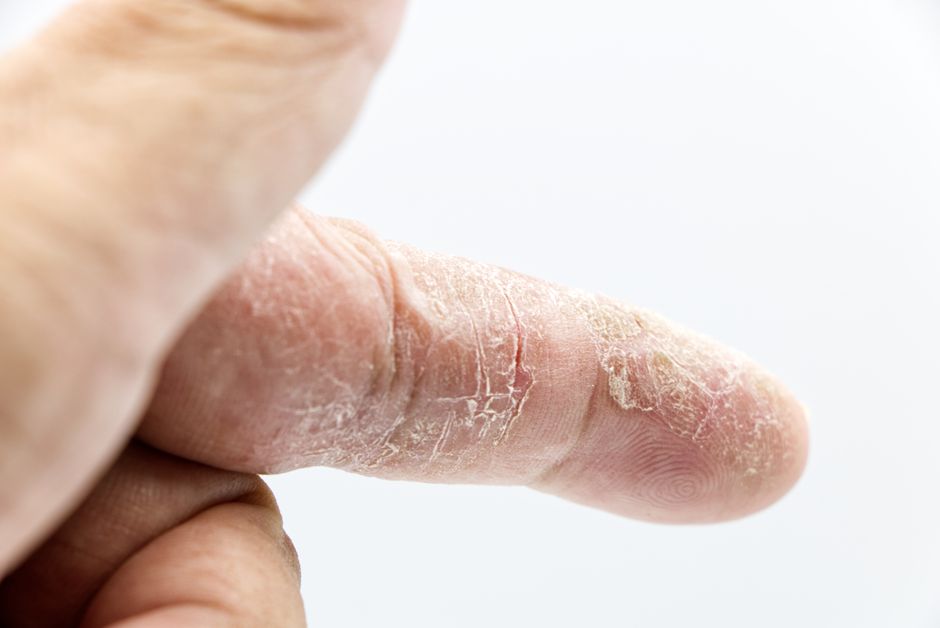
Scabies is caused by a tiny mite that burrows into the upper layer of your skin, and it has a very specific set of signs that separate it from eczema, psoriasis, and other rashes. The most reliable clues are intense itching that gets worse at night, a pimple-like rash, and thin, wavy burrow lines on the skin. If you are scratching more at night and see these tracks, scabies is the likely cause, but a doctor’s skin scraping is the only way to confirm it.
What Does a Scabies Rash Actually Look Like?
Scabies produces small, red bumps that often look like pimples or tiny blisters. In some people, the bumps crust over from scratching. The rash is not one uniform patch. It tends to appear in clusters or scattered lines across specific parts of the body.
The hallmark sign is the burrow. A burrow is a thin, grayish-white or skin-colored line, usually about 2 to 10 millimeters long, with a tiny dark dot at one end. That dot is the mite itself. Burrows are often hard to see because they are small and can be covered by scratching and inflammation.
These burrows are most common in the webs between the fingers, the inner wrists, elbows, armpits, waistline, and the soles of the feet in infants. The mite prefers warm, folded areas of skin where it can hide easily.
How To Identify Scabies Vs Other Skin Conditions: Key Differences
Distinguishing scabies from other skin conditions comes down to three main factors: the pattern of the rash, the location on the body, and the timing of the itch.
Scabies almost always spares the face and scalp in adults. Eczema and psoriasis frequently appear on the face, scalp, elbows, and knees. If your rash is on your face with no burrow lines elsewhere, scabies is less likely.
The itch of scabies is notoriously worse at night. While eczema and psoriasis can also itch at night, the intensity with scabies is often described as relentless and severe enough to disturb sleep. This is because the mite becomes more active in a warm bed, and the body’s allergic reaction to the mite, its eggs, and its droppings drives the itching.
Another key difference is how the rash spreads. Scabies spreads through close physical contact with an infected person. Eczema and psoriasis are not contagious. If multiple people in the same household have the same itchy rash, scabies is a strong possibility.
Scabies vs Eczema: Which One Is It?
Eczema, also called atopic dermatitis, is a chronic inflammatory skin condition that often runs in families. It appears as dry, red, scaly patches that can weep and crust. Scabies presents as discrete bumps and burrow lines, not broad dry patches.
Eczema typically appears on the inside of the elbows, behind the knees, and on the cheeks in children. Scabies prefers the finger webs, wrists, and waistline. Eczema does not create burrow tracks. If you see thin, wavy lines on the skin, that points strongly to scabies.
One confusing factor is that scratching scabies can damage the skin and cause it to look like eczema. This is called secondary eczema. A doctor may need to treat the scabies first before assessing whether an underlying eczema condition also exists.





Scabies vs Psoriasis: What Are the Visual Clues?
Psoriasis produces thick, silvery scales on red plaques, most commonly on the elbows, knees, scalp, and lower back. The scale is a defining feature. Scabies does not produce silvery scaling plaques.
Psoriasis is an autoimmune condition where skin cells multiply too quickly. It is not caused by an external organism and is not contagious. Scabies is an infestation with a living mite that you can catch from another person.
If your rash has a distinct silvery sheen and appears symmetrically on both elbows, psoriasis is more likely. Scabies rash is more scattered and asymmetric, with burrows and intense nighttime itch.
Scabies vs Bed Bug Bites: Location Matters
Bed bug bites are often mistaken for scabies because both cause itchy red bumps. However, bed bugs bite exposed skin while you sleep. The bites typically appear on the arms, neck, face, and hands — areas not covered by pajamas.
Bed bug bites often form a line or zigzag pattern of three or more bites, sometimes called “breakfast, lunch, and dinner.” They do not create burrow tracks, and the itching is not specifically worse at night in the same way scabies is. Bed bugs bite and leave, while scabies mites stay in the skin.
Another difference is persistence. Bed bug bites usually fade within one to two weeks. Scabies will continue to worsen and spread until the mites are killed with prescription treatment.
Scabies vs Contact Dermatitis: The Timeline Tells the Story
Contact dermatitis is a reaction to something that touches your skin, like poison ivy, nickel jewelry, or a new soap. The rash appears only where the skin touched the irritant. Scabies is not limited to contact areas and spreads to characteristic sites like the finger webs and wrists.
The timeline is also different. Contact dermatitis appears within hours to days after exposure and improves once you stop touching the trigger. Scabies symptoms typically appear two to six weeks after the first exposure because the body needs time to develop an allergic sensitivity to the mite.
If you recently started a new medication, soap, or laundry detergent and the rash appeared quickly, contact dermatitis is more likely. If the rash has been building for weeks and is spreading, scabies becomes more probable.
When to See a Doctor and How Diagnosis Works
Do not rely on home diagnosis alone. Several skin conditions look similar, and treating the wrong one wastes time and can make the real problem worse. See a doctor if the rash is spreading, the itching disrupts your sleep, or other household members develop the same symptoms.
A doctor diagnoses scabies by examining the skin and looking for burrows. If burrows are found, the doctor may perform a skin scraping. This involves gently scraping a small area of skin with a scalpel blade and examining the material under a microscope to look for mites, eggs, or mite feces. This is the definitive test.
Sometimes no mites are found even when scabies is present, especially if the person has bathed recently or has been scratching heavily. In that case, a doctor may base the diagnosis on the clinical appearance and the pattern of symptoms. Some clinicians may also use dermoscopy, a handheld magnifying device, to spot burrows more easily.
What Happens After Treatment
Scabies is treated with prescription creams or lotions, such as permethrin, which kill the mites. The treatment is applied from the neck down and left on for the recommended time, usually eight to fourteen hours, then washed off. A second application is often needed about one week later.
Itching does not stop immediately after treatment. The mites are dead, but your skin is still reacting to their remains. Itching can persist for two to four weeks after successful treatment. This does not mean the treatment failed.
All close contacts and household members need treatment at the same time, even if they have no symptoms. This prevents reinfestation. Wash bedding, clothing, and towels used in the past three days in hot water and dry on high heat. Items that cannot be washed should be sealed in a plastic bag for at least 72 hours, since mites cannot survive away from human skin for more than a few days.
Frequently Asked Questions
Can scabies be confused with eczema?
Yes, especially after scratching damages the skin and makes it look dry and inflamed. The key difference is that scabies produces burrow lines and prefers the finger webs and wrists, while eczema forms broader patches in elbow creases and behind the knees.
How fast does scabies spread on the body?
On a first infection, symptoms take two to six weeks to appear, but the mites spread slowly during that time. On a repeat infection, symptoms can appear within one to four days because the immune system already recognizes the mite.
Does scabies itch all day or only at night?
Scabies itches throughout the day, but it becomes significantly worse at night. The mites are more active in a warm environment, and the body’s allergic response intensifies when you are resting.
Can you see scabies mites with the naked eye?
No. The mites are microscopic, measuring about 0.2 to 0.4 millimeters. You can see the burrow tracks they create, but confirming the mite itself requires a microscope.
