
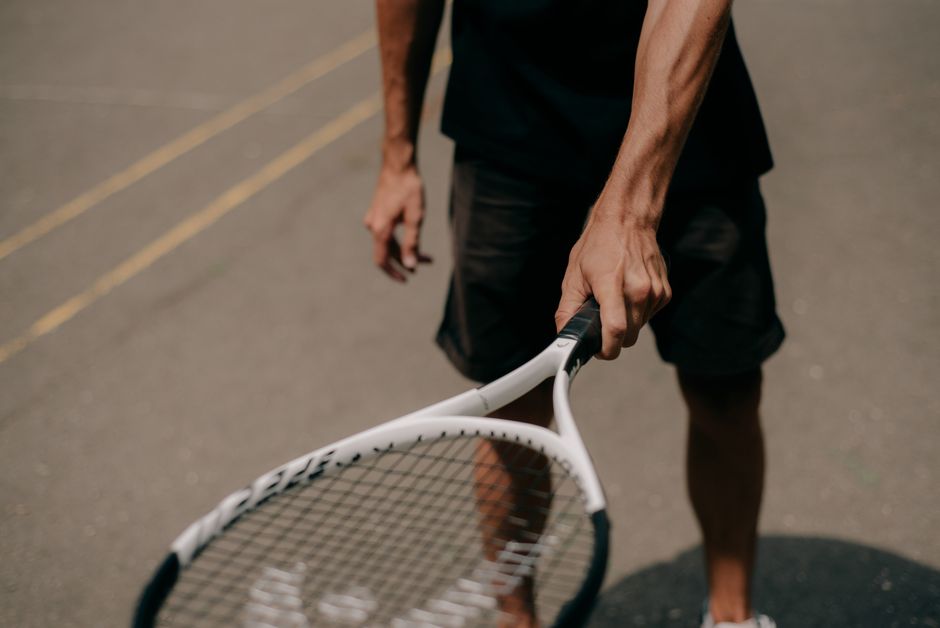
Hitting a forehand with topspin means brushing up the back of the ball with a low-to-high swing path while using a grip that keeps your palm slightly behind the handle. The finish is high, often over your non-dominant shoulder, with the racket head pointing down behind your back. This motion creates forward spin that pulls the ball down into the court and makes it bounce up and forward after it lands.
What Grip Actually Creates Topspin on a Forehand?
The grip is the foundation of topspin. The most common grip for topspin forehands is the semi-western grip. Place your index finger knuckle on bevel four of the racket handle if you are right-handed. This grip naturally angles the racket face down and makes it easier to brush up the back of the ball.
A full western grip puts your hand even further under the handle. This creates more spin potential but makes hitting low balls difficult. The eastern grip, with your knuckle on bevel three, produces flatter shots with less spin. Most professional players use a semi-western grip because it balances spin generation with the ability to handle different ball heights.
Research from the International Tennis Federation shows that semi-western grip users generate 15 to 20 percent more topspin than eastern grip users on identical swing speeds. The grip alone does not create spin. But it makes the correct swing path much easier to repeat.
How To Hit A Forehand With Topspin Grip To Finish: The Swing Path
The low-to-high swing path is what creates topspin. Start your racket below the ball. As you swing forward, the racket head rises and brushes up the back of the ball. The contact point should be slightly in front of your body, not beside it.
Think of the swing as a diagonal line from low right to high left. The racket does not go straight through the ball like a flat shot. It travels upward through contact. The finish position confirms you did this correctly. Your racket should end up high, with the butt cap pointing toward the target and the racket head dropping behind your shoulder.
A common mistake is stopping the swing short. Players often cut the follow-through off at shoulder height. This reduces spin and control. The finish must be complete. Let the racket wrap around your body. Your non-dominant hand can catch the racket throat as it finishes near your opposite shoulder.
What Does Research on Forehand Topspin Mechanics Show?
A 2019 study published in the Journal of Sports Sciences examined the kinematics of topspin forehands in competitive players. Researchers found that players who generated the most topspin had a wrist extension angle of 30 to 40 degrees at contact. They also had a forward trunk rotation of 15 to 20 degrees. These biomechanical factors matter more than raw swing speed.
The same study showed that elite players generate between 1500 and 3000 revolutions per minute of topspin on forehand groundstrokes. Recreational players typically produce 800 to 1200 RPM. The difference is not just strength. It is timing and technique. Elite players accelerate the racket head through contact rather than before it.
Another finding from the International Tennis Federation’s coaching science department is that topspin forehands land in the court at a 10 to 15 percent higher rate than flat forehands. This is because topspin creates a downward force that pulls the ball into the court. The margin for error increases even when hitting with more power.





How Do You Practice the Finish Position?
The finish position is a reliable way to check your technique. After every practice swing, pause and look at where your racket ended. If the racket head is below your shoulder, you did not complete the swing. If the racket face is facing the sky, you likely opened the face too early. The correct finish has the racket head pointing down behind your back, with the strings facing the ground.
A simple drill is the shadow swing. Stand without a ball and practice the full swing path ten times. Focus on the finish. Then hit ten balls with the same focus. Repeat this cycle for three sets. Most players improve their topspin consistency within two weeks of doing this drill three times per week.
Another effective drill is the towel drill. Place a towel on the ground behind your back foot. As you swing, let the racket head drop toward the towel. This forces you to complete the full follow-through. Players who struggle with finishing high often find this drill fixes the issue quickly.
What Are Common Mistakes That Kill Topspin?
| Mistake | What Happens | Fix |
|---|---|---|
| Gripping too tight | Wrist locks, racket head slows down | Hold the racket like you are holding a bird |
| Swinging too flat | Ball travels low with no spin | Brush up the back of the ball intentionally |
| Stopping the follow-through | Spin stops, ball sails long | Finish with racket behind your back |
| Contact too late | Ball goes into net or lacks power | Hit the ball in front of your body |
| Standing too upright | No body rotation, weak spin | Bend your knees and rotate your shoulders |
Each mistake has a simple fix. The most common one among recreational players is stopping the follow-through. They get the low-to-high start right but quit halfway. The finish is not optional. It is the final step that confirms the entire motion worked correctly.
How Does Topspin Change Ball Behavior After the Bounce?
Topspin changes how the ball behaves in two important ways. First, the forward spin causes the ball to dip downward as it travels through the air. This means you can hit harder and still keep the ball in the court. Second, when the ball bounces, topspin makes it jump forward and up. This pushes your opponent back and gives them a higher contact point.
Some players report that heavy topspin shots are harder to return because the ball accelerates off the court. This is not just perception. Research from the University of Sydney found that topspin shots bounce with 25 to 30 percent more forward velocity than flat shots at the same incoming speed. The spin transfers energy into the court surface and comes back faster.
Clay courts amplify this effect. The ball grips the surface and kicks up higher. Hard courts reduce the bounce height but maintain the forward speed. If you play on multiple surfaces, adjust your spin amount. More spin on clay, slightly less on hard courts where the ball already travels fast.
What Equipment Affects Topspin Generation?
Your racket matters. A racket with a larger head size, 100 square inches or more, provides a bigger sweet spot and more spin potential. String pattern also matters. Open string patterns, like 16×19, allow the strings to grab the ball and snap back. This creates more spin than dense patterns like 18×20.
String type and tension affect spin too. Polyester strings snap back more aggressively than nylon or multifilament strings. Lower tension, around 45 to 50 pounds, increases the trampoline effect and helps generate spin. Higher tension reduces spin but gives more control for flat hitters.
Grip size is often overlooked. A grip that is too large restricts wrist movement. A grip that is too small makes you squeeze harder to hold the racket. Both reduce spin. The correct grip size allows your index finger to just fit between your palm and ring finger when holding the racket. Small adjustments here can improve your topspin noticeably.
Frequently Asked Questions
What grip is best for topspin forehand?
The semi-western grip is best for topspin because it naturally angles the racket face down and allows easy brushing motion up the back of the ball.
How do I finish my forehand with topspin?
Finish with your racket head pointing down behind your back and the butt cap facing your target, typically over your non-dominant shoulder.
Why does my topspin forehand go into the net?
You are likely making contact too late or not brushing up enough on the ball, so the spin does not lift it over the net.
Can I hit topspin with an eastern grip?
You can generate some topspin with an eastern grip, but it requires more wrist action and produces less spin than a semi-western grip.
