
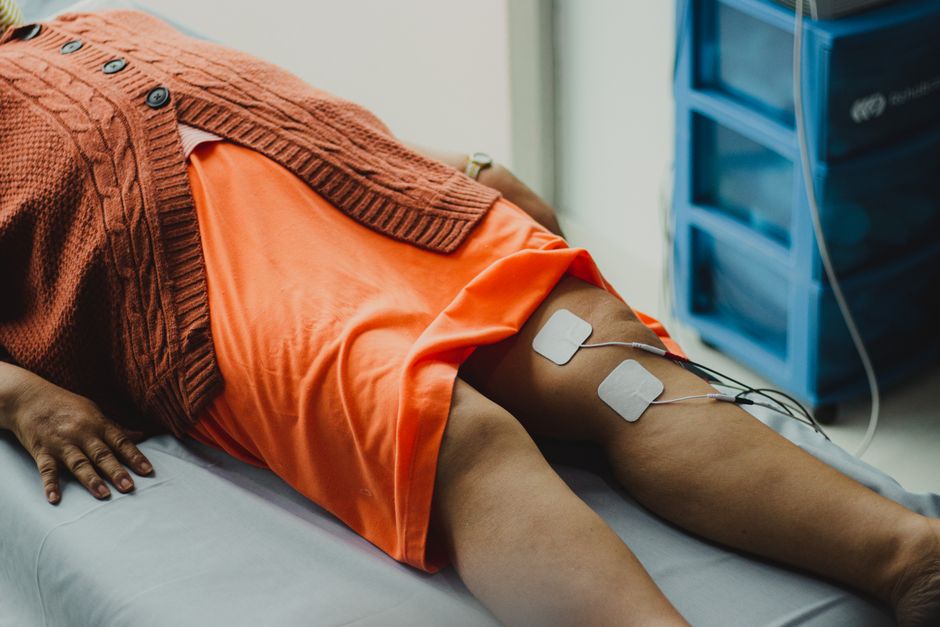
Quadriceps tendonitis heals best when you treat it in clear phases: protect the tendon first, then build strength gradually, and only return to full activity once the tendon tolerates load without pain. Most people try to stretch or push through the pain, which slows healing. The better approach is a phased rehab plan that respects the tendon’s slow healing timeline and progresses only when your symptoms allow.
What Is Quadriceps Tendonitis and Why Does It Happen?
Quadriceps tendonitis is inflammation and irritation of the tendon that connects your quadriceps muscle to your kneecap. This tendon works every time you straighten your knee, climb stairs, squat, or jump. When it gets overloaded faster than it can repair itself, pain develops.
The tendon sits right above the kneecap. Pain usually appears there, especially when you straighten your leg against resistance or after sitting for a long time. The area may feel tender to touch and may swell slightly.
This condition is common in runners, cyclists, basketball players, and anyone who does repeated squatting or jumping. It is also seen in people who suddenly increase their training volume or intensity. Weak hip and glute muscles can contribute because they force the quadriceps to work harder than necessary.
Phase 1: Protect and Reduce Pain
The first phase focuses on calming the tendon down. This does not mean complete rest. Complete rest actually weakens the tendon further and makes recovery slower. It means reducing the activities that cause pain while keeping the tendon gently active.
Stop or reduce activities that cause sharp pain. Running, jumping, deep squats, and stair climbing are common triggers. If walking hurts, shorten your stride and walk on flat ground. Some people need a short period of reduced activity, usually a few days to a week.
Ice can help reduce pain after activity. Apply an ice pack to the painful area for 15 to 20 minutes. Do not apply ice directly to the skin — wrap it in a thin cloth. Ice reduces pain and swelling but does not heal the tendon by itself.
Pain-free isometric exercises are the cornerstone of this phase. An isometric exercise is one where you contract the muscle without moving the joint. A wall sit at a shallow angle, holding for 30 to 45 seconds, is a good example. The key is to keep the intensity low enough that you feel no pain during or after the exercise.
These exercises maintain muscle activation and blood flow to the tendon without further irritating it. Research supports isometric exercises for tendon pain relief, though the effect varies from person to person.
Phase 2: Build Strength with Slow Loading
Once daily pain drops and you can do isometric exercises comfortably, you move to strengthening. This phase builds the tendon’s capacity to handle load. The tendon needs progressive loading — not too much, not too little — to remodel and become stronger.
Start with slow, controlled exercises. Straight leg raises, shallow squats, and leg presses at low resistance are good starting points. The weight should be light enough that you complete 3 sets of 15 repetitions without pain.
As you tolerate these, progress to heavier resistance with fewer repetitions. Exercises like step-ups, split squats, and wall sits at deeper angles load the quadriceps tendon more directly. The goal is to reach a point where you can do 3 sets of 8 to 12 repetitions with moderate weight, pain-free.
The single most important rule in this phase: exercise should not cause pain above a mild level. Some discomfort during exercise is acceptable, but it should settle within 24 hours. If pain increases the next day, reduce the load or the number of sets.
Strength work should happen every other day, not daily. Tendons need recovery time between sessions to adapt. Training the same tendon hard every day prevents adaptation and can worsen symptoms.





Phase 3: Return to Sport and Higher Impact
The final phase prepares the tendon for the demands of your sport or daily activities. This is where many people fail because they feel better and jump straight back into full training. The tendon may feel fine at rest but still cannot handle sudden high loads.
Introduce impact gradually. Start with walking, then brisk walking, then light jogging. If jogging is pain-free, progress to running at a comfortable pace. Increase distance slowly — no more than 10 percent per week is a common guideline used by many clinicians.
Add plyometric exercises like hopping and jumping only after you can run without pain. Begin with low-intensity hops on both legs, then progress to single-leg hops and eventually jumping exercises. Each level should be pain-free before you advance.
Strength work continues during this phase. The tendon needs to handle both strength and impact loads. Keep doing squats, lunges, and leg presses at least twice per week.
Return to sport is not a single day event. It is a gradual process that may take several weeks. The tendon typically needs 8 to 12 weeks of structured rehab before it can handle full sport demands, though this varies based on severity and how consistently you do the exercises.
How Long Does Quadriceps Tendonitis Take to Heal?
Healing time depends on how long you have had symptoms and how consistently you rehab. Acute cases — those present for less than six weeks — often improve within 4 to 8 weeks of consistent rehab. Chronic cases that have been present for months can take 3 to 6 months or longer.
Tendons heal slowly because they have poor blood supply compared to muscle. This is not something you can speed up with supplements or special treatments. The body needs time and the right loading stimulus.
You can expect to feel gradual improvement rather than sudden recovery. Pain typically reduces first during daily activities, then during exercise, and finally during high-impact activities. Each phase of improvement may take several weeks.
Some people experience flare-ups during rehab, especially when progressing to a new exercise or increasing load. This is normal. A flare-up means you have loaded the tendon slightly too much. Back off to the previous level for a few days, then try again.
What Makes Quadriceps Tendonitis Worse?
Certain habits slow healing or cause the condition to return. Knowing these can help you avoid setbacks.
- Ignoring pain — pushing through sharp pain during exercise overloads the tendon and delays healing.
- Stretching aggressively — intense quadriceps stretching can compress the tendon against the kneecap and worsen irritation.
- Returning to sport too early — feeling better does not mean the tendon is strong enough for full activity.
- Training the same way — repeating the exact same exercise pattern that caused the problem without addressing weaknesses.
- Sitting for long periods — prolonged knee bending can make the tendon stiff and more painful when you stand up.
Weak hip muscles are a common underlying issue. The glutes and hip stabilizers control how your knee tracks during movement. When they are weak, the quadriceps take on extra work and the tendon suffers. Including hip strengthening exercises like clamshells, side-lying leg raises, and glute bridges in your rehab plan can reduce the load on the quadriceps tendon.
When Should You See a Doctor or Physical Therapist?
See a healthcare provider if pain is severe, if you cannot bear weight on the leg, or if there is significant swelling around the knee. These symptoms can indicate a tendon tear or another injury that needs medical evaluation.
A physical therapist can assess your strength, flexibility, and movement patterns to design a rehab program specific to your needs. This is especially valuable if you have had symptoms for more than a few weeks or if previous attempts at rehab have failed.
Imaging such as ultrasound or MRI is not always needed. Doctors may order imaging if the diagnosis is unclear or if a tear is suspected. Most cases of quadriceps tendonitis are diagnosed based on physical examination and symptom history.
Can You Prevent Quadriceps Tendonitis from Returning?
Yes, but prevention requires ongoing work. The tendon that healed once is vulnerable to reinjury if you return to the same training patterns that caused the problem.
Maintain quadriceps and glute strength at least twice per week. This does not need to be heavy lifting — bodyweight squats, lunges, and glute bridges are enough for many people. The key is consistency.
Increase training load gradually. Whether you run, lift, or play sports, sudden jumps in intensity or volume are the most common trigger for tendon problems. Follow the 10 percent rule for increasing weekly training volume.
Warm up properly before activity. A brief warm-up that includes light aerobic activity and some gentle quadriceps activation prepares the tendon for load. Cold tendons are stiffer and more prone to irritation.
Frequently Asked Questions
Can I run with quadriceps tendonitis?
Only if running does not cause pain above a mild level. If running hurts during or after, stop and focus on the earlier rehab phases until the tendon tolerates impact.
Should I stretch my quadriceps with tendonitis?
Avoid aggressive stretching of the quadriceps during the early healing phase. Gentle stretching later in rehab is acceptable, but the tendon responds better to strengthening than stretching.
Is a knee brace helpful for quadriceps tendonitis?
Some people find a knee strap or brace reduces pain during activity, but no strong evidence shows it speeds healing. Braces are a temporary comfort measure, not a treatment.
How many times per week should I do rehab exercises?
Strength exercises are typically done every other day, about 3 times per week. Daily isometric exercises are fine during the early pain phase, but heavier strengthening needs recovery days between sessions.
Quadriceps tendonitis is frustrating because it heals slowly and flares up easily. But the phased approach works: protect the tendon first, load it progressively, and return to activity gradually. Consistency matters more than intensity. If you follow the phases and let pain guide your progress, most people recover fully and return to the activities they enjoy.
