
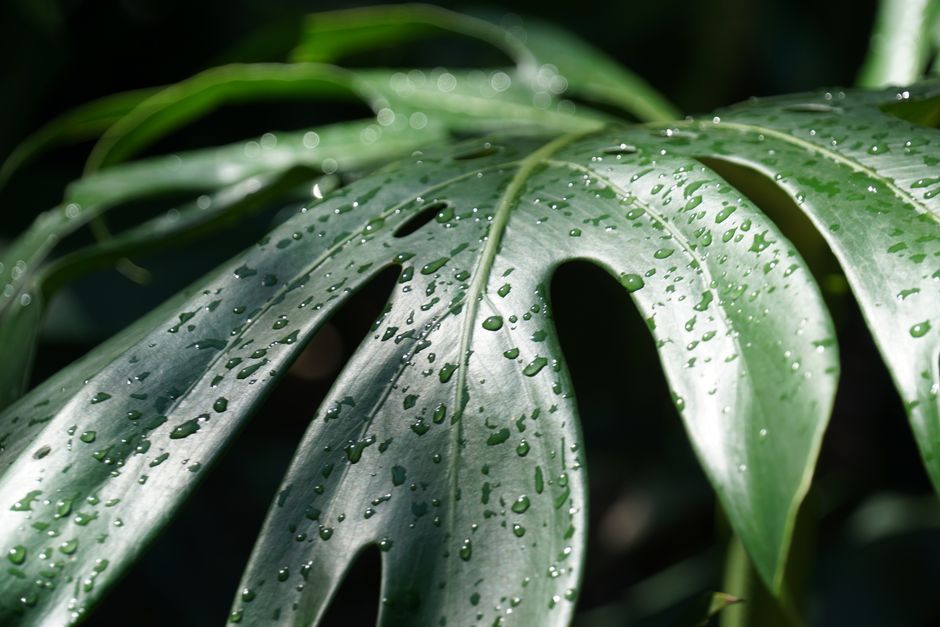
Amydrium medium ‘Silver’ is a climbing aroid from Southeast Asia. It grows best in bright, indirect light, high humidity, and a loose, airy potting mix that drains fast. It is not a beginner plant, and it does not tolerate soggy roots or dry air.
The silver in the name refers to the leaf pattern. New leaves emerge with a silvery, mottled sheen that fades somewhat as they harden. The plant is a climber, not a shrub, so it wants something to climb on. Give it a moss pole or similar support and it will produce larger leaves over time.
What Is Amydrium Medium Silver?
Amydrium is a small genus of climbing plants in the Araceae family, the same family as Monstera and Philodendron. Amydrium medium is native to parts of Southeast Asia, including Malaysia, Sumatra, and Borneo, where it grows as an epiphyte and hemiepiphyte on tree trunks in humid forest.
An epiphyte grows on another plant for support without taking nutrients from it. A hemiepiphyte starts life on a tree and may later send roots to the ground. Amydrium medium does both depending on where it grows. This matters for care, because the plant’s roots evolved in bark and moss, not in dense soil.
‘Silver’ is a cultivated form selected for its leaf pattern. The foliage shows irregular silver-grey mottling against a darker green base. The pattern is most visible on newer leaves and tends to soften as leaves mature. This is normal and not a sign of poor health.
One clarification worth making: the silver pattern is not a variegation in the genetic sense that a Monstera albo is. It is a structural feature of the leaf surface that reflects light differently. That distinction matters because silver-patterned aroids do not revert the way some true variegates do.
How Much Light Does Amydrium Medium Silver Need?
Bright, indirect light is the target. In practice that means a spot near a window that receives filtered daylight, or a few feet back from a bright window that never gets direct midday sun.
Direct sun through glass can scorch the leaves. The silver pattern makes this worse, because lighter leaf areas reflect more light but also heat up faster and burn more easily than solid green tissue. A south or west window with a sheer curtain usually works. An east window without a curtain often works too.
Too little light produces a different set of problems. Growth slows, new leaves come in smaller, and the silver pattern becomes less pronounced. The plant will not die in low light, but it will not thrive either. If you can read a book comfortably in the spot without turning on a lamp, there is probably enough light.
Grow lights are a reasonable option if your home lacks good natural light. A full-spectrum LED placed a foot or two above the plant, run for around 12 hours a day, is a common setup. There is no single correct distance, because intensity varies widely between fixtures. Watch the leaves and adjust.
What Soil and Potting Mix Works Best?
A chunky, fast-draining mix is essential. The single most common way people kill this plant is by keeping its roots wet in dense potting soil.
A workable mix combines roughly equal parts orchid bark, perlite, and a quality potting base, with some sphagnum moss or coco coir added for slight moisture retention. The goal is a mix that holds some water but lets excess drain away within seconds of watering.
- Orchid bark — provides structure and air pockets around roots
- Perlite — improves drainage and prevents compaction
- Coco coir or peat — holds a little moisture without staying saturated
- Sphagnum moss — adds moisture retention and is useful around aerial roots
Pot choice matters too. A pot with drainage holes is not optional. Terracotta dries faster than plastic, which can help if you tend to overwater. Size the pot to the root ball. A pot that is too large holds water the roots cannot reach, and that water sits and goes stale.




How Should You Water Amydrium Medium Silver?
Water when the top inch or two of the mix feels dry. That is the general rule. In a chunky aroid mix in a warm room, that might mean every 7 to 10 days. In cooler conditions or a denser mix, it could be two weeks or more.
Water thoroughly until it runs out the drainage holes, then let the pot drain completely. Never let the pot sit in a saucer of standing water. Roots that stay submerged lose access to oxygen, and that is what causes rot.
Signs you are watering too often include yellowing lower leaves, soft dark patches on the stems, and a sour smell from the soil. Signs you are watering too little include crisp brown leaf edges, curling leaves, and a pot that feels unusually light.
There is a nuance worth knowing. Amydrium medium is more tolerant of drying out slightly than of staying wet. When in doubt, wait another day. The plant will recover from a missed watering far more easily than from root rot.
What Humidity and Temperature Does It Need?
High humidity is important. This plant comes from humid forest understory, and typical indoor air in heated or air-conditioned homes is much drier than what it evolved in. Most growers aim for 60 percent relative humidity or higher, though the plant can survive somewhat below that.
Low humidity shows up as brown, crispy leaf tips and edges, especially on new leaves that fail to unfurl cleanly. A humidifier is the most reliable fix. Grouping plants together and using a pebble tray can raise humidity slightly, but the effect is modest and often overstated.
Temperature should stay in the range most tropical houseplants prefer, roughly 65 to 85 degrees Fahrenheit. Avoid cold drafts, and keep the plant away from air conditioning vents and heating registers. Cold damage shows as dark, mushy patches, which can be confused with rot.
Does Amydrium Medium Silver Need a Moss Pole?
Yes, and this is where many growers go wrong. Amydrium medium is a climbing plant. Its natural growth habit is to ascend a tree trunk, and its leaf size is tied to that behavior.
When the plant climbs, each new leaf tends to be larger than the last, and the silver pattern is often more developed. When it is left to trail or hang, growth usually stalls and leaves stay small. This is not a matter of preference. It is how the plant’s growth is regulated.
A moss pole, a cedar plank, or a piece of cork bark all work as a support. The key is that aerial roots can attach to it. Keep the support slightly moist if it is a moss pole, since aerial roots grow toward moisture. Guide new growth toward the support with soft ties if it does not grab on its own.
Common Problems and What Causes Them
Most problems with this plant trace back to water, light, or humidity. Root rot is the most serious and the most common. It usually starts with overwatering in a mix that holds too much moisture. Once roots are affected, the plant may collapse quickly. Repotting into fresh, dry mix and removing mushy roots is the usual response, though it does not always save the plant.
Yellowing leaves can mean several things. Lower leaves yellowing slowly over time is often normal aging. Widespread yellowing, especially with soft stems, points to overwatering. Yellowing between the veins can indicate a nutrient issue, though this is less common in a plant that is fed regularly.
Brown crispy edges almost always mean low humidity or inconsistent watering. Brown soft patches mean something else entirely, usually cold damage or bacterial or fungal infection, and those need different handling.
Pests are a real risk. Spider mites thrive in dry indoor air and show up as fine webbing and stippled, dull leaves. Mealybugs appear as small white cottony clusters in leaf joints. Thrips leave silvery streaks and tiny black specks. Check new leaves and the undersides of foliage regularly, since early detection makes management far easier.
Slow growth is usually not a problem at all. It is a sign the plant needs more light, more humidity, or something to climb. Fix those and growth typically resumes.
How Do You Propagate Amydrium Medium Silver?
Stem cuttings are the standard method. Take a cutting that includes at least one node, which is the point on the stem where a leaf attaches and where roots can form. A single node with a leaf is often enough, though two nodes improve the odds.
Root the cutting in water, sphagnum moss, or a light aroid mix. Water is the easiest to monitor, but roots grown in water can be fragile when moved to soil later. Moss and perlite keep the node humid while still allowing air, and many growers find this gives a stronger transition to soil.
Keep the cutting warm and humid, in bright indirect light. Roots typically appear within a few weeks, though timing varies with conditions. Wait until roots are a few inches long before potting into a proper mix. This plant is not difficult to propagate once you have a healthy stem to work with.
Is Amydrium Medium Silver Toxic to Pets?
Plants in the Araceae family contain calcium oxalate crystals, and Amydrium is in that family. These crystals are the reason many aroids are irritating when chewed. The American Society for the Prevention of Cruelty to Animals lists many Araceae genera as toxic to cats and dogs, though Amydrium specifically is not always named on those lists.
Given the family-wide pattern, the sensible approach is to treat it as potentially irritating and keep it out of reach of pets and small children. Chewing can cause mouth pain, drooling, and vomiting. If a pet eats a significant amount, contact your veterinarian or a pet poison helpline. Do not wait for symptoms to decide.
Frequently Asked Questions
How often should I water Amydrium medium Silver?
Water when the top inch or two of the potting mix feels dry, which is often every 7 to 10 days in a warm room with a chunky mix. Always let the pot drain fully and never leave it sitting in water.
Why are the leaves on my Amydrium medium Silver turning brown at the edges?
Crisp brown edges usually mean low humidity or inconsistent watering, both common in indoor conditions. Soft dark brown patches are different and usually point to cold damage or infection.
Does Amydrium medium Silver need a moss pole to grow well?
Yes, it is a climbing plant and grows larger leaves when it has something to ascend. Left to trail, growth often stalls and new leaves stay small.
Is Amydrium medium Silver safe around cats and dogs?
It belongs to the Araceae family, which contains calcium oxalate crystals that irritate the mouth and stomach if chewed. Keep it out of reach of pets and children, and contact a veterinarian if a pet eats any part of it.
