
Back flexibility is not about touching your toes or forcing your spine into shapes it was never built for. It is about having enough mobility in your spine, hips, and surrounding muscles to move through daily life without stiffness or pain. The most effective approach combines gentle daily stretching, strengthening the muscles that support your spine, and consistency over weeks, not days. Below is a practical guide to building a back flexibility routine that actually works.
What Does Back Flexibility Actually Mean?
When people say they want a flexible back, they usually mean one of three things: they can’t bend forward easily, they feel stiff when they wake up, or they’ve lost range of motion over time. These are different problems with different solutions.
Your spine is made up of 24 vertebrae stacked in a gentle S-curve, separated by discs that act as cushions. The spine’s primary job is stability, not extreme mobility. Most of the bending and twisting you associate with a “flexible back” actually comes from your hips and thoracic spine (the mid-back). The lumbar spine (lower back) has relatively limited rotation and side-bending capacity by design.
This matters because many people stretch their lower back aggressively when the real restriction is in their hips or upper back. If your hip flexors are tight, your pelvis tilts and your lower back compensates. Stretching the back alone won’t fix that.
True back flexibility means your spine can move through its normal range while the muscles around it support that movement. Flexibility without strength is not useful and may increase injury risk.
How To Get A Flexible Back Stretches And Routine
A good routine addresses the whole chain: hips, spine, and the muscles that connect them. Here is a basic sequence that covers the major areas. Hold each stretch for 20 to 30 seconds. Move slowly. Never bounce.
Cat-Cow
Start on your hands and knees. Arch your back upward (cat), then let it sag downward (cow). Move slowly between the two positions. This warms up the spine and improves segmental movement. Ten to fifteen slow cycles work well as a warm-up.
Child’s Pose
Kneel on the floor, sit back on your heels, and reach your arms forward while lowering your chest toward the ground. This stretches the lower back and lats. Hold for 30 seconds to one minute. If your knees bother you, place a cushion behind them.
Thoracic Rotation
Lie on your side with your knees bent and stacked. Extend your top arm and slowly rotate your upper body, reaching that arm behind you. This targets the mid-back, which is often the stiffest part of the spine. Do 8 to 10 slow repetitions per side.
Hip Flexor Stretch
Kneel on one knee with the other foot forward. Tuck your pelvis slightly and shift your weight forward until you feel a stretch in the front of the hip of the kneeling leg. Hold 30 seconds per side. Tight hip flexors pull the lower back into an exaggerated curve and are a common hidden cause of back stiffness.
Figure-Four Stretch
Lie on your back with both knees bent. Cross one ankle over the opposite thigh, then reach through and pull the supporting thigh toward your chest. This targets the glutes and piriformis. Hold 30 seconds per side.
Seated Spinal Twist
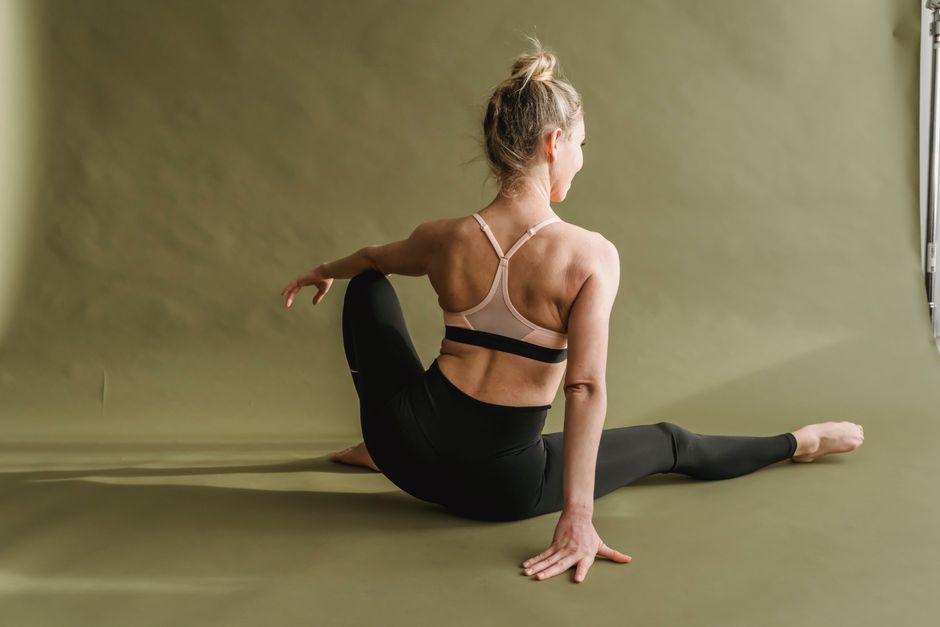
Sit on the floor with legs extended. Bend one knee and cross that foot over the opposite leg. Twist your torso toward the bent knee. Hold 20 to 30 seconds per side. Keep the twist gentle. The lumbar spine does not rotate much, so most of the movement should come from your mid-back.
How Often Should You Stretch for Back Flexibility?
Daily gentle stretching is generally safe for most healthy adults and tends to produce better results than occasional long sessions. A short routine of 10 to 15 minutes done most days is more effective than an hour once a week.
Flexibility gains take time. Research on stretching suggests that noticeable improvements in range of motion typically require several weeks of consistent practice. Some studies indicate that holding stretches for a total of about 60 seconds per muscle group per session is enough to see progress, though individual responses vary.
Warm muscles stretch more safely than cold ones. A five-minute walk or a few minutes of gentle movement before stretching is a reasonable warm-up. Stretching cold muscles aggressively is more likely to cause strain than benefit.
If you are stretching to address pain rather than general stiffness, the timeline and approach may be different. Pain that worsens with stretching is a signal to stop and get evaluated.





Stretching Alone Is Not Enough
This is the part most flexibility advice skips. Your back needs strength as much as it needs length. Muscles that are strong through their full range help protect the spine during movement.
Core stability exercises — planks, dead bugs, bird dogs — train the deep muscles that support your spine. Glute strength matters too, because weak glutes shift load to the lower back. Some evidence suggests that strengthening programs are at least as effective as stretching for improving back function, and combining both tends to work better than either alone.
Think of it this way: stretching creates the range, and strengthening teaches your body to use it. One without the other is incomplete.
- Planks: Hold 20 to 30 seconds, working up to 60 seconds as you get stronger.
- Bird dogs: On hands and knees, extend opposite arm and leg. Do 8 to 10 per side.
- Dead bugs: Lie on your back, extend opposite arm and leg while keeping your lower back pressed to the floor. Do 8 to 10 per side.
- Glute bridges: Lie on your back, knees bent, lift your hips. Do 10 to 15 repetitions.
These are general starting points, not prescriptions. If you have an existing back condition, a physical therapist can tailor the approach to your situation.
When Stretching Can Make Things Worse
Not all back stiffness responds to stretching. In some cases, stretching the wrong area or stretching too aggressively can aggravate the problem.
If you have an acute disc injury, certain forward-bending stretches may increase pain because they load the disc. If you have spinal stenosis, extension movements (arching backward) often feel worse while gentle flexion (bending forward) provides relief. These are opposite patterns, which is why a generic routine does not work for everyone.
Warning signs that mean stop and see a clinician:
- Pain that shoots down your leg or arm
- Numbness, tingling, or weakness in your limbs
- Stiffness that is worse in the morning and improves with movement (this pattern can suggest an inflammatory condition)
- Back pain accompanied by unexplained weight loss, fever, or night pain
- Loss of bladder or bowel control — this is a medical emergency
For ordinary muscular stiffness, stretching is usually helpful. For pain with neurological symptoms, it is not the right first step.
Common Mistakes That Limit Progress
Bouncing during stretches triggers a reflex that makes muscles tighten rather than relax. Holding still is more effective.
Stretching only the lower back misses the hips and mid-back, which are often the actual source of restriction. A complete routine addresses all three areas.
Pushing into pain is counterproductive. A stretch should feel like mild tension, not sharp pain. Pain causes muscles to guard and tighten, which is the opposite of what you want.
Skipping days matters more than people think. Flexibility gains fade relatively quickly when you stop. Consistency beats intensity.
Ignoring strength work limits how much flexibility you can actually use. A muscle that is long but weak cannot support your spine under load.
How Long Before You See Results?
Most people notice some improvement in stiffness within one to two weeks of daily gentle stretching. Meaningful changes in range of motion generally take four to six weeks of consistent practice.
These timelines are general. Age, activity level, underlying conditions, and how long you have been stiff all affect how quickly you progress. Some people respond faster. Others need more time.
The goal is not extreme flexibility. It is having enough mobility to move comfortably through your day — bending, reaching, twisting, and getting up from a chair without stiffness holding you back. That is a realistic and achievable target for most people.
Frequently Asked Questions
How long does it take to get a flexible back?
Most people see some improvement in stiffness within one to two weeks of daily stretching, with more noticeable range-of-motion gains after four to six weeks. Individual results vary based on age, activity level, and underlying conditions.
Can you stretch your back too much?
Yes. Aggressive or excessive stretching can strain muscles and ligaments, and certain movements may worsen conditions like disc injuries or spinal stenosis. Stretching should feel like mild tension, never sharp pain.
Is it better to stretch in the morning or at night?
Either works. What matters more is that your muscles are warm. A few minutes of gentle movement before stretching is more important than the time of day.
Do you need to stretch every day for a flexible back?
Daily gentle stretching tends to produce better results than occasional sessions, but most people can make progress with five to six days per week. Consistency matters more than duration.
