
To find the height of a pyramid, you need its volume and the area of its base, or you need to measure it directly. The most common method uses the formula height = (3 × volume) ÷ base area. If you cannot measure the pyramid physically, you can calculate its height from its slant height and the dimensions of its base using the Pythagorean theorem.
The math is straightforward once you know which measurements you have. This guide covers the standard formulas, explains the difference between vertical height and slant height, and shows how the same geometry applies to real structures.
What Is the Difference Between Height and Slant Height?
Height and slant height are two different measurements, and mixing them up is the most common mistake people make. The vertical height (often written as h) is the perpendicular distance from the apex straight down to the center of the base. The slant height (often written as l) is the distance from the apex to the midpoint of any edge along the face of the pyramid.
Think of it this way: the vertical height goes through the inside of the pyramid. The slant height runs along the outside surface. They form a right triangle with the distance from the center of the base to the midpoint of an edge.
For a pyramid with a square base, that relationship is:
- l² = h² + (s/2)², where s is the side length of the base
So if you know the slant height and the base side length, you can rearrange to find the vertical height:
- h = √(l² − (s/2)²)
This is just the Pythagorean theorem applied to the cross-section of the pyramid. Nothing more complicated than that.
How Do You Find Height Using Volume and Base Area?
The volume formula for any pyramid is V = (1/3) × base area × height. Rearranging it gives you the height directly: h = (3V) ÷ B, where V is volume and B is base area.
This works for any pyramid shape — square, rectangular, triangular, or any other polygon base. The base area calculation changes depending on the shape, but the height formula stays the same.
Here is a worked example. Suppose a pyramid has a volume of 300 cubic units and a square base with sides of 10 units.
- Base area = 10 × 10 = 100 square units
- Height = (3 × 300) ÷ 100 = 900 ÷ 100 = 9 units
The key step most people miss is multiplying volume by 3 before dividing. That factor of 3 comes from the (1/3) in the volume formula. Without it, your answer will be one-third of the correct height.
How Do You Find the Height of a Square Pyramid?
A square pyramid has a square base, so the base area is simply side length squared. If you know the volume, the height is h = 3V ÷ s², where s is the side length.
If you do not know the volume but you know the slant height and the base side, use h = √(l² − (s/2)²).
If you know the length of a lateral edge (the edge running from the apex to a base corner) and the base side length, the relationship is slightly different. The distance from the center of the base to a corner is (s√2)/2, so:
- h = √(e² − (s√2/2)²), where e is the lateral edge length
Each of these formulas comes from the same right-triangle geometry. Which one you use depends entirely on what you can measure or what information you already have.





How Do You Find the Height of a Triangular Pyramid?
A triangular pyramid (tetrahedron) has a triangular base. First find the area of that triangle, then apply h = 3V ÷ B.
The area of a triangle is (1/2) × base × height of the triangle itself. Be careful here — the “height” in that formula refers to the height of the triangle, not the height of the pyramid. It is an easy mix-up.
For an equilateral triangle with side length a, the area is (√3/4) × a². Once you have the base area, plug it into the pyramid height formula.
Example: a triangular pyramid with volume 60 cubic units and an equilateral base with sides of 6 units.
- Base area = (√3/4) × 36 ≈ 15.59 square units
- Height = (3 × 60) ÷ 15.59 ≈ 180 ÷ 15.59 ≈ 11.55 units
Regular triangular pyramids have all faces as equilateral triangles, which simplifies things. Irregular ones require you to calculate the base area separately.
How Do You Find the Height of a Rectangular Pyramid?
A rectangular pyramid has a rectangle for a base, so the base area is length × width. The height formula remains h = 3V ÷ (l × w).
If you know the slant height to the midpoint of one side, you can use the Pythagorean theorem with half the corresponding base dimension. For a rectangle with length L and width W:
- Using slant height to the long side: h = √(l² − (W/2)²)
- Using slant height to the short side: h = √(l² − (L/2)²)
The slant height is different for each pair of faces in a rectangular pyramid. This is a key difference from a square pyramid, where all four faces are identical.
How Was the Height of the Great Pyramid Measured?
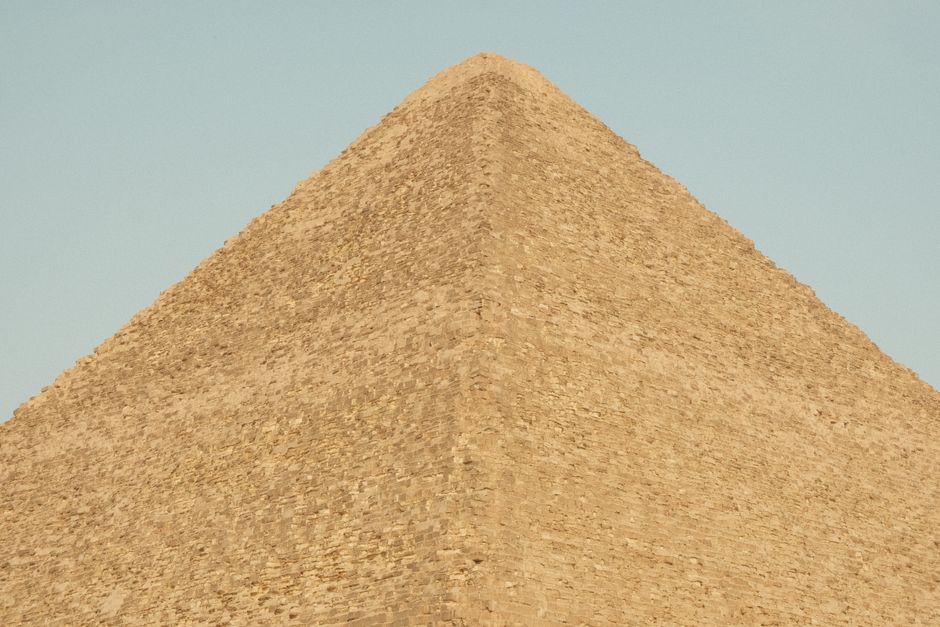
The Great Pyramid of Giza originally stood about 146.6 meters (roughly 481 feet) tall, according to measurements published by the Egyptologist Flinders Petrie in the late 1800s. Because the outer casing stones have been removed over millennia, its current height is about 138.5 meters (roughly 454 feet).
Modern measurement uses surveying tools like theodolites and GPS, which calculate height by triangulating from known reference points. Historical measurement relied on similar geometric principles — measuring angles and distances from the ground.
The same math you use in a classroom applies to real structures. The difference is scale and the precision of the instruments. No special formula is needed.
What Units Should You Use?
Use consistent units throughout the calculation. If volume is in cubic meters, the base area should be in square meters, and the resulting height will be in meters.
Mixing units is a common source of error. If your volume is in cubic centimeters but your base area is in square meters, convert one before dividing. There are 10,000 square centimeters in one square meter and 1,000,000 cubic centimeters in one cubic meter.
The formula itself does not care about units. It only requires that they match. Keep them consistent and the answer will be correct.
Frequently Asked Questions
What is the formula to find the height of a pyramid?
The formula is h = (3 × volume) ÷ base area. This works for any pyramid regardless of the shape of its base.
Can you find the height of a pyramid without knowing the volume?
Yes, if you know the slant height and base dimensions. Use h = √(l² − (s/2)²) for a square pyramid, where l is the slant height and s is the side length of the base.
What is the difference between height and slant height?
Height is the perpendicular distance from the apex to the center of the base. Slant height is the distance from the apex to the midpoint of a base edge along the face.
How do you find the height of a pyramid with a triangular base?
Calculate the area of the triangular base first, then use h = 3V ÷ B. For an equilateral triangle with side a, the base area is (√3/4) × a².
