
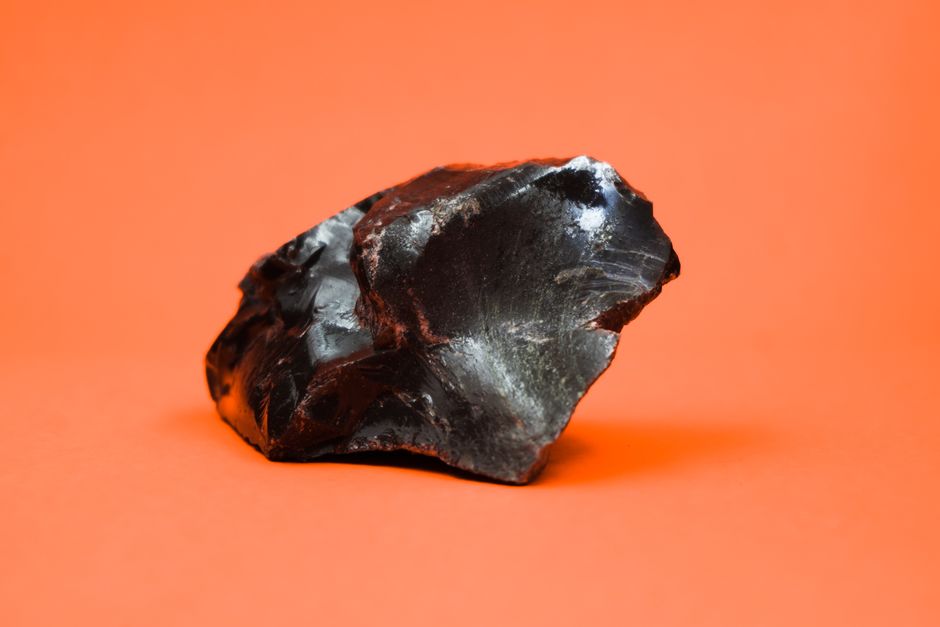
Obsidian is volcanic glass, not a mineral, and it forms only where lava cools so fast that atoms never arrange into crystals. That means you find it in volcanic regions, usually near rhyolite domes and older lava flows. The best field strategy is simple: target young volcanic terrain, look for shiny black rock with curved “conchoidal” fractures and sharp edges, and check road cuts, dry creek beds, and scree slopes where fresh rock has been exposed.
What Exactly Is Obsidian and Why Does It Only Form in Some Places?
Obsidian is natural glass created when molten rock cools too quickly for crystals to grow. Most rocks cool slowly underground and develop visible mineral grains. Obsidian skips that step entirely.
The key requirement is silica-rich lava, usually rhyolitic in composition. Silica-rich magma is thick and sticky, which is why it tends to erupt as domes and short flows rather than runny rivers of basalt. When that sticky lava hits air or water, the outer surface can chill within hours or days. The result is a glassy rock that looks like broken bottle glass.
This is why obsidian is rare compared to other volcanic rocks. It needs the right chemistry, the right cooling speed, and the right exposure at the surface. Over geologic time, obsidian slowly devitrifies — the glass gradually converts to tiny crystals. Most obsidian you can collect is geologically young, often less than a few million years old, though some older deposits survive in dry climates.
How To Find Obsidian Best Regions And Field Tips
The best regions share three traits: recent volcanic activity, silica-rich lava, and dry or eroded terrain that exposes fresh rock. Obsidian weathers into a dull gray, pitted surface called perlite over time, so you want areas where erosion keeps stripping that layer away.
Well-known obsidian-producing areas include the western United States, parts of Mexico, Iceland, Italy, Turkey, Japan, and East Africa’s rift valley. In the US, volcanic terrain in Oregon, California, Idaho, Nevada, Arizona, and New Mexico is where most collectors look. Specific sites vary, and land access rules matter — much of this ground sits on public land with its own collecting regulations.
Field tips that actually help:
- Walk dry creek beds and gullies. Water carries and concentrates obsidian cobbles.
- Check road cuts and fresh landslide scars. They expose rock that has not weathered yet.
- Look at the base of cliffs and scree slopes below rhyolite domes.
- Search early morning or after rain. Wet glass catches light and flashes.
- Bring a hand lens and a rock hammer if collecting is allowed where you are.
One thing worth knowing: obsidian’s fresh surface is genuinely sharp. Fractured edges can be thinner than a surgical scalpel. Gloves are not optional if you plan to handle it.
How Do You Identify Obsidian in the Field?
Fresh obsidian is glassy, dark, and breaks with smooth curved surfaces. Those curved break patterns are called conchoidal fractures, and they are the single most useful identifying feature.
Look for these traits:
- Luster: shiny and glass-like, not dull or grainy.
- Color: usually black, but can be brown, gray, green, or reddish.
- Fracture: smooth curved shell-like breaks with sharp edges.
- Translucency: thin edges may let light through, sometimes showing a smoky or banded look.
- Hardness: roughly 5 to 5.5 on the Mohs scale, similar to window glass.
Two lookalikes cause most confusion. Flint and chert also break with curved fractures, but they are usually lighter in color, more opaque, and form in sedimentary settings rather than volcanic ones. Slag — industrial waste glass — can look almost identical. Slag often contains bubbles, has irregular color streaks, and turns up near old smelting or railroad sites rather than lava fields.
Snowflake obsidian shows white-gray crystal patches. Apache tears are small rounded obsidian nodules. Mahogany obsidian has reddish-brown streaks. These are all the same base material with different inclusions or weathering.




Can You Find Obsidian Without Special Gear?
Yes. Finding obsidian requires no specialized equipment. It is a surface rock in many volcanic areas, and cobbles often sit loose on the ground.
That said, a few basic items make the trip safer and more productive. Sturdy gloves protect against razor edges. A small hand lens helps you check the glassy texture. A rock hammer and chisel are useful only where collecting is permitted. Safety glasses matter if you break rock, because obsidian flakes fly.
What you should not do is assume any dark shiny rock is obsidian. Volcanic glass, industrial slag, and even some dark cherts overlap in appearance. Context is your best tool — if you are standing on a rhyolite dome in a young volcanic field, your odds are good. If you are in a limestone quarry, they are not.
Where Is Obsidian Found Around the World?
Obsidian shows up wherever silica-rich volcanism has occurred recently enough that the glass has not fully crystallized. That is a fairly short list of places.
Major source regions include:
- Western North America: the Cascade Range, the Great Basin, and parts of the Southwest.
- Mexico: volcanic highlands, historically a major source of tool stone.
- Iceland: active rift volcanism with rhyolite centers.
- Italy: islands like Lipari and Sardinia have long been known for obsidian.
- Turkey: central Anatolian volcanic fields.
- East Africa: the rift valley, including parts of Ethiopia and Kenya.
- Japan and the western Pacific: island arc volcanoes.
Historically, obsidian was one of the most traded materials in the ancient world because it made excellent cutting tools. Archaeologists still trace ancient trade routes by matching obsidian artifacts to their geologic source, a technique called sourcing. Each source has a distinct chemical fingerprint.
If you are planning a collecting trip, check land status first. Many obsidian-rich areas sit on national forest or BLM land in the US, and rules about removing rock differ by location. Some areas allow limited personal collecting; others prohibit it entirely. A quick call to the local land management office saves a lot of trouble.
Why Does Some Obsidian Look Different From Other Pieces?
Obsidian varies because the lava it came from varies. Small differences in chemistry, gas content, and cooling history produce visibly different rock.
Common varieties include:
- Black obsidian: the most familiar form, high in iron and magnesium oxides.
- Snowflake obsidian: contains white cristobalite crystal clusters that grew as the glass cooled.
- Mahogany obsidian: reddish-brown from iron oxide inclusions.
- Rainbow obsidian: shows thin layers that split light into colors when viewed at an angle.
- Sheen obsidian: contains tiny gas bubbles aligned in layers that reflect light.
These differences are not just cosmetic. They tell you something about how the lava behaved and how quickly it cooled. Banded and layered obsidian often comes from flows where lava moved in pulses, trapping different compositions in sequence.
One clarification worth making: obsidian is not a crystal, and it is not a mineral. Minerals have a defined chemical composition and an ordered atomic structure. Obsidian has neither. It is a rock, and specifically a volcanic glass. That distinction matters in geology even though it rarely comes up in casual conversation.
What Should You Know Before Collecting?
Check the rules where you plan to collect. Public lands in the US have different policies depending on the agency and the specific area. Some allow small amounts of rock for personal use; others do not. National parks generally prohibit removing any rock or mineral.
Safety matters more than most people expect. Obsidian edges cut deeply and cleanly, and small flakes can lodge in skin or eyes. Wear gloves and eye protection. Do not strike obsidian against hard surfaces without protection — it can shatter unpredictably.
Also think about weight. Obsidian is dense, and a backpack full of it gets heavy fast. Collect a few good pieces rather than a pile of mediocre ones.
Frequently Asked Questions
Where is obsidian most commonly found?
Obsidian is found in young volcanic regions with silica-rich lava, including the western United States, Mexico, Iceland, Italy, Turkey, Japan, and East Africa’s rift valley. It is rare compared to other volcanic rocks because it requires fast cooling of sticky, silica-rich magma.
How can I tell obsidian from regular black rock?
Obsidian has a shiny, glass-like surface and breaks with smooth curved fractures, unlike most black rocks that look dull or grainy. If the rock is near an old industrial site and contains bubbles or irregular color streaks, it may be slag instead.
Is it legal to collect obsidian?
It depends on where you are. Many US public lands allow limited personal collecting, but national parks generally prohibit removing rock, so check with the local land management office before you go.
Why is obsidian sharp?
When obsidian breaks, it fractures along smooth curved surfaces that taper to edges thinner than a surgical scalpel. That is why it was widely used for cutting tools in the ancient world and why gloves are essential when handling it.
