
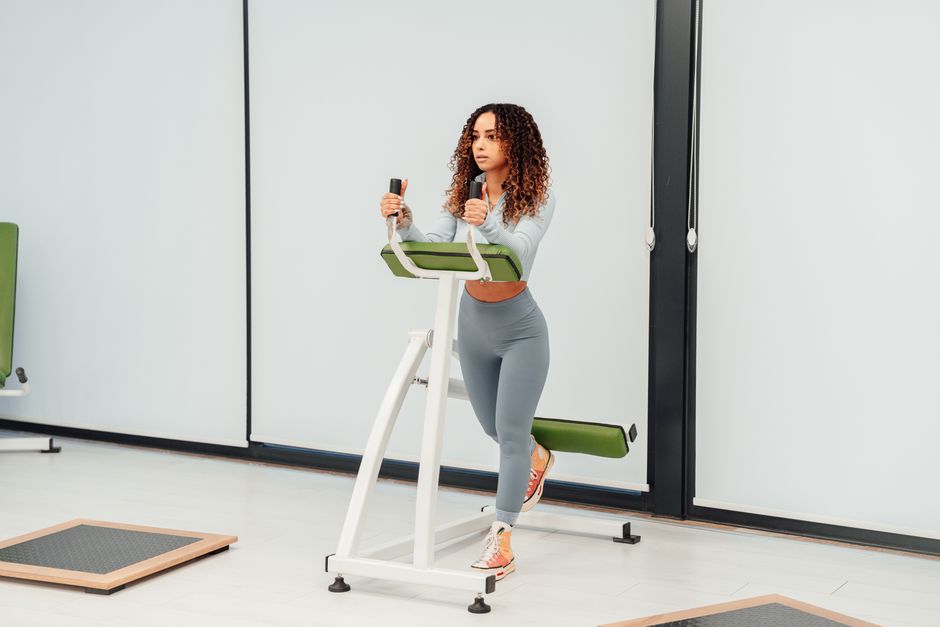
The hip thrust machine can be a highly effective tool for building your glutes, but only if you set it up correctly and move with purpose. Many people either load up too much weight or let their lower back take over, which shifts the work away from the muscles you are targeting. To do the hip thrust machine with proper form, adjust the seat and pad so your upper back rests against the pad and the lever sits just below your hip crease, then drive through your heels to lift your hips until your torso forms a straight line from shoulders to knees.
How To Do Hip Thrust Machine Proper Form Tips
Start by setting the machine to your height. The back pad should hit your upper back, near your shoulder blades, not your neck. The padded lever should rest across your hips, right at the crease where your legs meet your torso. When you press your feet into the platform, your shins should be close to vertical at the top of the movement.
Place your feet about shoulder-width apart on the platform. Push through your heels and lift your hips until your body forms a straight line from your shoulders to your knees. Squeeze your glutes hard at the top for one full second. Lower the weight back down under control until your hips are just above the floor, then repeat.
The most common mistake is arching your lower back at the top of the lift. This turns the exercise into a back extension and takes tension off the glutes. Keep your ribs down and your core braced throughout the movement. Think about tucking your pelvis slightly under as you reach the top position.
How Does the Hip Thrust Machine Differ From a Barbell?
The machine offers a fixed path of motion. This means you do not have to balance a loaded barbell across your lap, which can be uncomfortable or awkward for some lifters. The machine also typically has a footplate that helps you maintain consistent foot placement from rep to rep.
With a barbell, you have more freedom to adjust your stance and range of motion, but you also need to manage the bar rolling and the pressure on your hips. Some research suggests that both methods can activate the glutes similarly when performed with proper technique. The better choice is often the one that feels most comfortable and allows you to train with good form consistently.
One advantage of the machine is how easy it is to set up and unload. You do not need to lift a heavy bar into position. This can make it safer to train alone or push closer to failure without needing a spotter.
What Muscles Does the Hip Thrust Machine Work?
The primary muscles are the gluteus maximus and the hamstrings. The gluteus maximus is the largest muscle in your body and is responsible for hip extension, which is the main movement in this exercise. Your hamstrings assist with this hip extension, especially during the lower portion of the lift.
Your core muscles work isometrically to keep your torso stable. Your adductors, or inner thighs, help stabilize your legs on the footplate. Your quadriceps are minimally involved because your knees do not extend significantly during the movement.
To emphasize the glutes over the hamstrings, keep your torso more upright and drive through your heels. To shift more work to the hamstrings, some lifters position their feet slightly further forward on the platform. Foot placement changes the angle of the movement and alters which muscles work hardest.





How Much Weight Should You Use?
Start with a light load to learn the movement pattern. This is not an exercise where you should test your one-rep max on the first visit. Focus on feeling your glutes do the work rather than your lower back or quads.
A good starting point is a weight you can lift for 10 to 12 controlled repetitions with good form. If you can complete all reps without your lower back arching, consider increasing the weight slightly on your next set. If your hips start to drift forward or your back takes over, the weight is too heavy.
Progressive overload is key for muscle growth. Over time, gradually increase the weight or the number of reps you perform. Adding weight every session is not necessary. Small, steady increases over weeks and months produce the best results.
How Often Should You Do Hip Thrusts?
Most people can benefit from training the glutes two to three times per week. This frequency allows for adequate recovery while providing enough stimulus for growth. Your glutes are large muscles and respond well to regular, targeted training.
If you are new to this exercise, start with one or two sessions per week. Allow at least 48 hours between sessions that target the same muscles. Soreness is normal, especially at first, but sharp pain during the movement is not.
You do not need to do hip thrusts every workout. You can alternate them with other glute exercises like squats, lunges, or step-ups. Variety helps ensure you train your glutes from different angles and movement patterns.
Common Form Mistakes and How to Fix Them
Arching your lower back. This is the most frequent error. It happens when you lift your hips too high or use too much weight. Fix it by reducing the load and focusing on squeezing your glutes rather than pushing your hips upward. Your torso should be straight, not overextended.
Pushing through your toes. This shifts the work to your quads and can cause knee discomfort. Press firmly through your heels and mid-foot. Imagine pushing the floor away from you rather than pointing your toes.
Not going low enough. Cutting the range of motion short reduces the stretch on your glutes. Lower your hips until they are just above the floor or until you feel a comfortable stretch in your glutes at the bottom. Full range of motion is important for muscle development.
Moving too fast. Using momentum to swing the weight up reduces muscle tension. Lift in a controlled manner, pause at the top, and lower slowly. Aim for a two-second lift and a three-second lowering phase.
Incorrect pad position. If the pad sits too high on your waist, it can compress your lower back. If it sits too low, it may slide down your thighs. The pad should rest at the crease of your hip, where your legs bend.
How to Add Hip Thrusts to Your Workout
Hip thrusts work well as a primary lower-body exercise. You can perform them at the beginning of your workout when your energy levels are highest. They also work well as a second exercise after heavy squats or deadlifts if your glutes are not fully fatigued.
A typical set and rep scheme for muscle growth is 3 to 4 sets of 8 to 12 repetitions. Rest for 60 to 90 seconds between sets. This rest period is enough to recover without making your workout excessively long.
You can combine hip thrusts with other glute exercises in a single session. For example, you might do hip thrusts, followed by Bulgarian split squats and cable kickbacks. This approach targets the glutes from different angles and movement patterns.
Listen to your body. If your lower back feels strained during or after the exercise, check your form and reduce the weight. Hip thrusts should produce a strong burn in your glutes and hamstrings, not pain in your spine.
Warm-Up Before Hip Thrusts
A proper warm-up prepares your muscles and joints for the work ahead. Spend 5 to 10 minutes raising your heart rate with light cardio like walking or cycling. Then perform dynamic stretches that mimic the hip thrust movement.
Bodyweight glute bridges are an excellent warm-up for this exercise. Perform 2 sets of 15 repetitions, focusing on squeezing your glutes at the top. This movement pattern is nearly identical to the hip thrust and activates the target muscles.
You can also do banded walks or clamshells to activate your glute medius, a smaller muscle that stabilizes your pelvis. This helps ensure your hips stay level throughout the movement. A well-activated glute medius can improve your form and reduce the risk of compensation patterns.
Frequently Asked Questions
Is the hip thrust machine safe for your lower back?
Yes, when performed with proper form, the hip thrust machine is generally safe for your lower back. The key is to avoid arching your back at the top of the movement and to use a weight you can control.
How often should I do hip thrusts to see results?
Training your glutes two to three times per week is effective for most people. Consistency over several months matters more than doing them every single day.
Can hip thrusts replace squats for glute growth?
Hip thrusts target the glutes more directly than squats, but they do not replace squats entirely. Squats build your quads and overall lower-body strength, so including both exercises in your routine is often the best approach.
Why do I feel hip thrusts in my lower back instead of my glutes?
This usually means you are arching your lower back or using too much weight. Reduce the load, brace your core, and focus on squeezing your glutes to lift your hips rather than pushing with your spine.
