
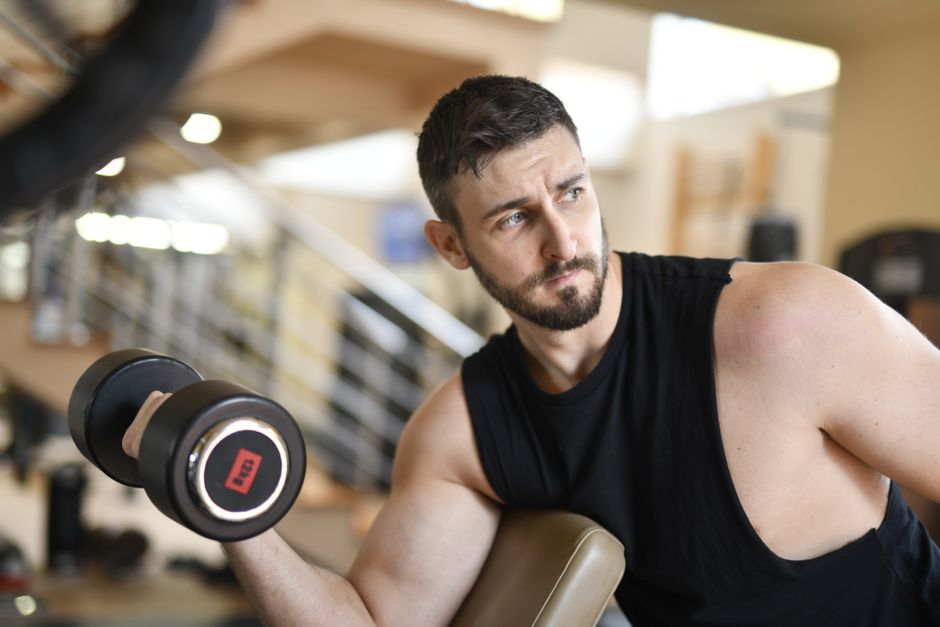
The bicep curl looks simple, but most people get it wrong. The goal is to move the weight using your biceps, not your momentum, shoulders, or back. To do a proper dumbbell bicep curl, stand tall with your feet shoulder-width apart, hold a dumbbell in each hand with your palms facing forward, and keep your elbows pinned to your sides. Curl the weights up toward your shoulders by bending your elbows, then lower them slowly back to the starting position. The entire movement should take about two seconds up and two seconds down, and your upper arms should not move at all.
What Are the Most Common Bicep Curl Mistakes?
The most common mistake is swinging the weights. People use their lower back and hips to “cheat” the weight up. This takes tension off the biceps and puts stress on the spine. If you have to lean back to lift the dumbbell, the weight is too heavy.
Another frequent error is letting the elbows drift forward. When your elbows move away from your body, the front of your shoulder takes over the work. Your biceps get less stimulation, and your shoulder joint takes unnecessary strain. Keep your elbows locked at your sides throughout the entire set.
A third mistake is dropping the weight too fast on the way down. Lowering the dumbbell quickly uses gravity instead of muscle. The lowering phase, called the eccentric phase, is where much of the muscle-building stimulus occurs. Control the descent for a full two seconds.
How To Do Bicep Curls With Dumbbells Proper Form
Start with your feet shoulder-width apart and your knees slightly bent. Hold a dumbbell in each hand with your arms hanging straight down. Your palms should face forward, and your elbows should be close to your ribs.
Exhale as you bend your elbows and lift the weights toward your shoulders. Keep your upper arms perfectly still. Only your forearms should move. Stop when the dumbbells reach shoulder height, then pause for a moment at the top.
Inhale as you slowly lower the weights back to the starting position. Do not let your arms fully lock out at the bottom if that causes strain, but do lower until your elbows are nearly straight. That full range of motion is what works the muscle through its entire length.
Choose a weight that lets you complete your target repetitions with good form. If you cannot keep your elbows still or you feel the work in your lower back, the weight is too heavy. Drop down to a lighter pair of dumbbells.
How Does Grip Position Change the Exercise?
The standard curl uses a palms-up grip. This position directly targets the biceps brachii, the main muscle on the front of your upper arm. It also works the brachialis, a deeper muscle that sits underneath the biceps.
A neutral grip, where your palms face each other like you are holding a hammer, shifts more of the work to the brachialis and the brachioradialis, a muscle in the forearm. This variation, called the hammer curl, is easier on the wrists and can help build overall arm thickness.
You can also rotate your palms during the movement. Start with your palms facing your body, then rotate them to face forward as you curl up. This is called a supinating curl. It allows the biceps to work from a stretched position, which some research suggests may improve muscle growth. No large trials have confirmed a major advantage, but it is a safe and common variation.



How Many Reps and Sets Should You Do?
For muscle growth, most people do well with 3 to 4 sets of 8 to 12 repetitions. The last few reps of each set should feel challenging but not impossible. You should be able to complete every rep with strict form.
Rest for 60 to 90 seconds between sets. This is enough time to recover without letting the muscle cool down completely.
Bicep curls are an isolation exercise. They work one joint and one muscle group. They should not be the foundation of your arm training. Compound exercises like pull-ups and rows work the biceps heavily while also training your back. Most balanced programs include both compound pulling movements and direct curl work.
Should You Do Bicep Curls Standing or Seated?
Standing curls are the standard version. They allow for a natural posture and make it easier to keep your shoulders back. The main risk is using your body to swing the weight.
Seated curls remove most of the momentum problem. When you sit on a bench, your hips and lower back are stabilized, making it harder to cheat. You can use an incline bench and let your arms hang behind your body for a deeper stretch at the bottom of the movement.
Neither version is clearly superior. The best choice is the one that lets you maintain strict form. If you tend to swing, sit down. If you have no trouble keeping your body still, standing is perfectly fine.
What About Curling With an EZ Bar or Barbell?
Dumbbells allow each arm to work independently. This helps correct muscle imbalances where one arm is stronger than the other. Dumbbells also allow a fuller range of motion because your wrists can rotate naturally.
An EZ bar has a curved grip that places your wrists at a slight angle. Many people find this more comfortable than a straight barbell, especially at heavier weights. A straight barbell forces your wrists into a fixed palms-up position, which can be uncomfortable for people with wrist issues.
All three tools can build muscle effectively. The dumbbell version is the most versatile and the easiest to learn correctly. If you have wrist pain, an EZ bar or neutral-grip dumbbell curls may be more comfortable.
How Fast Should You Lower the Weight?
Control the lowering phase. A two-second descent is a good standard for most people. Lowering slower, such as three to four seconds, increases time under tension but requires a lighter weight.
Dropping the weight quickly is the most common form breakdown. It feels like you are getting more work done, but you are actually letting gravity do the work. The muscle is only active when it is controlling the weight, not when the weight is falling freely.
If you cannot slow down the lowering phase, the weight is too heavy. Reduce the load until you can control the entire movement. This is not a sign of weakness. It is the definition of proper form.
Can Bicep Curls Cause Injury?
Bicep curls are generally safe when performed with proper form and a reasonable weight. The most common injuries are strains to the biceps tendon and irritation of the elbow joint.
Using too much weight and swinging puts excessive stress on the tendons at the elbow and shoulder. This can lead to tendinitis over time. Pain on the inside of the elbow, often called golfer’s elbow, is one of the more common curl-related complaints.
If you feel sharp pain during a curl, stop immediately. Mild muscle fatigue is normal. Sharp pain is not. Give the area time to recover before attempting the exercise again.
Frequently Asked Questions
How heavy should my dumbbells be for bicep curls?
Choose a weight that lets you complete 8 to 12 reps with strict form and a controlled two-second lowering phase. If you cannot keep your elbows still, the weight is too heavy.
Should I do bicep curls every day?
No. Your biceps need time to recover and grow. Training them two to three times per week with at least 48 hours between sessions is sufficient for most people.
Why don’t I feel my biceps working during curls?
You are likely using momentum or recruiting your shoulders and back to lift the weight. Slow down, lighten the load, and focus on keeping your upper arms completely still.
Is it better to curl with both arms at the same time or one at a time?
Both work well. Alternating arms lets you focus on each side individually and can help identify strength imbalances. Curling both at once is more time-efficient.
