
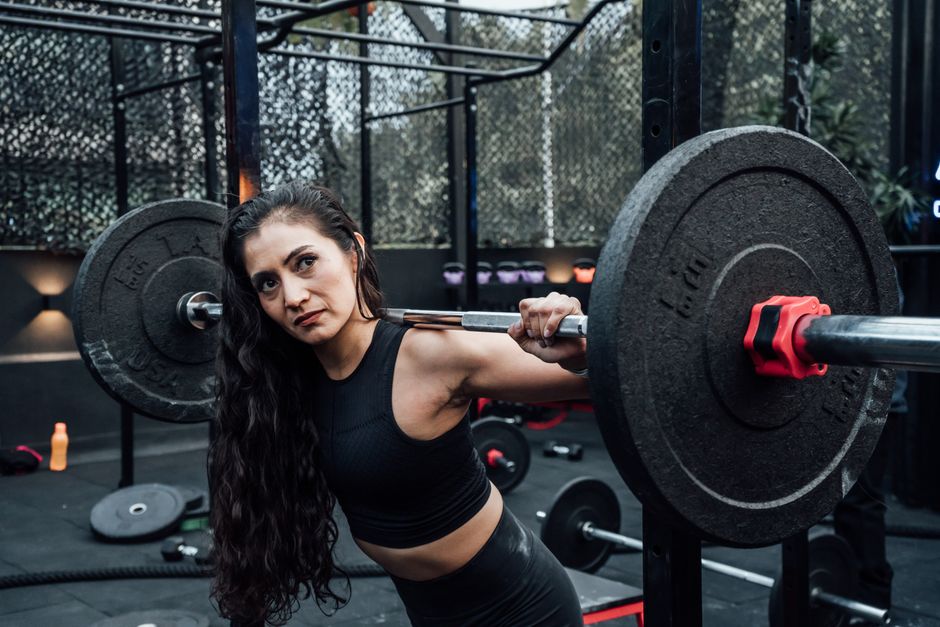
A back squat done with proper barbell form means the bar rests across your upper back, not your neck, and you sit down and back until your hip crease drops below the top of your knee. Your spine stays braced and neutral, your knees track in line with your toes, and your whole foot stays planted on the floor. Done this way, the squat spreads load across your hips, knees, and ankles instead of dumping it into your lower back.
The back squat is one of the most studied strength movements in the world, and the mechanics are well understood. What trips most people up is not effort. It is setup, depth, and bracing. Get those three right and the rest tends to follow.
How To Do Back Squats With Proper Barbell Form Step By Step
Set the bar in a rack at roughly mid-chest height. Step under it so it sits across the meaty shelf of your upper back, not on the bony point of your neck. Squeeze your shoulder blades together, grip the bar, and lift your chest. Stand up with the bar, take two or three steps back, and set your feet about shoulder-width apart with toes turned slightly out.
Before you descend, take a breath into your belly and brace as if bracing for a light punch. This creates pressure inside your trunk that helps protect your spine. Then break at the hips and knees together, sit down and back, and keep the bar path roughly over the middle of your foot.
Descend under control until your hip crease drops just below the top of your knee. Then drive up through your whole foot, keeping your chest proud and your knees tracking over your toes. Exhale near the top, reset, and repeat.
A few checkpoints worth watching:
- The bar stays over the middle of the foot for the whole rep.
- Your heels, big toes, and little toes all stay in contact with the floor.
- Your knees travel forward and out, but do not cave inward.
- Your spine stays neutral — no rounding or over-arching under load.
If any of those break down, the weight is probably too heavy for the rep. That is not a failure. It is information.
Where Should The Barbell Sit On Your Back?
There are two common bar positions, and both are legitimate. The high-bar squat places the bar across the top of your traps, just below the base of your neck. The low-bar squat places it a few inches lower, across the rear deltoids and the shelf of muscle at the back of your shoulders.
Neither position is on your neck bones. If you feel the bar pressing on your cervical spine, it is too high. Move it down onto muscle.
The high-bar position tends to keep your torso more upright. The low-bar position usually asks for more forward lean of the torso. Some lifters find one position more comfortable on their shoulders or lower back. There is no single correct answer here — the right position is the one you can hold securely without pain.
How Deep Should You Squat?
For most healthy lifters, squatting until the hip crease drops below the top of the knee is a reasonable and well-established target. This is the depth used in competitive powerlifting, and it is the depth most commonly studied in research on squat mechanics.
The reason depth matters is that it changes how the work is shared. Shallower squats load the knee joint more and the hips less. Deeper squats bring the hips and glutes into the movement more. This is normal joint mechanics, not a warning.
That said, individual anatomy sets real limits. Hip socket shape, femur length, and ankle mobility all affect how deep you can go before your pelvis tucks under, a motion called a posterior pelvic tilt. When that happens under load, the lower back rounds. If you cannot reach full depth without losing a neutral spine, squat to the depth you can control and work on mobility separately.
The evidence on deep squatting and knee health is more reassuring than the gym rumor mill suggests. Research on recreational and competitive lifters has not shown that deep squats damage healthy knees when performed with reasonable technique and progressive loading. People with existing knee conditions should get individualized guidance rather than assuming the standard applies to them.




What Is The Valsalva Maneuver And Should You Use It?
The Valsalva maneuver is a hard breath held against a closed throat while you brace your trunk. It is what happens when you strain to lift something heavy. In a squat, it is the technique that creates the internal pressure supporting your spine.
It is widely used in strength training and taught in most serious coaching programs. It is also not appropriate for everyone. The maneuver raises blood pressure sharply and briefly during the hold. People with uncontrolled high blood pressure, certain heart conditions, or a history of stroke should talk to a doctor before using it. For those individuals, a lighter load with a gentler brace may be the safer route.
For healthy lifters, the standard practice is to inhale before the descent, hold through the hardest part of the rep, and exhale as you finish. Do not hold your breath for a whole set. Breathe between reps.
Common Back Squat Mistakes And How To Fix Them
Most form problems trace back to one of a few root causes. Here are the ones that show up most often.
Knees caving inward. This usually means the weight is too heavy or the glutes are not engaging. Cue yourself to push your knees out over your toes as you stand. If it keeps happening, drop the load.
Heels lifting off the floor. This often points to limited ankle mobility. Elevating your heels slightly on a small wedge or weight plate can help while you work on ankle flexibility. Some lifters find squat shoes with a raised heel useful for the same reason.
Rounding the lower back at the bottom. This is the pelvic tuck mentioned earlier. Cut your depth to where you can hold a neutral spine, then build mobility over time.
The bar drifting forward. This usually means you are leading with your chest instead of driving through your whole foot. Think about pushing the floor away rather than lifting the bar.
Bouncing out of the bottom. A controlled descent and a brief pause at the bottom build more strength and control than a fast rebound. Save the bounce for when you are advanced and coached.
How Should You Set Up A Back Squat Program?
Progressive overload is the principle that drives strength gains: gradually increase the demand on your muscles over time. That can mean adding weight, adding reps, or adding sets. The exact scheme matters less than the direction of travel.
For someone new to barbell squats, the priority is technique before load. Spend several sessions with an empty bar or light weight, drilling the movement pattern until it feels automatic. Then add weight in small increments.
Recovery matters as much as the work. Muscles adapt during rest, not during the set. Most strength programs schedule squat sessions two to three times per week, with at least one day between heavy sessions. That is a common structure, not a rule written in stone. Individual recovery varies widely with age, sleep, nutrition, and training history.
If you are new to lifting, or if you have a history of back, hip, or knee problems, working with a qualified coach for a few sessions is worth the investment. A coach can see things you cannot feel, and form faults caught early are much easier to fix than ones grooved in over months.
Is The Back Squat Safe?
For healthy adults using reasonable technique and progressive loading, the back squat has a strong safety record in the research literature. Injuries in strength training tend to come from sudden load increases, poor technique under fatigue, or pre-existing conditions — not from the movement itself.
That does not mean it is risk-free for everyone. People with certain spinal conditions, hip impingement, or significant knee arthritis may need modifications or alternatives. This is a conversation to have with a physician or physical therapist who knows your history, not something to self-diagnose from an article.
One clarification worth making: the idea that squats are bad for your knees because they bend them deeply is not supported by the evidence in healthy populations. Knees are built to bend. The load and the control are what matter.
Frequently Asked Questions
How do I know if my squat depth is correct?
Your hip crease should drop just below the top of your knee at the bottom of the rep. If your lower back rounds before you get there, stop at the depth you can hold with a neutral spine.
Should the bar rest on my neck during a back squat?
No. The bar should sit on the muscle of your upper back or rear shoulders, never on the bony point of your neck. If you feel pressure on your cervical spine, the bar is too high.
Is it bad for your knees to squat below parallel?
Research on healthy lifters has not shown that deep squats damage knees when performed with good technique and progressive loading. People with existing knee conditions should get individualized advice from a clinician.
How often should I back squat each week?
Many strength programs schedule squats two to three times per week with at least one recovery day between heavy sessions. That is a common structure, not a fixed rule, and recovery needs vary by person.
