
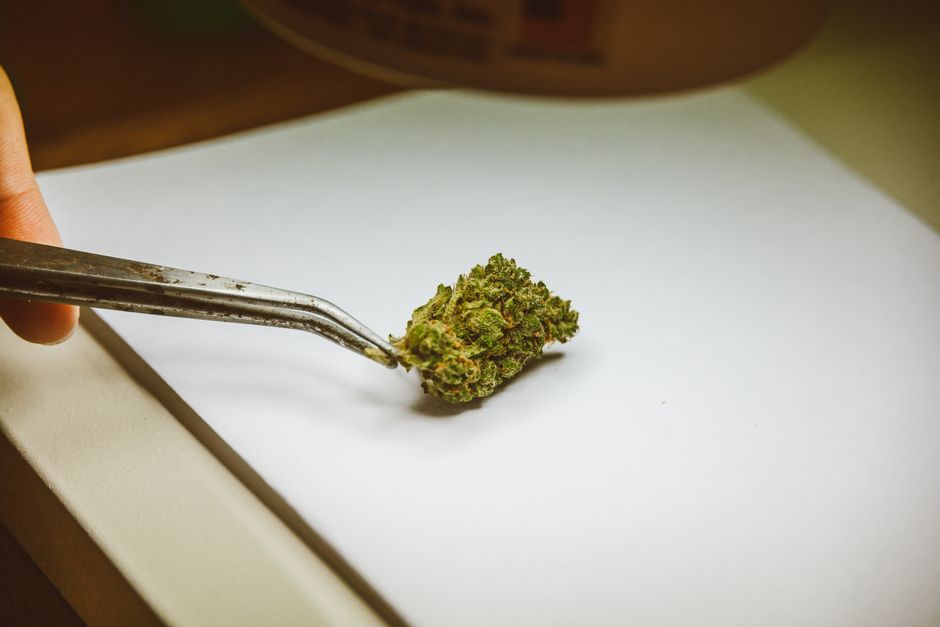
Decarboxylation is the chemical step that turns the main cannabinoid acids in raw cannabis into their active forms. THCA becomes THC, and CBDA becomes CBD, when heat removes a carboxyl group from the molecule. For THC, that process becomes practical somewhere between 220°F and 245°F (105°C to 120°C), held for roughly 30 to 60 minutes, though the exact time depends on your oven, your starting material, and how much degradation you are willing to accept.
What Actually Happens During Decarboxylation?
Raw cannabis does not contain much THC. It contains THCA, a larger molecule with an extra carboxyl group (COOH) attached. That group keeps THCA from binding well to CB1 receptors in the brain, which is why eating raw bud does not get you high. Heat breaks the bond holding that group in place, releasing carbon dioxide and leaving behind THC.
The same logic applies to CBDA and CBD. And it applies to several other minor cannabinoid acids, each with its own conversion behavior.
Two things happen at once when you apply heat. Decarboxylation converts THCA into THC. Past a certain point, oxidation and evaporation start converting THC into CBN and driving volatile compounds off the material. This is why decarboxylation is a balance, not a simple on-off switch. Under-heat and you leave THCA unconverted. Over-heat and you lose THC to degradation while the material turns brown and the terpenes largely disappear.
A detail worth knowing: decarboxylation does not require a perfectly precise temperature. It is a rate process. Lower temperatures convert more slowly; higher temperatures convert faster but push you closer to the degradation threshold. Time and temperature trade off against each other.
What Temperature Should You Decarboxylate At?
The commonly cited target range for THC is 220°F to 245°F (105°C to 120°C). This range is not a formal clinical guideline — no regulatory body publishes decarboxylation protocols — but it reflects the temperatures most often used in published analytical work and in laboratory practice for preparing cannabis samples.
Below about 200°F, conversion is slow and may be incomplete within a reasonable timeframe. Above roughly 300°F, THC begins converting to CBN at a meaningful rate, and terpenes — many of which boil off between 300°F and 400°F — are largely lost.
Here is the non-obvious part: the temperature you set on your oven dial is not the temperature your material reaches. Most home ovens cycle above and below the set point, often by 25°F or more. An oven thermometer placed inside the chamber is the only reliable way to know what is actually happening. This single step does more for consistency than any other adjustment.
How Long Does Decarboxylation Take?
At 240°F, a commonly used reference point, most protocols call for 30 to 60 minutes. Shorter times at that temperature tend to leave more THCA unconverted. Longer times push more THC toward CBN.
Conversion is not linear. It follows a curve — relatively fast at first, then flattening out as the remaining THCA becomes harder to convert. This means the difference between 40 minutes and 60 minutes is often smaller than the difference between 20 minutes and 40 minutes.
Several factors shift the curve:
- Moisture content. Damp material decarboxylates more slowly because water has to evaporate before the material reaches target temperature.
- Particle size. Ground or broken-up material heats more evenly than whole buds. Whole buds can have cooler interiors.
- Material density. A thick layer on a baking sheet heats unevenly. A thin, spread-out layer is more consistent.
- Starting THCA content. High-THCA material has more to convert and may benefit from the longer end of the range.



What Methods Work for Decarboxylation?
Several methods are used, and they differ mainly in how evenly and how controllably they apply heat.
Oven
The most common method. Spread material thinly on a baking sheet lined with parchment. Cover loosely with foil to reduce terpene loss, though this also traps moisture. Expect oven cycling, and verify with a separate thermometer. This is the method most home users rely on, and it works — but it is also the least precise.
Sous vide
Sealed cannabis in a vacuum bag, held in a water bath at a precise temperature. Water baths hold temperature far more tightly than ovens, so results are more repeatable. The tradeoff is longer times, since the temperature is typically lower. Some people report better terpene retention with this approach. The evidence here is mostly anecdotal rather than from controlled comparisons.
Slow cooker or oil infusion
Decarboxylation happens during infusion into butter or oil, but it is less controlled. Oil heats unevenly, and the temperature is harder to monitor. Many people decarboxylate first in an oven, then infuse — a two-step approach that gives more predictable results than trying to do both at once.
Microwave and open flame
Neither is recommended. Microwaves heat unevenly and can scorch material before the interior reaches temperature. Open flame chars the outside long before the inside converts. There is no reliable way to control either process.
Does Decarboxylation Work the Same for CBD?
CBDA converts to CBD under similar conditions, but the practical protocol differs. CBD is often decarboxylated at somewhat higher temperatures and for longer times than THC, because CBDA conversion tends to be slower and because CBD users are typically less concerned about preserving THC content.
Some commonly cited ranges for CBD fall between 240°F and 280°F, with times extending past an hour. These are not standardized. A significant complication is that most cannabis material contains both THCA and CBDA, so you cannot fully separate the two processes. Decarboxylating for maximum CBD also converts the THCA present.
If you are working with hemp that is legally required to contain very low THC, the small amount of THC produced during decarboxylation is usually well below the legal threshold — but it is not zero. This matters for anyone subject to drug testing.
How Do You Know When It Is Done?
Visual and aromatic cues are the most practical indicators available to a home user. Properly decarboxylated material typically looks slightly darker and drier than the starting product, and it smells distinctly different — more toasted, less grassy and raw. The green, vegetal aroma of raw cannabis fades as terpenes volatilize.
These cues are imprecise. There is no reliable home test that tells you the exact conversion percentage. Laboratory analysis is the only way to know the actual THC and THCA content of your finished material, and most home users do not have access to it.
What you can do is control the variables you can control: verify oven temperature, use consistent times, keep the material in a thin even layer, and record what you did. Consistency across batches matters more than hitting a theoretical ideal.
What Are the Risks and Limitations?
The main risk is simply that decarboxylation is easy to do poorly. Too little heat leaves you with mostly inactive THCA. Too much heat degrades THC into CBN and destroys most of the terpenes that give cannabis its characteristic smell and much of its subjective character.
There is also a safety consideration that gets less attention than it deserves. Decarboxylation produces volatile organic compounds, and heating cannabis indoors — particularly in an oven — releases compounds into the air. Ventilation matters. The long-term health effects of repeatedly inhaling these vapors in a home kitchen have not been well studied.
Finally, potency is not something decarboxylation guarantees. The THC content of your finished material depends on the THCA content of your starting material, the completeness of conversion, and losses along the way. There is no standard conversion factor that applies across all cannabis, and any calculator that claims one should be treated as an estimate, not a measurement.
Frequently Asked Questions
What temperature decarboxylates weed best?
220°F to 245°F (105°C to 120°C) is the range most commonly used for THC conversion. Higher temperatures convert faster but increase the risk of THC degrading into CBN and of losing terpenes.
How long should I decarb weed in the oven?
At 240°F, most protocols call for 30 to 60 minutes. Actual time depends on your oven’s accuracy, the moisture content of your material, and how finely it is broken up.
Can you decarb weed at too high a temperature?
Yes. Above roughly 300°F, THC begins converting to CBN at a meaningful rate, and many terpenes boil off between 300°F and 400°F. The result is weaker, less aromatic material.
Does decarboxylation work the same for CBD as for THC?
No. CBDA conversion tends to be slower, and CBD protocols often use somewhat higher temperatures and longer times. Because most cannabis contains both THCA and CBDA, you cannot fully separate the two processes.
