
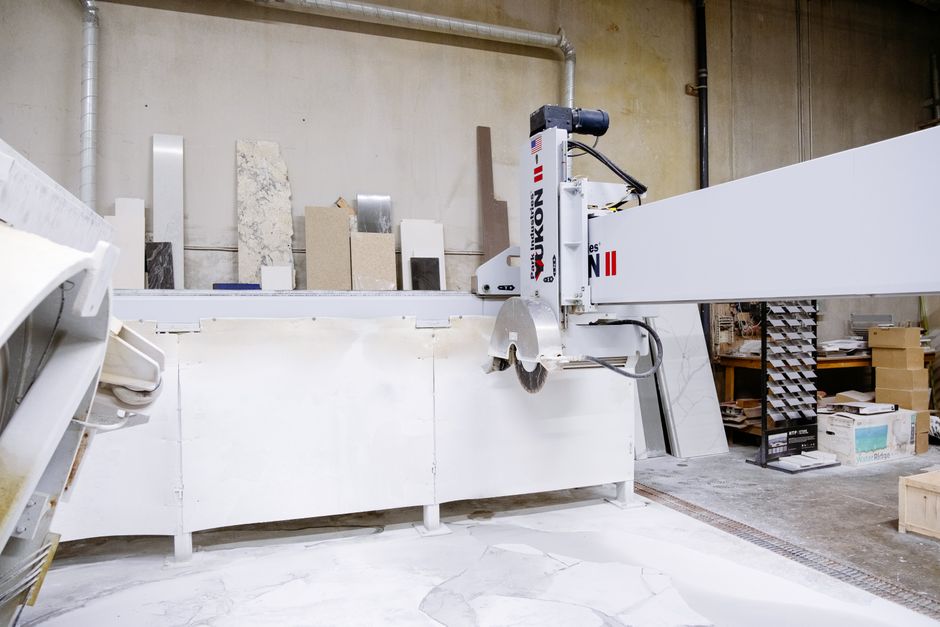
Cutting engineered stone — the quartz-based slabs used for countertops — should always be done wet whenever possible. Wet cutting uses water to suppress the silica dust that makes this material dangerous to cut. Dry cutting releases that dust into the air, where it can be inhaled deep into the lungs. The difference is not about convenience. It is about whether you are creating a serious lung hazard in your workspace.
Engineered stone contains far more crystalline silica than natural granite or marble. In many products it makes up the large majority of the material by weight. When a blade or grinder hits it, the silica fractures into particles small enough to reach the deepest parts of the lungs. Water keeps those particles out of the air in the first place. That is the whole reason wet cutting exists.
What Makes Engineered Stone Different From Natural Stone?
Engineered stone is not quarried. It is manufactured by mixing crushed quartz with resins, pigments, and binders, then pressing and curing the mixture into slabs. The result looks like stone but contains a much higher concentration of crystalline silica than most natural stone products.
That difference matters because silica is the hazard. Granite contains silica too, typically in the range of 20 to 45 percent depending on the variety. Engineered quartz products often contain 90 percent or more. Cutting a material with double or triple the silica content produces correspondingly more respirable dust when you cut it dry.
Respirable crystalline silica is the specific concern. These are particles small enough — generally under 10 microns — to bypass the body’s upper airway defenses and settle in the alveoli, the tiny air sacs where gas exchange happens. The lungs cannot easily clear them. Over years of exposure, the resulting inflammation and scarring can lead to silicosis, a progressive and irreversible lung disease.
The risk is not theoretical. Clusters of silicosis have been documented among workers who fabricate engineered stone countertops, including relatively young workers with fewer than ten years in the trade. Public health agencies in several countries have responded with new regulations specifically targeting engineered stone fabrication.
How Does Wet Cutting Control Silica Dust?
Wet cutting delivers a continuous stream of water directly to the point where the blade meets the stone. The water does two things at once: it cools the blade and it captures dust at the source before particles become airborne.
The mechanism is straightforward. Dust particles bind to water droplets and become too heavy to float. Instead of drifting into the breathing zone, they settle into a slurry that can be collected and disposed of properly. When the system works correctly, the visible dust plume is largely eliminated.
For wet cutting to actually protect you, the water has to reach the cut. Tools designed for wet cutting — bridge saws, wet tile saws, and wet-cutting grinders with water feed attachments — are built to do this. Adding a splash of water to a dry-cutting tool does not accomplish the same thing.
Water volume matters. A trickle is not enough. The water needs to flow steadily and hit the blade contact point consistently throughout the cut. If you can see dust rising while you cut, the water is not doing its job.
What Happens When You Cut Engineered Stone Dry?
Dry cutting sends respirable silica directly into the air around the tool. The dust is fine enough to stay suspended for a long time and can travel well beyond the immediate work area.
The particles you cannot see are the ones that cause harm. Visible dust is a warning sign, but the most dangerous fraction — the respirable fraction — is often invisible. A workspace can look relatively clean while airborne silica levels remain high.
Dry cutting is sometimes done because it is faster, requires less setup, or avoids the mess of water and slurry. Those are real tradeoffs. But they do not change what the dust does once it is in the air. Standard dust masks and basic shop ventilation are not adequate protection against respirable silica in a confined space.
This is why dry cutting of engineered stone is restricted or banned in a growing number of jurisdictions, and why occupational safety agencies treat it as a serious hazard rather than a minor inconvenience.





Wet Cutting vs Dry Cutting: A Direct Comparison
| Factor | Wet Cutting | Dry Cutting |
|---|---|---|
| Silica dust released | Largely suppressed at the source | Released into the air |
| Primary protection | Water captures dust before it floats | Requires engineered dust extraction |
| Slurry waste | Produces wet slurry that needs cleanup | Produces dry dust that settles everywhere |
| Typical equipment | Wet saws, water-fed grinders | Dry saws, angle grinders |
| Respiratory risk when done without controls | Low if water flow is adequate | High |
The table makes the tradeoff clear. Wet cutting creates a cleanup problem. Dry cutting without proper controls creates a health problem. Those are not equivalent costs.
Can Dry Cutting Ever Be Done Safely?
Dry cutting can be performed with reduced risk if it is paired with engineering controls that capture dust at the point of generation. The key word is engineering controls, not personal protective equipment alone.
On-tool dust extraction systems attach directly to the grinder or saw and pull dust into a HEPA-filtered vacuum as it is created. When these systems are working correctly and the filter is maintained, they can substantially reduce airborne silica. This approach is used in some settings where water is not practical.
But the margin for error is smaller than with wet cutting. A clogged filter, a loose hose, or a vacuum that is not rated for silica can let dust escape. The system has to be checked and maintained, not just purchased.
Respirators add a layer of protection but should be treated as the last line of defense, not the primary control. If a respirator is used, it needs to be fit-tested and matched to the hazard. A poorly fitting mask provides little protection against particles this small.
Some clinicians and safety professionals recommend that anyone cutting engineered stone regularly should have their exposure assessed rather than relying on assumptions about whether their setup is adequate. That is a reasonable position, though it reflects professional judgment rather than a single standardized protocol.
What Safety Measures Matter Most?
The hierarchy of controls is the framework that occupational health professionals use, and it applies directly here. The most effective measures remove the hazard at the source. Less effective measures rely on the worker to avoid it.
In order of effectiveness:
- Elimination or substitution: Use a lower-silica material when the design allows it. This removes the hazard entirely.
- Engineering controls: Wet cutting or on-tool dust extraction with HEPA filtration. These reduce dust at the source.
- Administrative controls: Limit time spent cutting, work in well-ventilated areas, and keep the cutting zone separate from other workers.
- Personal protective equipment: Fit-tested respirators, eye protection, and hearing protection. These protect the individual but do not reduce the dust in the air.
Wet cutting sits near the top of this list because it addresses the hazard before it becomes airborne. That is why it is the preferred method for engineered stone whenever the work allows it.
One detail people often overlook: the slurry produced by wet cutting still contains silica. Once it dries, that dust can become airborne again. Slurry should be cleaned up while it is still wet and disposed of according to local regulations, not left to dry on the floor.
Does the Type of Blade or Tool Change the Risk?
Blade choice affects how much dust is generated and how much heat builds up, but it does not change the fundamental hazard. A sharper, correctly matched blade cuts more efficiently and produces less dust overall, whether you are cutting wet or dry.
For wet cutting, the tool must be designed to handle water. Standard angle grinders are not built for continuous water exposure and can create electrical hazards if used that way. Water-fed tools are engineered with the appropriate seals, guards, and electrical protection.
For dry cutting with dust extraction, the shroud and vacuum connection need to fit the tool properly. A loose or mismatched shroud lets dust escape around the edges. The system works as a unit, not as separate parts.
Diamond blades are standard for engineered stone because the material is hard and abrasive. Using the wrong blade can overheat the stone, damage the edge, and increase dust production. Matching the blade to the material is basic practice, not an optional refinement.
Why Does This Matter for Homeowners Too?
This is not only a workplace issue. Homeowners who cut engineered stone for a DIY countertop project can create the same hazard in their garage or driveway.
A single dry cut with an angle grinder can release a significant amount of respirable silica into the air. In an enclosed space like a garage, those particles linger. In an open driveway, they disperse but still pose a risk to the person doing the cutting.
If you are cutting engineered stone at home, wet cutting with a proper wet saw is the safer approach. If you must cut dry, use a tool with dust extraction and wear a fit-tested respirator. Work outdoors when possible, and keep others — especially children — away from the cutting area.
Many fabrication shops will make cuts for customers precisely because the hazard is difficult to manage without proper equipment. Having the supplier make the cuts is often the simplest way to avoid the problem entirely.
Frequently Asked Questions
Is wet cutting required for engineered stone?
Wet cutting is the preferred method and is required in many workplaces under occupational safety rules, though specific requirements vary by jurisdiction. It suppresses silica dust at the source more effectively than dry cutting without controls.
Can I cut engineered stone dry with a regular mask?
A standard dust mask does not provide adequate protection against respirable crystalline silica. Dry cutting requires engineering controls such as on-tool dust extraction, and any respirator used should be fit-tested for the hazard.
Why is engineered stone more dangerous to cut than granite?
Engineered stone typically contains a much higher percentage of crystalline silica than natural granite, so cutting it produces more respirable dust. The higher the silica content, the greater the exposure risk when dust is not controlled.
What should I do with the slurry from wet cutting?
Clean it up while it is still wet, because dried slurry can release silica dust back into the air. Dispose of it according to local regulations rather than letting it dry in place.
