
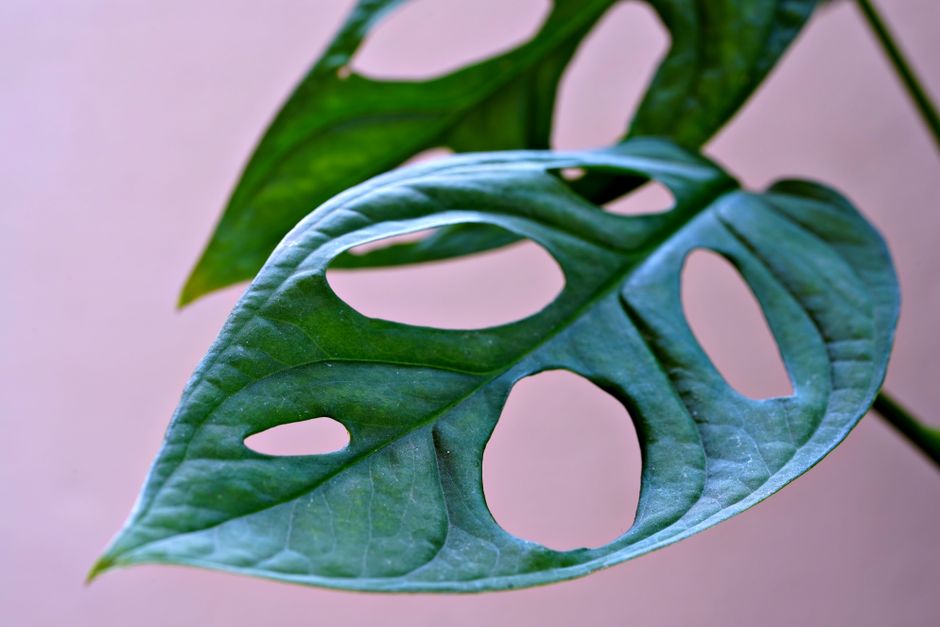
Monstera adansonii is a tropical climbing vine from Central and South America, known for its oval leaves that develop natural holes as they mature. Caring for one means giving it bright indirect light, watering when the top inch or two of soil dries out, keeping humidity moderate to high, and providing a moss pole or trellis to climb. “Archipelago” is a trade name you may see on plant labels, not a separately documented botanical variety, so the care that keeps Monstera adansonii healthy applies to plants sold under that name.
What Is Monstera Adansonii, and What Does “Archipelago” Mean?
Monstera adansonii is a species in the arum family, Araceae. It grows as a hemiepiphyte in the wild, meaning it starts life on the ground or on another plant and then climbs. Its leaves are heart-shaped to oval with distinctive oval holes, called fenestrations, that form as the leaf expands.
The name “Archipelago” appears on some nursery labels and in online plant listings. It is best understood as a cultivar or trade designation rather than a formally recognized botanical variety. Plant taxonomy for Monstera is genuinely unsettled. Botanists have described several closely related forms — including narrow-leaf and wide-leaf types — and what one seller calls a separate variety, another may treat as the same species. If you bought a plant labeled “Archipelago,” you have a Monstera adansonii. Treat it as one.
One clarification worth knowing: fenestration, the holes in the leaves, is not a sign of disease or damage. It is normal development. Young leaves usually lack holes, and mature leaves on a climbing plant tend to have more.
What Kind of Light Does Monstera Adansonii Need?
Bright, indirect light is the target. In a home, that usually means a spot a few feet back from a window that gets good daylight but not hours of direct midday sun.
Direct sun through glass can scorch leaves, causing pale, bleached, or brown patches. Too little light produces a plant that grows slowly, keeps small leaves, and develops few or no fenestrations. The plant will survive in low light but will not thrive.
An east-facing window is often a good fit. A south- or west-facing window can work if the plant sits far enough back or behind a sheer curtain. If your home is dim, a full-spectrum grow light on a timer is a reasonable supplement. Keep the light source close enough to matter but not so close that it heats the leaves.
Watch the plant. Leaves that lean hard toward the window or grow with long gaps between them are telling you light is too low. Leaf edges that turn crisp and brown in bright spots are telling you it is too high.
How Often Should You Water Monstera Adansonii?
Water when the top one to two inches of soil feel dry to the touch. That is the most reliable rule. There is no fixed schedule, because watering needs depend on light, temperature, pot size, and soil mix.
Overwatering is the more common mistake. Monstera adansonii roots need oxygen, and soil that stays constantly wet can lead to root rot. Yellowing lower leaves, mushy stems, and a sour smell from the soil are warning signs.
Underwatering looks different. Leaves droop, curl, and the soil pulls away from the sides of the pot. The plant usually recovers quickly once watered.
A few practical points:
- Use a pot with drainage holes. This matters more than any watering trick.
- Water thoroughly until it runs out the bottom, then empty the saucer.
- Check the soil with your finger or a moisture meter rather than guessing by calendar.
- Water less in winter, when growth slows and soil dries more slowly.
If you are unsure, wait. A day or two of dryness is far less harmful to this plant than a week of wet feet.





What Soil and Pot Does It Need?
A chunky, well-draining mix is what this plant wants. Standard potting soil alone tends to hold too much water indoors. A common approach is to blend potting soil with materials that create air pockets, such as perlite, orchid bark, or coco coir.
The goal is a mix that holds some moisture but drains freely. If water pools on the surface and sits there, the mix is too dense.
Repot when roots circle the inside of the pot or grow out the drainage holes, which often happens every one to two years for a growing plant. Choose a pot only slightly larger than the current one. Moving a plant into a much bigger pot can leave excess wet soil around the roots and increase rot risk.
Do You Need a Moss Pole or Trellis?
Yes, if you want the plant to look its best. Monstera adansonii is a climber. In nature it ascends tree trunks, and its leaves get larger and more fenestrated as it climbs.
A moss pole, trellis, or even a simple stake gives the aerial roots something to grip. Plants that are allowed to trail from a hanging basket tend to produce smaller leaves with fewer holes, because the plant is not getting the vertical support it evolved to use.
To train it, guide the stem toward the pole and tie it loosely with soft plant ties. Mist the moss pole occasionally, or keep it damp, since aerial roots can take up moisture from it. Do not tie tightly — stems thicken as they grow and can be damaged by constriction.
What About Humidity and Temperature?
Monstera adansonii comes from humid tropical forests and does well in moderate to high humidity. Typical indoor air, especially in heated or air-conditioned rooms, is often drier than the plant prefers.
You do not need a greenhouse. A few options help:
- Group it with other plants to create a slightly more humid microclimate.
- Place it on a tray of pebbles with water, keeping the pot above the water line.
- Run a small room humidifier nearby.
Misting is popular but its benefit is short-lived, and wet leaves left too long can encourage fungal problems. It is not a substitute for real humidity.
Keep the plant away from cold drafts, heating vents, and air-conditioning blasts. This is a tropical species and does not tolerate cold well. Chilly air can cause leaf drop and stalled growth.
How Do You Prune and Propagate It?
Pruning keeps the plant full and controls its size. Cut just above a node, the small bump where a leaf and root meet. Regular trimming encourages branching and removes any yellowing or damaged leaves.
Propagation is straightforward and one of the easier parts of caring for this plant. Take a stem cutting with at least one node, then root it in water or directly in moist soil. Roots typically appear within a few weeks in water, though timing varies with temperature and light. Change the water every few days to keep it fresh.
Once roots are a couple of inches long, the cutting can be potted into the same chunky mix you use for the parent plant.
What Pests and Problems Should You Watch For?
Spider mites, mealybugs, and scale are the pests most often seen on indoor Monstera. Check the undersides of leaves and the joints where leaves meet stems. Small webbing, white cottony spots, or sticky residue are clues.
Treat pests by wiping leaves and applying an appropriate insecticide or insecticidal soap, following the product label. Repeat treatment as directed, because eggs and hidden pests can survive a single application.
Common problems and their usual causes:
- Yellow lower leaves: often overwatering.
- Crisp brown edges: often low humidity or inconsistent watering.
- No fenestrations: often too little light or a plant that is not climbing.
- Leggy growth with long gaps between leaves: often insufficient light.
One honest note: not every yellow leaf means disease. Older leaves naturally age and drop. Look at the pattern before assuming something is wrong.
Is Monstera Adansonii Toxic to Pets?
Yes. Monstera adansonii contains calcium oxalate crystals, which are irritating to the mouth and digestive tract. It is listed as toxic to cats and dogs by the American Society for the Prevention of Cruelty to Animals.
If a pet chews on it, symptoms can include drooling, pawing at the mouth, and vomiting. Contact your veterinarian or a pet poison helpline if you suspect your pet ate part of the plant. Keep it out of reach of pets and small children.
Frequently Asked Questions
How often should I water a Monstera adansonii Archipelago?
Water when the top one to two inches of soil feel dry, rather than on a fixed schedule. In most homes this works out to roughly once a week in summer and less often in winter.
Why does my Monstera adansonii have no holes in its leaves?
Young leaves normally lack holes, and mature leaves develop more when the plant gets bright light and something to climb. Low light and trailing growth usually mean fewer fenestrations.
Is Monstera adansonii Archipelago toxic to cats and dogs?
Yes, it contains calcium oxalate crystals and is listed as toxic to cats and dogs by the ASPCA. Chewing can cause drooling, mouth irritation, and vomiting, so keep it out of reach.
Does Monstera adansonii need a moss pole?
It is not strictly required, but the plant is a natural climber and produces larger, more fenestrated leaves when given a pole or trellis. Trailing plants tend to stay smaller and sparser.
