
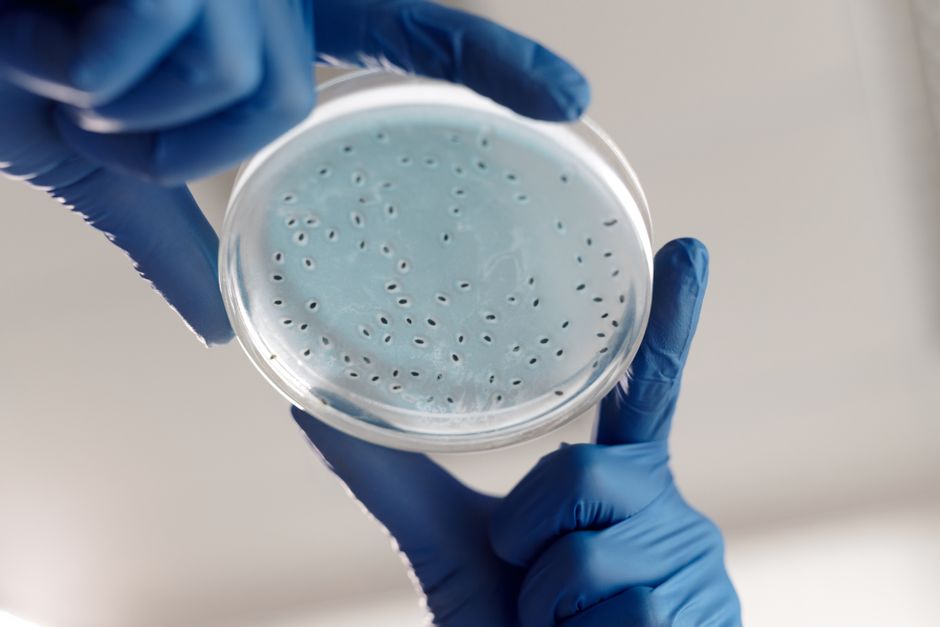
Bacterial growth follows a predictable pattern, and calculating it comes down to understanding how cells divide over time. The core formula is N = N₀ × 2^(t/g), where N is the final cell number, N₀ is the starting number, t is total time, and g is generation time. This simple exponential equation is the foundation for everything from food safety to medical research.
What Is the Basic Formula for Bacterial Growth?
Bacteria reproduce through binary fission, meaning one cell splits into two. This doubling is why growth is exponential, not linear. The formula N = N₀ × 2^(t/g) captures this perfectly.
Let’s break it down. N₀ is your starting bacterial count. If you begin with 100 cells, that is N₀. The generation time (g) is how long it takes for one cell to become two. For E. coli in ideal conditions, that is about 20 minutes. Total time (t) is the period you are measuring, usually in the same units as g.
Here is a quick example. If you start with 100 E. coli cells and let them grow for 2 hours (120 minutes) with a 20-minute generation time, the math is: N = 100 × 2^(120/20) = 100 × 2^6 = 100 × 64 = 6,400 cells. This calculation assumes unlimited resources and no death, which only happens in a lab setting.
How Do You Measure Generation Time Accurately?
Generation time is the most critical number in the formula, and getting it wrong throws off everything. The standard method is tracking optical density (OD) using a spectrophotometer. As bacteria multiply, the liquid culture gets cloudier, and the device measures this turbidity.
You take readings at regular intervals, usually every 15 to 30 minutes, and plot them on a graph with time on the x-axis and the log of cell count on the y-axis. The straight part of that curve is the exponential phase. The slope of that line directly gives you the generation time. The CDC uses this method for tracking foodborne pathogens.
There is a simpler method for rough estimates. Take a sample, count the cells under a microscope using a Petroff-Hausser chamber, wait a set time, and count again. The formula for generation time is then g = (t × log(2)) / log(N/N₀). This is less precise but works without expensive equipment.
What Are the Four Phases of Bacterial Growth?
Bacterial growth does not happen at a constant rate. It follows a predictable four-phase curve that every microbiology textbook covers. Understanding these phases is essential because the formula only applies during one of them.
| Phase | What Happens | Formula Applies? |
|---|---|---|
| Lag Phase | Cells adapt to environment. No division yet. Metabolic activity increases. | No |
| Log (Exponential) Phase | Cells divide at maximum rate. Growth is exponential. | Yes |
| Stationary Phase | Nutrients run low. Waste builds up. Death rate equals growth rate. | No |
| Death Phase | Cells die faster than they divide. Exponential decline. | No |
The exponential growth formula only works during the log phase. If you try to apply it during lag or stationary phases, your numbers will be meaningless. In food safety testing, researchers specifically measure growth during the log phase to determine how fast a pathogen can multiply in a given food product.





How Does Temperature Affect Bacterial Growth Calculations?
Temperature is the single biggest factor that changes generation time. Every bacterial species has a minimum, optimum, and maximum growth temperature. For Salmonella, the optimum is around 37°C (body temperature), and generation time can be as short as 20 minutes. At 10°C, generation time stretches to hours or even days.
Research published in the International Journal of Food Microbiology found that for Listeria monocytogenes, generation time at 4°C (refrigerator temperature) is about 24 hours. At 37°C, it drops to roughly 1 hour. This is why refrigeration is a primary food safety tool — it does not kill bacteria, but it slows their growth dramatically.
When calculating bacterial growth for real-world situations, you must adjust generation time based on temperature. There is no universal formula for this adjustment because each species responds differently. The USDA provides specific growth rate tables for common pathogens at various temperatures, which food safety professionals use instead of guessing.
What Are the Common Mistakes in Bacterial Growth Calculations?
The biggest mistake is using the exponential formula outside the log phase. Many people assume bacteria grow at a constant rate from start to finish, but they do not. The lag phase can last anywhere from a few minutes to several hours depending on the bacteria and the environment.
- Ignoring the lag phase: If you start counting during lag, your calculated generation time will be too long. Wait until you see consistent doubling before taking measurements.
- Assuming unlimited resources: The formula assumes nutrients are infinite and waste does not accumulate. In a closed system like a petri dish, this is only true for the first few hours.
- Mixing units: Generation time and total time must be in the same unit. Using minutes for one and hours for the other gives wrong results. Always convert before plugging numbers in.
- Using the wrong generation time: Generation time changes with temperature, pH, and nutrient availability. Using a textbook value for ideal conditions when your actual conditions differ will give you bad data.
A study in Applied and Environmental Microbiology showed that even experienced researchers sometimes misidentify the log phase when looking at growth curves. The safest approach is to plot your data and visually confirm the exponential portion before applying the formula.
How To Calculate Bacterial Growth in Real-World Applications
In food safety, the formula is used to predict how long it takes for a pathogen to reach dangerous levels. The USDA uses a model called the Pathogen Modeling Program, which incorporates generation time, temperature, pH, and water activity. You input your conditions, and it calculates growth over time.
For example, if you have cooked chicken left at room temperature (20°C) with a starting Staphylococcus aureus count of 100 cells per gram, and the generation time at that temperature is 30 minutes, after 4 hours you would have about 25,600 cells per gram. That is well above the 10,000 cells per gram threshold where toxin production becomes a concern.
In clinical settings, the formula helps determine antibiotic effectiveness. If a patient has a bacterial infection with a generation time of 1 hour and a starting load of 1,000 cells, and the antibiotic kills 99% of cells per dose, you can calculate how many doses are needed to eliminate the infection. This is why doctors stress completing the full course of antibiotics — stopping early leaves surviving cells that can regrow.
What Does Research Say About Accuracy of These Calculations?
The exponential growth formula is one of the most well-validated models in microbiology. It has been used since the 1940s and is taught in every introductory microbiology course. However, real-world accuracy depends entirely on how well you measure generation time and how closely your conditions match the assumptions.
Research from the Journal of Bacteriology found that even under ideal lab conditions, generation time can vary by up to 10% between replicate experiments. In natural environments like soil or the human gut, variation is much larger. Some studies suggest that generation time in the gut can vary by a factor of 2 or more depending on location and available nutrients.
Some people claim you can calculate bacterial growth in a wound or on a kitchen counter with high precision. This is not supported by evidence. The formula works well in controlled systems like broth cultures or food matrices with known properties. In complex, variable environments, it provides only a rough estimate.
Frequently Asked Questions
How do I find generation time if I only have two cell counts?
Use the formula g = (t × log(2)) / log(N/N₀) where t is the time between counts. This gives you an average generation time for that period.
Can I calculate bacterial growth without a spectrophotometer?
Yes, you can use a microscope and counting chamber for direct cell counts, or use serial dilution and plate counting. These methods are more labor-intensive but do not require expensive equipment.
Why does bacterial growth slow down after a few hours?
Nutrients become depleted and waste products accumulate. This shifts bacteria from the log phase into the stationary phase where growth rate equals death rate.
Does the formula work for bacteria that form biofilms?
No, biofilm growth is more complex and does not follow simple exponential models. Biofilms have heterogeneous growth rates and require specialized models.
