
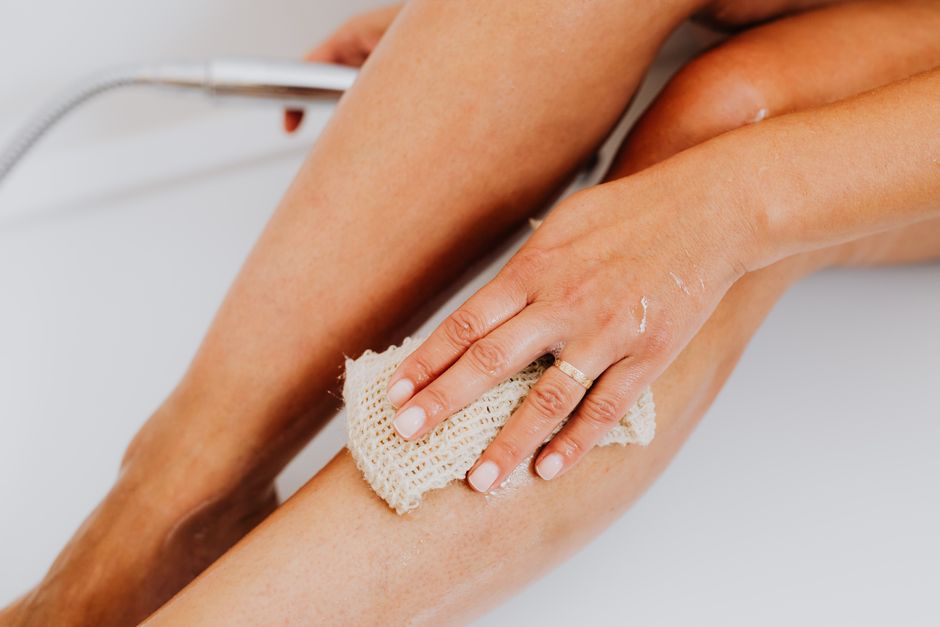
Most people do not need to exfoliate their body more than once or twice a week. For many, once a week is plenty. If you have sensitive skin, dry skin, or a skin condition like eczema or psoriasis, you may need to exfoliate less often or skip it entirely. The right frequency depends on your skin type, the method you use, and how your skin responds. More is not better here — over-exfoliating is a real problem and it is more common than under-exfoliating.
How Often Should You Exfoliate Your Body?
For most adults with healthy skin, once or twice a week is a reasonable range. That guidance holds whether you use a physical scrub, a washcloth, or a chemical exfoliant containing acids.
The skin on your body is thicker than the skin on your face. That is why body exfoliation can often be tolerated a bit more often than facial exfoliation. But thicker skin still has limits. Your outermost skin layer, the stratum corneum, is built from dead cells that stack like bricks and shed on their own in a cycle that takes roughly four weeks. Exfoliation speeds that process up. Push it too fast and you strip away cells that are still doing their job.
That job matters. The outer layer holds in water and blocks irritants, allergens, and microbes. When you remove it faster than the body can rebuild it, you get the opposite of what you wanted: dryness, tightness, redness, and sometimes more breakouts or flaking than before you started.
A simple test: if your skin feels smooth and comfortable after exfoliating, your frequency is probably fine. If it feels tight, stings, or looks red, you are doing it too often or too aggressively.
What Happens to Your Skin When You Exfoliate Too Much?
Over-exfoliation damages the skin barrier. That is the main risk, and it is well documented in dermatology.
The skin barrier is often described as a brick-and-mortar wall. Skin cells are the bricks, and lipids — fats like ceramides and cholesterol — are the mortar holding them together. Physical scrubs and chemical acids both disrupt this structure when used too often. The mortar breaks down faster than the body replaces it.
When the barrier is compromised, several things tend to follow:
- Water loss increases, so skin feels dry and tight even if you moisturize
- Irritants and allergens get in more easily, causing redness and itching
- Skin may become more sensitive to products that never bothered you before
- In some people, oil production and breakouts increase as the skin reacts to the disruption
- Small cracks can allow bacteria to enter, raising the risk of infection
There is a common misunderstanding worth correcting. Many people believe that if a little exfoliation smooths their skin, more will make it even smoother. The opposite tends to happen. Once the barrier is damaged, skin looks duller and rougher, not better. People then exfoliate more to fix it, which makes things worse. Breaking that cycle usually means stopping exfoliation for a while and letting the barrier rebuild.
Does Your Skin Type Change How Often You Should Exfoliate?
Yes. Skin type is one of the biggest factors in choosing a frequency.
Oily skin and skin prone to clogged pores on the body — the back, chest, and shoulders — often tolerate exfoliation twice a week. Dry skin usually does better with once a week or less, because dry skin already has a weaker barrier and less oil to protect it. Sensitive skin may do best with once every week or two, or with no exfoliation at all.
Combination skin is common on the body, where the back may be oilier than the legs. In that case, you can exfoliate different areas at different frequencies. There is no rule that says your whole body needs the same schedule.
Age matters too. As people get older, skin thins, oil production drops, and cell turnover slows. Skin that handled a scrub twice a week at 25 may not handle it the same way at 55. Adjusting frequency with age is reasonable, though the change is gradual and varies a lot between people.





Physical Scrubs vs. Chemical Exfoliants: Which Is Gentler?
Chemical exfoliants are generally gentler than physical scrubs when used correctly. That surprises many people because “chemical” sounds harsher. In practice, the opposite is often true.
Physical scrubs — salt, sugar, coffee grounds, walnut shells, and similar particles — work by friction. The problem is that you cannot fully control how much pressure you apply or how evenly the particles hit the skin. Rough-edged particles can cause tiny tears. This is sometimes called microtrauma. It is not usually visible, but it adds up with repeated use.
Chemical exfoliants dissolve the bonds between dead skin cells. The two main categories are alpha-hydroxy acids, such as glycolic and lactic acid, and beta-hydroxy acid, which is salicylic acid. Lactic acid tends to be gentler than glycolic because its molecules are larger and penetrate more slowly. Salicylic acid is oil-soluble, which is why it is often used on oily and acne-prone areas.
Neither type is risk-free. Chemical exfoliants can cause stinging, redness, and peeling, especially at higher concentrations or when layered with other active ingredients. The key point is that gentleness depends more on concentration, frequency, and your skin than on the category itself.
Should You Exfoliate Before or After Shaving?
Exfoliating before shaving tends to work better for most people. It removes dead cells and lifts hairs slightly, which can allow a closer shave with less pulling.
Exfoliating after shaving is more likely to irritate skin. Shaving already removes a thin layer of skin cells and can cause small nicks. Adding a scrub or acid on top of that increases the chance of stinging, redness, and razor bumps.
If you shave often, do not exfoliate on the same day every time. Giving skin a day or two between shaving and exfoliating reduces irritation. If you use a chemical exfoliant, apply it on a day you are not shaving that area.
When Should You Not Exfoliate at All?
Some situations call for skipping exfoliation entirely, at least for a while.
If you have an active skin condition such as eczema, psoriasis, or rosacea, exfoliation can worsen it. These conditions already involve a disrupted or inflamed skin barrier. Scrubbing or applying acids can trigger flares. Some clinicians recommend gentle chemical exfoliation for certain cases of these conditions, but that should come from a dermatologist, not a general rule.
Skip exfoliation if you have:
- Sunburned skin, which is already damaged and healing
- Open cuts, scrapes, or sores
- An active rash or infection
- Recently had a chemical peel, waxing, or laser treatment on that area
- Skin that is currently irritated, stinging, or peeling
If you are pregnant or breastfeeding, there is no single guideline that covers all exfoliation products. Physical scrubs are generally considered low risk. For chemical exfoliants, the picture is less clear. Some ingredients used in higher-strength products are not recommended during pregnancy, and it is worth checking with a clinician before using them. No clinical guidelines currently exist for exfoliation frequency in pregnant or breastfeeding women specifically.
Does Exfoliating Help With Body Acne or Keratosis Pilaris?
Exfoliation can help with some body skin concerns, but it is not a cure and it can backfire.
For body acne, salicylic acid is a common ingredient in over-the-counter washes and treatments. It works by helping clear pores and reduce the buildup that contributes to breakouts. That said, body acne has several causes, including hormones and bacteria, and exfoliation addresses only part of the picture. Aggressive scrubbing can irritate acne and make it look worse.
Keratosis pilaris is a common condition that causes small rough bumps, usually on the upper arms and thighs. It happens when keratin, a protein in skin, plugs hair follicles. Chemical exfoliants containing lactic acid or salicylic acid are often used to smooth the bumps. Results vary, and the condition tends to come back when you stop. No exfoliation method has been shown to eliminate it permanently.
For both conditions, gentle and consistent beats aggressive and frequent. If your skin is red and irritated, you are past the point of benefit.
How Do You Build a Routine That Does Not Damage Your Skin?
Start less often than you think you need, then adjust based on how your skin responds.
A reasonable approach for most people is to begin with once a week. Use a gentle product. Apply light pressure if using a scrub. Rinse with lukewarm water, not hot. Follow with a moisturizer within a few minutes, while skin is still slightly damp, to help hold in water.
If your skin handles once a week well for a few weeks, you can try twice a week. If it does not, stay at once a week or stretch it to every 10 days. There is no benefit to pushing past what your skin tolerates.
Moisturizing is not optional here. Exfoliation removes some of the lipids that keep water in. Replacing them with a moisturizer containing ceramides, glycerin, or hyaluronic acid supports the barrier while it recovers. Sun protection also matters, because freshly exfoliated skin is more vulnerable to ultraviolet damage. This is especially true after chemical exfoliants, which can increase sun sensitivity.
The bottom line is simple. Your skin renews itself on its own. Exfoliation is a nudge, not a requirement. Once or twice a week is enough for most people, and for many, less is better.
Frequently Asked Questions
How often should you exfoliate your body if you have sensitive skin?
Once every one to two weeks, or not at all, is often best for sensitive skin. Sensitive skin usually has a weaker barrier, so frequent exfoliation tends to cause irritation rather than improvement.
Can you exfoliate your body every day?
Daily body exfoliation is not recommended for most people. It can break down the skin barrier and lead to dryness, redness, and irritation over time.
Is it better to exfoliate in the shower or before?
Exfoliating in a warm shower works well because warm water and steam soften the skin. Keep the water lukewarm rather than hot, since hot water strips oils and can add to irritation.
What happens if you stop exfoliating your body?
Your skin will continue to shed dead cells on its own, roughly on a four-week cycle. Most people notice no harm from stopping, and some notice less dryness and irritation.
