
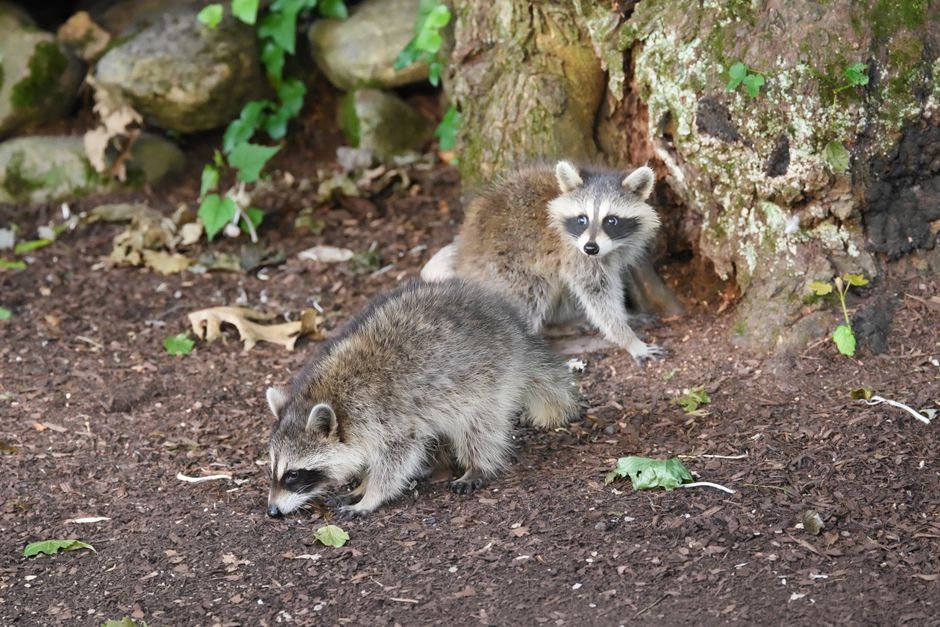
Baby raccoons nurse from their mother every 2 to 4 hours during their first few weeks of life. As they grow and start eating solid food, feeding frequency drops to about 3 to 4 times per day. By the time they are 12 to 16 weeks old, they are mostly weaned and forage independently like adult raccoons.
How Often Do Baby Raccoons Eat In The Wild During Their First Month?
Newborn raccoons are completely dependent on their mother’s milk. They are born blind, deaf, and nearly hairless. During the first 2 to 3 weeks, they nurse frequently — roughly every 2 to 4 hours around the clock.
The mother stays close to the den during this period. She leaves only briefly to find food and water for herself. Her milk is rich in fat and protein, which supports the rapid growth of her kits. A healthy baby raccoon can double its birth weight within the first few weeks.
Raccoon mothers typically give birth to 3 to 5 kits in the spring, usually between March and May in North America. The timing depends on latitude and local climate. Kits born earlier in the season have more time to grow before winter.
What Changes When Baby Raccoons Start Eating Solid Food?
Around 7 to 8 weeks of age, baby raccoons begin showing interest in solid food. The mother brings food to the den or takes the kits on short foraging trips. At this stage, nursing continues but becomes less frequent.
Weaning is gradual. The kits still nurse for comfort and nutrition, but they increasingly rely on solid food. By 10 to 12 weeks, most kits are eating a mix of mother’s milk and solid food. Their feeding schedule shifts to roughly 3 to 4 meals per day, mirroring adult patterns.
Raccoons are omnivores. In the wild, they eat fruits, nuts, insects, small vertebrates, eggs, and even carrion. Baby raccoons learn what to eat by watching their mother. This learning period is critical for their survival.
How Long Do Baby Raccoons Stay With Their Mother?
Baby raccoons stay with their mother for most of their first year. They typically remain together through the fall and often into the following spring. Some young females stay longer and may even den with their mother during their first winter.
Young males tend to disperse earlier than females. They usually leave the family group in late fall or early winter, when they are around 8 to 12 months old. Females may establish territories near their mother’s range.
This extended period of parental care is unusual among small mammals. It gives young raccoons time to learn foraging skills, recognize predators, and understand their environment. Raccoons are intelligent animals, and much of that intelligence develops through this prolonged learning period.





Do Baby Raccoons Eat The Same Foods As Adults?
Not immediately. Young kits start with soft, easily digestible foods. Their mother often pre-chews or partially digests food before giving it to them. This is common among many carnivores and omnivores.
As their teeth develop and their digestive systems mature, kits transition to adult foods. By 12 to 16 weeks, they eat essentially the same diet as adult raccoons in their area. The specific foods depend entirely on what is available in their habitat.
Raccoons are highly adaptable feeders. In urban and suburban areas, they may eat from garbage cans, pet food bowls, and gardens. In rural areas, they rely more on natural food sources. This adaptability is one reason raccoons thrive across North America.
How Much Do Baby Raccoons Eat Per Day?
During the nursing phase, a baby raccoon consumes about 10 to 15 percent of its body weight in milk daily. This is similar to many other mammalian infants. The exact amount varies with age, growth rate, and the mother’s milk production.
Once weaned, a young raccoon eats roughly 5 to 10 percent of its body weight in food per day. Adult raccoons eat about the same proportion. However, young raccoons may eat slightly more relative to their size because they are still growing.
Raccoons do not have a fixed feeding schedule. They are opportunistic feeders. In the wild, they eat when food is available. This means a baby raccoon might eat several small meals throughout the day and night, or one or two larger meals, depending on what the mother finds.
What Happens If A Baby Raccoon Is Orphaned?
An orphaned baby raccoon faces serious survival challenges. Raccoons are not born with the knowledge to find food or avoid predators. They learn these skills from their mother. Without her, survival rates drop significantly.
Very young kits — under 8 weeks — require bottle feeding every 3 to 4 hours if rescued. This is demanding care that most people are not prepared to provide. The formula must be specifically designed for raccoons or other wild mammals. Cow’s milk is not appropriate and can cause digestive problems.
If you find an orphaned baby raccoon, the best course of action is to contact a licensed wildlife rehabilitator. They have the training and resources to care for orphaned kits properly. In many areas, it is also illegal to keep wild raccoons as pets, even temporarily.
Do not attempt to raise a baby raccoon on your own. Beyond the legal issues, raccoons can carry diseases transmissible to humans, including rabies and raccoon roundworm. A rehabilitator can assess the animal’s health and provide appropriate care.
How Can You Tell A Baby Raccoon’s Age?
Age estimation is useful for wildlife rehabilitators and curious observers. A few physical markers help determine approximate age.
- Birth to 2 weeks: Eyes and ears closed. Skin is pink and nearly hairless. Weighs about 75 to 100 grams.
- 3 to 4 weeks: Eyes open. Fur starts growing in. Begins crawling.
- 5 to 6 weeks: Fur is full. Can walk. Starts exploring near the den.
- 7 to 8 weeks: Eating solid food. Teeth are coming in. More mobile and curious.
- 10 to 12 weeks: Nearly weaned. Foraging with mother. Looks like a smaller version of an adult.
These markers are general guidelines. Individual raccoons develop at slightly different rates depending on nutrition and health. A rehabilitator can provide a more precise estimate based on weight, tooth eruption, and behavior.
Frequently Asked Questions
How long can a baby raccoon go without eating?
A newborn baby raccoon should not go more than 4 to 6 hours without feeding. Older kits that are eating solid food can go longer, but regular meals are still important for healthy growth.
Do baby raccoons eat at night?
Yes. Raccoons are primarily nocturnal, and baby raccoons nurse and eat throughout the night. During the first few weeks, they feed every 2 to 4 hours regardless of time of day.
When do baby raccoons leave the den?
Baby raccoons start leaving the den with their mother at around 7 to 8 weeks of age. Before that, they stay inside the den while the mother forages nearby.
Can baby raccoons survive without their mother?
Kits under 8 weeks old have very low survival rates without their mother. Older kits have a better chance but still face significant challenges learning to forage and avoid predators on their own.
