
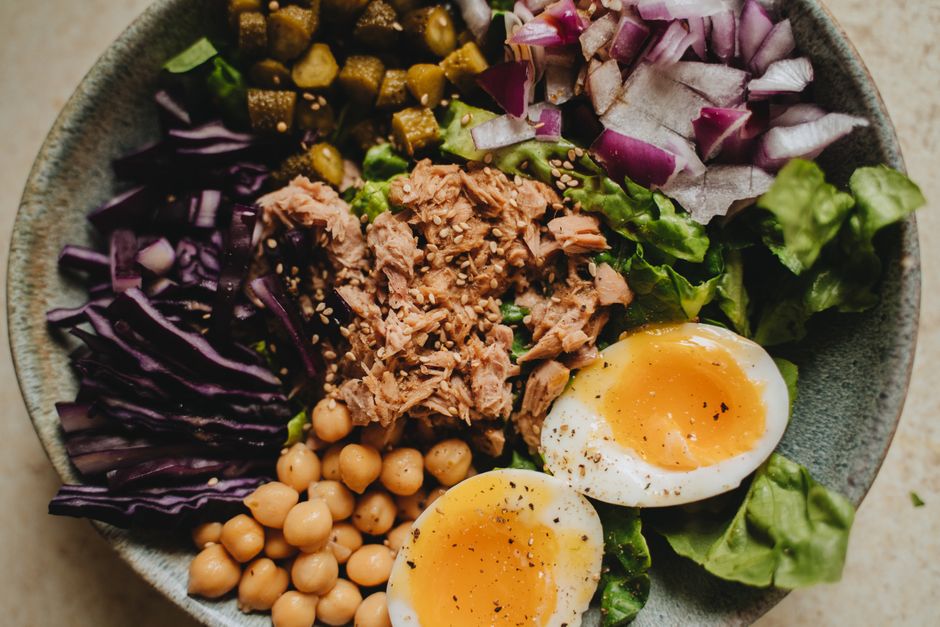
The answer depends almost entirely on the type of tuna. For canned light tuna, most adults can eat two to three standard 5-ounce cans per week without exceeding recommended mercury limits. For canned albacore (white) tuna and fresh or frozen tuna steaks, the limit is lower — often just one or two servings per week, and less for certain groups.
Those numbers come from mercury, not calories or protein. Tuna is one of the healthiest foods in the sea. It is also one of the higher-mercury fish. Getting the balance right matters most for pregnant women, nursing mothers, and young children.
Why Mercury Is the Limiting Factor With Tuna
Mercury occurs naturally in the environment and is released into the air by volcanoes, mining, and the burning of coal. It settles into oceans and lakes, where bacteria convert it into methylmercury — the form that accumulates in fish tissue.
Small fish absorb tiny amounts. Larger predatory fish eat many small fish over many years, and the mercury builds up in their bodies. This process is called bioaccumulation. Tuna sit high on the food chain, which is why they carry more mercury than salmon, sardines, or shrimp.
In humans, methylmercury is absorbed efficiently through the gut and distributed throughout the body. It crosses the blood-brain barrier and, in pregnant women, the placenta. The developing nervous system of a fetus or young child is the most sensitive to its effects. In adults, the kidneys and central nervous system are the main targets of concern at high exposure levels.
The good news is that the body clears methylmercury over time. This is why weekly limits exist rather than daily ones. Occasional higher intake is generally not the issue — sustained high intake is.
How Much Tuna Can You Eat In A Week?
For most healthy adults, the practical weekly range looks like this:
- Canned light tuna (usually skipjack): two to three 5-ounce cans per week
- Canned albacore or white tuna: one to two 5-ounce cans per week
- Fresh or frozen tuna steaks (yellowfin, bigeye): one serving per week, sometimes less depending on the species
These figures are based on guidance from the U.S. Food and Drug Administration and the Environmental Protection Agency, which set advice for fish consumption based on mercury content. The FDA groups tuna into “Best Choices” (canned light) and “Good Choices” (fresh and canned albacore), with recommended weekly servings differing between the two categories.
A standard serving is 4 ounces, or about the size of your palm. Most canned tuna comes in 5-ounce cans, so one can is slightly more than one serving. This matters when you are counting.
Bigeye tuna deserves special mention. It is often sold as ahi and used in sushi. It carries substantially more mercury than yellowfin or skipjack. The FDA places bigeye in the “Choices to Avoid” category. If you eat sushi regularly, this distinction is worth knowing.
How Much Tuna Is Safe During Pregnancy?
Pregnancy is where the numbers tighten considerably. The developing fetal brain is the most vulnerable to methylmercury, and the consequences of high exposure are well documented.
Federal guidance for pregnant women, nursing mothers, and young children recommends eating fish as part of a healthy diet — fish provides omega-3 fatty acids that support fetal brain development. But it recommends choosing fish low in mercury and limiting higher-mercury options.
Under this guidance, canned light tuna is generally limited to about two to three servings per week for this group, and albacore to about one serving per week. Some clinicians advise pregnant women to avoid albacore and fresh tuna entirely and stick with lower-mercury fish like salmon, sardines, trout, and canned light tuna.
If you are pregnant or breastfeeding and unsure about your intake, this is a conversation to have with your obstetrician or a registered dietitian. The general principle — eat fish, choose low-mercury types, limit high-mercury types — is well established. The exact weekly number for any individual depends on body weight, other fish in the diet, and other factors.





Is Canned Light Tuna Lower in Mercury Than Albacore?
Yes, and the difference is meaningful. Canned light tuna is usually skipjack, a smaller species that lives a shorter life and accumulates less mercury. Albacore is a larger, longer-lived fish and typically carries roughly two to three times the mercury of skipjack.
This is why the FDA puts them in different categories with different weekly serving recommendations. It is also why “white tuna” labels matter. If a can says “white” or “albacore,” treat it as the higher-mercury option.
One practical complication: some cans labeled simply “tuna” contain a mix of species. Reading the label for the specific type — skipjack, yellowfin, albacore, bigeye — tells you more than the front of the can usually does.
What About Sushi and Tuna Steaks?
Sushi and tuna steaks are harder to pin down because the species is often not labeled clearly. Yellowfin is common and moderate in mercury. Bigeye is higher and often sold without distinguishing itself. Bluefin is highest of all and is best treated as a rare indulgence rather than a routine choice.
If you eat tuna sushi or steaks regularly, the safest approach is to keep the frequency low, ask what species you are eating, and vary your fish choices. Rotating between salmon, shrimp, cod, and other low-mercury options reduces total mercury load while still delivering the nutritional benefits of seafood.
One point that often gets lost: farmed or wild does not determine mercury content. Mercury comes from the environment and the food chain, not from how the fish was raised or caught. A farmed tuna can carry just as much mercury as a wild one.
What Are the Benefits of Eating Tuna?
Tuna is genuinely nutritious. A 3-ounce serving of canned light tuna packed in water provides roughly 20 grams of protein, is low in saturated fat, and contains vitamin D, vitamin B12, and selenium. Selenium is notable because it can bind to mercury in the body and may reduce its absorption — though this does not eliminate the need to limit high-mercury fish.
Tuna also supplies omega-3 fatty acids, though less than fatty fish like salmon or sardines. The American Heart Association recommends eating fish at least twice a week as part of a heart-healthy diet, and tuna can count toward that goal.
The balance is straightforward: tuna is a good food, mercury is a real concern at high intake, and the weekly limits exist to let you get the benefits without the risk.
Who Needs to Be Most Careful?
Three groups need to pay closest attention to tuna intake:
- Pregnant women and those trying to conceive — fetal brain development is most sensitive to methylmercury
- Nursing mothers — mercury passes into breast milk, though at lower levels than across the placenta
- Young children — smaller bodies and developing nervous systems mean lower thresholds
For these groups, the general approach is to favor low-mercury fish, keep portions small, and limit albacore and fresh tuna. Federal guidance provides specific serving sizes for children based on age, which are smaller than adult portions.
Healthy adults without these considerations have more room. The weekly limits above are not a hard ceiling that triggers harm the moment you cross it — they are a guideline designed to keep average intake in a range considered safe over time.
Frequently Asked Questions
How many cans of light tuna can I eat per week?
Most healthy adults can eat two to three 5-ounce cans of canned light tuna per week without exceeding recommended mercury limits. Pregnant women, nursing mothers, and young children should follow lower limits set specifically for those groups.
Is albacore tuna higher in mercury than light tuna?
Yes. Albacore typically contains roughly two to three times the mercury of skipjack, the fish usually found in canned light tuna. Federal guidance places them in different categories with different weekly serving recommendations.
Can I eat tuna every day?
Eating tuna every day is not recommended because mercury accumulates in the body over time. Weekly limits exist specifically to keep average intake in a range considered safe.
Is it safe to eat tuna while pregnant?
Fish is recommended during pregnancy, but higher-mercury types like albacore and fresh tuna should be limited or avoided. Canned light tuna is generally allowed in small amounts, and your obstetrician can give guidance specific to your situation.
