
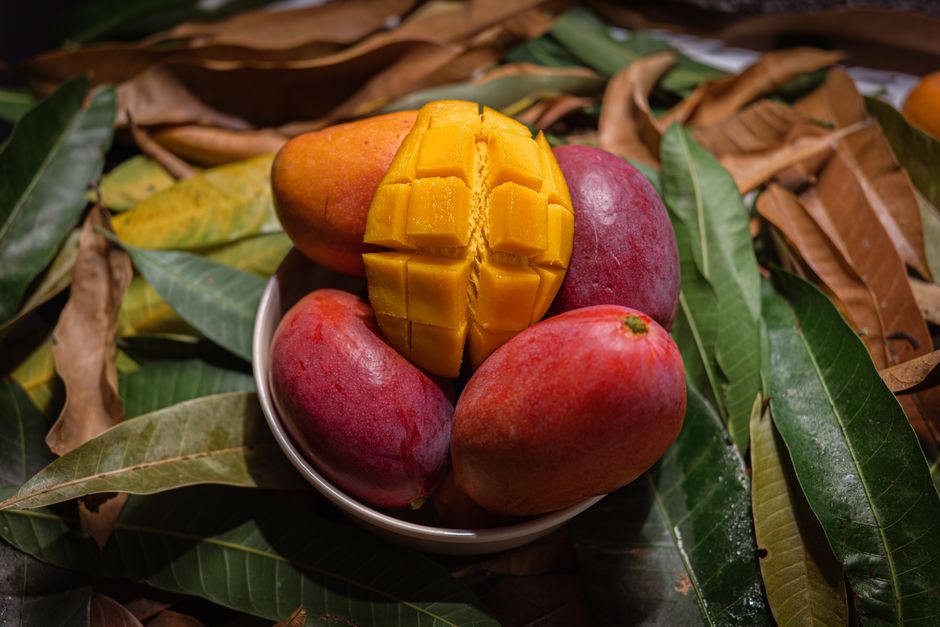
There is no official daily limit on mango, but most healthy adults can reasonably eat about one cup of sliced mango — roughly 165 grams — in a day as part of a balanced diet. That amount is one standard serving and delivers about 100 calories and 23 grams of sugar. Eating more is not dangerous for most people, but mango is high in natural sugar, and the calories and carbohydrates add up quickly.
How Much Mango Can You Eat a Day?
One serving is a useful anchor. The USDA defines a cup of raw mango pieces as about 165 grams. That portion provides roughly 100 calories, 23 grams of sugar, and about 3 grams of fiber.
For a healthy adult eating a varied diet, one to two servings a day fits comfortably within most calorie and sugar targets. Two cups would be about 200 calories and 46 grams of sugar — still within range for many people, but it starts to crowd out other foods.
The bigger question is rarely mango itself. It is what the rest of the day looks like. Someone eating 1,800 calories with plenty of vegetables, protein, and whole grains has more room for fruit than someone managing a tight calorie budget or watching blood sugar closely.
People with diabetes need to account for mango’s carbohydrate content the same way they would any other fruit. That does not mean avoiding it. It means counting it.
What Is Actually in a Mango?
A mango is mostly water and carbohydrate, with small amounts of fiber, vitamins, and minerals. The nutrition profile changes depending on the variety and ripeness, but the general picture is consistent.
Here is what one cup of raw mango pieces (about 165 grams) provides, based on USDA data:
- Calories: about 100
- Carbohydrates: about 25 grams
- Sugars: about 23 grams
- Fiber: about 3 grams
- Vitamin C: a large share of daily needs
- Vitamin A (as beta-carotene): a meaningful amount
- Potassium: a modest amount
That sugar figure surprises people. Twenty-three grams is roughly six teaspoons of sugar. It is natural sugar, not added sugar, and it comes packaged with fiber, water, and micronutrients. But the body still processes it as sugar, and it still counts toward carbohydrate intake.
This is where a lot of fruit marketing goes wrong. “Natural sugar” is not a free pass. It is a more nutritious delivery system for sugar than soda, but it is still sugar.
Is Mango Bad for Blood Sugar?
Mango raises blood sugar, like all fruit. The question is how much and how fast.
Mango has a moderate glycemic index, meaning it raises blood glucose at a moderate pace compared with pure glucose. The exact value varies by ripeness and variety — a very ripe mango will spike blood sugar faster than a firm one. Riper fruit has more free sugars and less starch.
For people without diabetes, this is largely a non-issue. The body handles the glucose load, and the fiber in the fruit blunts the rise somewhat.
For people with type 2 diabetes or prediabetes, the picture is more nuanced. Fruit is generally part of a healthy diet, and research consistently shows that whole fruit intake is not linked to worse blood sugar control. But portion matters. A large mango eaten alone can push blood glucose up more than a small portion eaten with protein or fat.
Some clinicians recommend pairing fruit with a protein or fat source to slow absorption. The evidence for this strategy is reasonable but not overwhelming. It is a widely used approach, not a firmly proven rule.
If you take insulin or a medication that can cause low blood sugar, mango’s carbohydrate content needs to be factored into your dosing plan. That is a conversation for your care team, not a general article.





Can You Eat Too Much Mango?
You can eat too much of anything. With mango, the practical concerns are calories, sugar, and fiber.
A whole large mango can weigh 400 grams or more. Eat two of those and you have consumed roughly 500 calories and over 100 grams of sugar, mostly from fruit. That is a lot of carbohydrate in one sitting for most people.
Fiber is the other issue. One cup of mango has about 3 grams of fiber. Four or five cups would deliver 12 to 15 grams of fiber in a short window. For someone not used to it, that can cause bloating, gas, or loose stools.
There is no evidence that eating a large amount of mango causes lasting harm in a healthy person. The body regulates blood sugar in people without diabetes. The main downside is that filling up on mango leaves less room for foods that provide protein, fat, and a wider range of nutrients.
One more point that gets repeated online: mango does not “burn fat” or “detox” the body. No study has confirmed those claims. Mango is a fruit with nutrients. It is not a weight-loss tool.
Does Mango Cause Weight Gain?
Mango does not cause weight gain by itself. Excess calories cause weight gain, and mango contains calories.
At about 100 calories per cup, mango is not a high-calorie food. But it is easy to eat a lot of it without noticing. A mango smoothie with two cups of fruit, yogurt, and honey can easily exceed 400 calories. That is a meal, not a snack.
The research on fruit and body weight is fairly consistent: higher fruit intake is generally associated with lower body weight, not higher. That association likely reflects overall diet quality rather than fruit being uniquely slimming.
The practical takeaway is simple. Mango fits in a weight-management plan if the total calories work. It does not fit if it is added on top of everything else without adjustment.
Who Should Be More Careful With Mango?
Most people can eat mango without concern. A few groups need to pay closer attention.
- People with diabetes should count mango’s carbohydrates and monitor blood sugar response, especially with larger portions.
- People with irritable bowel syndrome may react to mango. It contains fermentable carbohydrates that can trigger symptoms in some people.
- People with a mango or urushiol allergy should avoid it. Mango skin contains urushiol, the same compound found in poison ivy, and can cause a skin reaction in sensitive people.
- People on a potassium-restricted diet should check with their care team. Mango contains potassium, though less than bananas or oranges.
Mango allergy is uncommon but real. Symptoms can include itching, rash, or swelling around the mouth. In rare cases, a more serious reaction can occur. Anyone with a known mango allergy should treat it like any other food allergy.
How to Fit Mango Into Your Day
The simplest approach is to treat mango like any other fruit. One serving is a cup. Most adults benefit from two to four servings of fruit a day, and mango can be one or two of those.
If you want to eat more without overloading on sugar, pair it with protein or fat. Mango with plain yogurt, cottage cheese, or a handful of nuts slows the sugar release and makes the portion more satisfying.
Watch the form. Dried mango is much more concentrated in sugar than fresh. A cup of dried mango can contain far more sugar and calories than a cup of fresh, because the water has been removed. Mango juice is similar — the fiber is largely gone, and the sugar absorbs quickly.
Fresh or frozen mango pieces are the most straightforward choice. They give you the fiber and the water content that make fruit a better option than juice or candy.
Frequently Asked Questions
How much mango is too much in a day?
There is no official upper limit, but eating more than two or three servings in a day can add a lot of sugar and calories. For most people, one to two cups of fresh mango a day is a reasonable range.
Can I eat mango every day?
Yes, eating mango daily is fine for most healthy adults as part of a varied diet. People with diabetes should count it toward their daily carbohydrate intake.
Is mango high in sugar?
Mango is relatively high in natural sugar compared with many other fruits, with about 23 grams per cup. That sugar comes with fiber and nutrients, but it still counts toward daily carbohydrate intake.
Does mango raise blood sugar?
Yes, mango raises blood sugar because it contains carbohydrates. The rise is moderate compared with high-glycemic foods, and pairing it with protein or fat can slow absorption.
