
Most emergency food guidance lands on the same range: about 2,000 calories per person per day for an average adult, which works out to roughly 14,000 calories per person for one week, 60,000 for one month, and 730,000 for a full year. Those figures are planning baselines, not personal prescriptions. Actual needs vary with age, sex, body size, pregnancy, and activity level, and no single number fits every household.
The more useful question is not just how many calories to store, but what kind of calories, how long you plan to be without normal food access, and how you will rotate the supply so it does not spoil. This guide breaks down the numbers, the food categories, and the storage realities behind them.
How Many Calories Does One Person Need Per Day?
The 2,000-calorie figure comes from general dietary reference values used for labeling and population planning, not from a personalized calculation. The Institute of Medicine’s dietary reference intakes set estimated energy requirements that vary widely by age, sex, and activity level. A sedentary adult woman may need closer to 1,600 to 1,800 calories daily, while an active adult man may need 2,800 to 3,200. Children, older adults, and pregnant or breastfeeding women fall outside a simple average.
For stockpiling purposes, most emergency preparedness guidance uses a round 2,000 calories per person per day because it is easy to multiply and covers a reasonable middle range. If your household includes several large, active adults, plan higher. If it includes young children or older sedentary adults, you can plan somewhat lower — but many planners deliberately build in a buffer rather than cutting close to the minimum.
One thing worth knowing: calorie needs rise in cold environments and with heavy physical work, both of which are common during extended emergencies. A person doing manual labor in cold weather can burn well above their usual daily requirement. Disaster planning guidance from organizations like the American Red Cross and FEMA does not publish a single universal per-person calorie number, but the 2,000-calorie planning figure is widely used across emergency management materials because it is a practical benchmark.
How Much Food To Stockpile Per Person Calories Lists?
This is where the math becomes concrete. Once you settle on a daily calorie target, you simply multiply by the number of days you want to cover, then by the number of people in your household. The table below shows the totals using a 2,000-calorie-per-person-per-day baseline.
| Time Period | Calories Per Person | Calories for 4 People |
|---|---|---|
| 3 days | 6,000 | 24,000 |
| 1 week | 14,000 | 56,000 |
| 2 weeks | 28,000 | 112,000 |
| 1 month | 60,000 | 240,000 |
| 3 months | 180,000 | 720,000 |
| 6 months | 360,000 | 1,440,000 |
| 1 year | 730,000 | 2,920,000 |
These are planning totals, not guarantees of adequacy. They assume the stored food is actually eaten and that nothing spoils, gets contaminated, or is lost. They also assume the person remains at roughly their normal activity level, which may not hold during a crisis.
What Foods Should You Store to Hit Those Calories?
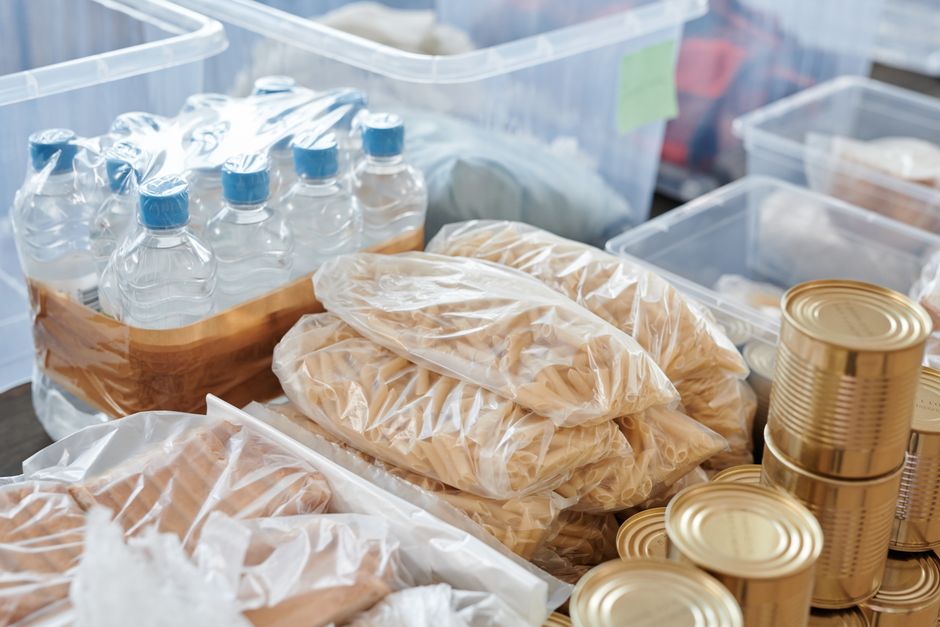
Calories alone do not make a usable food supply. You also need protein, fat, and micronutrients, and you need foods that store well without refrigeration. The most calorie-dense, shelf-stable staples are grains, fats, and sugars, with legumes and canned or freeze-dried proteins rounding out nutrition.
- Grains: White rice, rolled oats, pasta, and wheat berries store for years in airtight containers. They provide roughly 1,600 to 1,700 calories per pound dry.
- Fats and oils: Vegetable oil, olive oil, coconut oil, peanut butter, and shortening are the most calorie-dense foods by weight, at roughly 4,000 calories per pound. Fats are also the hardest category to store long-term because they go rancid.
- Legumes: Dried beans and lentils provide protein and calories, roughly 1,500 to 1,600 calories per pound dry, and store for years.
- Sugars: White sugar, honey, and maple syrup add calories and improve the palatability of plain staples. Sugar stores essentially indefinitely if kept dry.
- Canned and freeze-dried foods: Canned meat, fish, and vegetables add protein and variety. Freeze-dried meals are lightweight and long-lasting but expensive per calorie.
- Salt and spices: Not calorie sources, but essential for making stored staples edible over months.
A practical approach is to build the base of your supply from grains and legumes, add a meaningful share of fats, and then layer in canned goods, freeze-dried items, and treats for morale. A supply that is all rice and beans will meet calorie needs but can become difficult to eat day after day, and morale matters in extended disruptions.




How Long Does Stored Food Actually Last?
Shelf life varies enormously by food type and storage conditions. Cool, dark, dry storage extends life across the board, while heat, light, moisture, and oxygen shorten it. The following are general ranges for properly stored foods, not guarantees.
- White rice, dry pasta, and wheat berries: many years, often 10 or more in airtight, oxygen-free containers
- Rolled oats: roughly 1 to 2 years in original packaging, longer if repackaged airtight
- Dried beans and lentils: several years, though older beans take longer to cook and may never fully soften
- Canned goods: commonly 2 to 5 years, sometimes longer if cans remain undamaged
- White sugar, honey, and salt: effectively indefinite if kept dry
- Oils and nuts: 1 to 2 years, less once opened, because fats oxidize and turn rancid
- Freeze-dried meals: often 10 to 25 years depending on packaging and storage
Fats deserve special attention because they are both the most calorie-dense category and the most perishable. Rotating oils and nut butters regularly is more important than stockpiling them in bulk and hoping they last. A supply that is heavy on fats but never rotated can leave you with calories you cannot safely eat.
How Do You Rotate and Store a Food Stockpile?
Rotation is what separates a working food supply from a pile of expired goods. The principle is simple: store what you eat, eat what you store, and use the oldest items first. This keeps the supply fresh and ensures you actually know how to cook with it before you need to.
Store food in a cool, dark, dry place, ideally below 70 degrees Fahrenheit if you can manage it. Heat is the single biggest enemy of shelf life. Use food-grade containers with tight seals, and consider oxygen absorbers for dry goods you intend to store for many years. Mylar bags with oxygen absorbers are a common method for long-term storage of grains and legumes.
Keep a written inventory with dates and check it periodically. When an item approaches the end of its practical life, move it into your regular kitchen rotation and replace it. This is the most reliable way to avoid waste and to keep your supply genuinely usable.
One more consideration that many planners overlook: water. Stored dry staples like rice and beans require water to prepare, and a food supply without a matching water supply is not fully functional. Federal emergency guidance generally recommends at least one gallon of water per person per day for drinking and basic sanitation, with more for cooking and hot conditions.
What About Special Dietary Needs?
A single per-person calorie number assumes a healthy adult with no special requirements. Households with infants, young children, pregnant or breastfeeding women, older adults, or people with medical conditions may need different foods and different quantities. Infant formula, for example, cannot be substituted with stored adult staples, and breastfeeding women have higher calorie and fluid needs.
No clinical guidelines specify a universal stockpile calorie target for infants, children, or pregnant women. If your household includes these groups, the honest position is that you should plan around their specific needs rather than a generic average, and consult a healthcare provider for guidance tailored to your situation.
People with diabetes, kidney disease, food allergies, or other conditions that restrict diet also need a supply built around what they can safely eat. A stockpile that meets calorie targets but ignores a medical dietary restriction is not a usable plan for that person.
Frequently Asked Questions
How many calories should I stockpile per person per day?
A common planning baseline is 2,000 calories per person per day for an average adult. Actual needs vary with age, sex, body size, and activity level, so treat 2,000 as a starting point rather than a fixed target.
How many calories do I need to store for one month for four people?
Using a 2,000-calorie daily baseline, one month for four people comes to about 240,000 calories. This assumes the food is fully consumed and nothing spoils or is lost.
What foods give the most calories per pound for storage?
Fats and oils are the most calorie-dense, at roughly 4,000 calories per pound, followed by grains and legumes at about 1,500 to 1,700 calories per pound dry. Fats are also the most perishable, so they need regular rotation.
Do I need to store water along with food?
Yes. Dry staples like rice and beans require water to prepare, and federal emergency guidance generally recommends at least one gallon of water per person per day for drinking and basic sanitation.
