
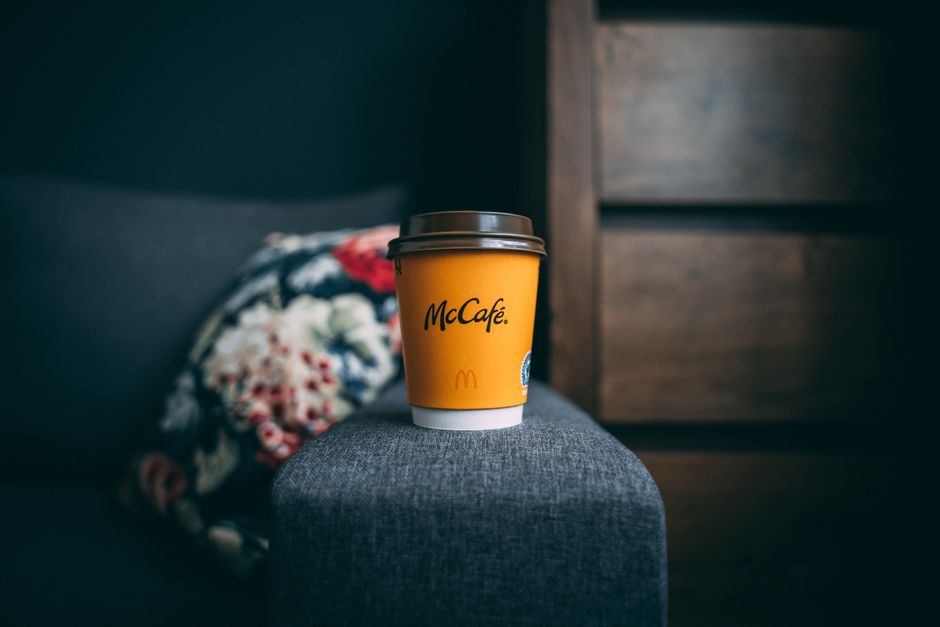
A medium McDonald’s iced coffee contains about 200 milligrams of caffeine. A large has roughly 320 milligrams. A small has about 133 milligrams. These numbers are for the plain brewed iced coffee, not the specialty drinks like the caramel or mocha versions.
How Much Caffeine Is in Each Size of McDonald’s Iced Coffee?
The caffeine content changes by size because the recipe is straightforward. McDonald’s brews hot coffee and then cools it over ice. The larger the cup, the more coffee liquid you get. A small (16 ounces) has 133mg. A medium (24 ounces) has 200mg. A large (32 ounces) has 320mg. These numbers come directly from McDonald’s own nutrition information. They are not estimates from third-party labs. The company has tested its recipes and publishes the data publicly.
For comparison, a standard 8-ounce cup of home-brewed coffee has about 95mg of caffeine. So a medium McDonald’s iced coffee has more than double that. A large has more than three times as much. If you drink a large McDonald’s iced coffee, you are getting the caffeine equivalent of roughly three and a half home-brewed cups. That matters if you are sensitive to caffeine or have a medical condition that limits your intake.
Does the Flavor Syrup Add More Caffeine?
No. The sugar-free vanilla syrup and the regular vanilla syrup contain no caffeine. Neither does the caramel syrup or the hazelnut syrup. The caffeine comes only from the coffee base. When you order a vanilla iced coffee or a caramel iced coffee, you are getting the same amount of caffeine as the plain version. The syrups add sugar and calories, but not caffeine.
This is a common point of confusion. Many people assume that flavored coffee drinks have more caffeine because they taste stronger. That is not how it works. The flavor syrups are essentially concentrated sugar water with artificial or natural flavoring. They do not contain coffee extract or any stimulant. If you want less caffeine, ask for half the coffee and extra milk or ice. That is the only way to reduce it without switching to decaf.
How Does McDonald’s Iced Coffee Compare to Other Fast Food Iced Coffees?
McDonald’s is in the middle of the pack. Dunkin’s medium iced coffee (24 ounces) has about 297mg of caffeine. That is nearly 100mg more than McDonald’s medium. Starbucks’ grande iced coffee (16 ounces) has about 165mg. That is higher than McDonald’s small but lower than the medium. Chick-fil-A’s medium iced coffee (20 ounces) has about 215mg. Burger King’s medium (20 ounces) has about 190mg.
The differences come down to how each chain brews its coffee. Dunkin uses a stronger coffee-to-water ratio. Starbucks uses a standard ratio but a dark roast that can vary by batch. McDonald’s uses a medium roast and a consistent brewing process. If you are tracking caffeine closely, Dunkin’s iced coffee is the strongest among the major fast food chains. McDonald’s is a moderate option. If you want the lowest caffeine option among fast food iced coffees, Burger King or Wendy’s are slightly lower.





Is McDonald’s Iced Coffee Safe for People with Heart Conditions?
The American Heart Association recommends that most adults limit caffeine to 400mg per day. That is the safe upper limit for healthy adults. A large McDonald’s iced coffee at 320mg is below that limit. But it is close. If you have high blood pressure, an arrhythmia, or any heart condition, you should talk to your doctor before drinking that much caffeine. Some people with heart conditions are advised to stay under 200mg per day.
A small McDonald’s iced coffee at 133mg is within the safe range for most people with heart conditions. But individual sensitivity varies widely. Research published in the Journal of the American Heart Association found that people with genetic variations in caffeine metabolism can have different blood pressure responses to the same dose. If you notice palpitations, anxiety, or a racing heart after drinking coffee, you may be a slow metabolizer. In that case, even a small iced coffee might be too much.
What Are the Common Side Effects of Too Much Caffeine?
The most common side effects are anxiety, jitteriness, insomnia, and digestive upset. At doses above 400mg, some people also experience headaches, rapid heart rate, and dizziness. These effects are dose-dependent. A large McDonald’s iced coffee at 320mg is enough to cause symptoms in people who are sensitive. A medium at 200mg is less likely to cause problems for most people.
There is also the question of when you drink it. Caffeine has a half-life of about 5 hours. That means if you drink a large iced coffee at 4 PM, you will still have about 160mg of caffeine in your system at 9 PM. That is enough to disrupt sleep for many people. The National Sleep Foundation recommends stopping caffeine intake at least 6 hours before bed. For a large McDonald’s iced coffee, that means finishing it by 2 PM if you go to bed at 8 PM. For a small, 4 PM is safer.
Can You Order McDonald’s Iced Coffee with Less Caffeine?
Yes, but you have to ask for it. McDonald’s does not have a half-caff option on the menu. But you can order a small iced coffee with light ice and extra milk. That dilutes the coffee and reduces the caffeine per ounce. You can also ask for a half-coffee, half-milk or half-coffee, half-cream base. The employees are trained to make custom drinks, though it may take a moment longer.
A better option is to order a small iced coffee and add a splash of milk yourself. That way you control the ratio. If you want to go really low, order a small decaf iced coffee. Decaf still has about 2-5mg of caffeine per 8 ounces. A small decaf iced coffee would have roughly 10-20mg total. That is negligible for most people but worth knowing if you are extremely sensitive.
Common Misconceptions About Caffeine in McDonald’s Iced Coffee
One myth is that the ice melts and dilutes the caffeine. That is partially true but not as much as people think. The coffee is brewed hot and then poured over ice. Some ice melts during the brewing process, but McDonald’s accounts for that in their recipe. The published caffeine numbers are for the final drink as served, not the pre-ice coffee. So the 200mg in a medium is what you actually consume, not what you would get if you let all the ice melt.
Another myth is that the caramel or mocha versions have extra caffeine from chocolate. Chocolate does contain a small amount of caffeine. A standard mocha syrup pump has about 5mg of caffeine. That is not enough to change the total meaningfully. If you order a mocha iced coffee, you are getting roughly 205mg instead of 200mg. That is within the margin of error for most people. Do not worry about the chocolate adding significant caffeine.
A third myth is that iced coffee has less caffeine than hot coffee because it is weaker. This is false. Iced coffee is brewed at the same strength as hot coffee. The ice takes up volume, but the coffee concentrate is the same. In fact, some chains use a stronger brew for iced coffee to compensate for the ice dilution. McDonald’s does not do that, but the caffeine content is still comparable to the same volume of hot coffee.
Frequently Asked Questions
How much caffeine is in a small McDonald’s iced coffee?
A small McDonald’s iced coffee (16 ounces) contains about 133 milligrams of caffeine. This is roughly the same as one and a half standard cups of home-brewed coffee.
How much caffeine is in a large McDonald’s iced coffee?
A large McDonald’s iced coffee (32 ounces) contains about 320 milligrams of caffeine. That is close to the 400 milligram daily limit recommended for healthy adults.
Does McDonald’s iced coffee have more caffeine than their hot coffee?
No. The caffeine content per ounce is similar between McDonald’s hot and iced coffee. The iced coffee is just brewed hot coffee poured over ice, so the caffeine concentration is the same.
Can you get a decaf iced coffee at McDonald’s?
Yes. McDonald’s offers decaf iced coffee by request. It contains about 2-5 milligrams of caffeine per 8 ounces, so a small decaf iced coffee would have roughly 10-20 milligrams total.
