
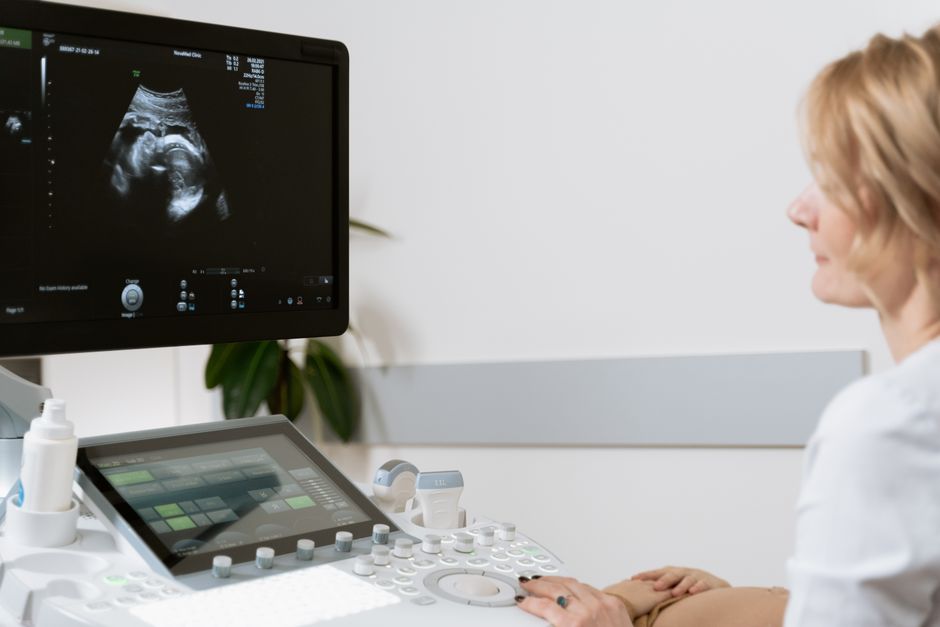
Most pregnant people in the United States get at least two sonograms: one in the first trimester and one between 18 and 22 weeks. The first confirms the pregnancy and dates it accurately. The second, often called the anatomy scan, checks the baby’s development in detail. Some pregnancies require more scans, but for a low-risk pregnancy, two is the standard number.
What Is a Sonogram and Why Is It Done?
A sonogram is the image produced by an ultrasound exam. The exam uses sound waves to create a picture of the baby inside the uterus. It is a standard part of prenatal care and has been used for decades.
Ultrasound does not use radiation. It uses high-frequency sound waves that bounce off tissues to create images. This is why it is considered safe for routine use during pregnancy when a medical reason exists.
Each scan has a specific purpose. The first scan confirms viability and dates. The second scan is a detailed look at the baby’s anatomy. Additional scans are ordered only when a clinician needs more information.
How Many Sonograms Do You Get During Pregnancy for a Low-Risk Pregnancy?
For a healthy pregnancy with no complications, the standard is two ultrasound exams. This is the widely accepted practice in the United States based on guidance from major medical organizations.
The first scan usually happens between 8 and 14 weeks. This scan confirms the due date. It also checks for a heartbeat and confirms whether there is one baby or more.
The second scan happens between 18 and 22 weeks. This is the anatomy scan. The technician looks at the baby’s organs, limbs, spine, and brain. This scan also checks the placenta and the amount of amniotic fluid.
Some providers do an early scan at 6 to 7 weeks if there is bleeding or pain. Others may do a quick scan at a later visit to check the baby’s position. But these are not part of the standard schedule. They are done for specific reasons.
Why the First Trimester Scan Matters
The first scan is about dating, not just confirmation. Early in pregnancy, babies grow at a very predictable rate. Measuring the baby in the first trimester gives the most accurate due date.
A due date based on the last menstrual period can be off by a week or more. A first-trimester ultrasound measurement is more reliable. This matters because many decisions later in pregnancy depend on how far along you are.
The first scan also checks for a heartbeat. A heartbeat is usually visible by 6 to 7 weeks. If no heartbeat is seen at that point, the provider may recommend a repeat scan in a week to confirm.
This scan can also reveal whether you are carrying twins or more. That changes the entire prenatal care plan, including how many future scans you will need.





The Anatomy Scan at 18 to 22 Weeks
The anatomy scan is the most detailed ultrasound of the pregnancy. It is sometimes called the 20-week scan. It takes longer than the first scan, often 30 to 45 minutes.
The technician checks the baby’s heart, brain, spine, kidneys, and limbs. They also measure the baby’s head, abdomen, and thigh bone to confirm growth is on track. The scan looks for major structural problems, though it cannot detect every condition.
This scan also checks the placenta. It confirms whether the placenta is positioned safely away from the cervix. If the placenta is low, a repeat scan later in pregnancy may be needed to see if it has moved.
Amniotic fluid levels are checked here too. Too much or too little fluid can signal a problem. If levels are outside the normal range, the provider will discuss next steps.
When You Might Need More Than Two Sonograms
More scans are ordered when a specific concern exists. They are not routine. They are diagnostic tools.
Common reasons for additional scans include:
- High blood pressure or preeclampsia concerns
- Gestational diabetes
- Concern about the baby’s growth
- Low or high amniotic fluid
- A previous pregnancy with complications
- Bleeding during pregnancy
- Checking the baby’s position late in pregnancy
Some practices offer a third-trimester growth scan to all patients. This is more common in some regions than others. It is not the universal standard, but it is not harmful either.
If you have a condition like gestational diabetes, your provider may order scans every few weeks to monitor the baby’s size. If the baby measures large or small, more frequent monitoring follows.
Are Extra Sonograms Safe?
Ultrasound has been studied for decades. No harmful effects have been confirmed from routine prenatal ultrasound use. That said, ultrasound delivers energy to tissue, so the general principle is to use it only when there is a medical reason.
Major medical organizations recommend against non-medical ultrasounds. This includes “keepsake” photos or videos done at commercial studios. These are not part of medical care and are not recommended.
There is no proven risk from extra medically indicated scans. But there is also no proven benefit to scans done without a medical reason. The safest approach is to follow your provider’s recommendations.
What About 3D and 4D Ultrasounds?
3D and 4D ultrasounds use the same sound wave technology as standard 2D scans. They create a more detailed image of the baby’s surface. These are often offered by commercial studios for keepsake purposes.
These scans are not a routine part of prenatal care. Some medical offices offer them during a regular scan, but they are not necessary for medical purposes. The diagnostic information comes from the standard 2D images.
If you are considering a commercial 3D or 4D scan, know that it is not medically recommended. The FDA advises against ultrasounds done for non-medical reasons. The session may expose the baby to sound waves for longer than a standard medical scan.
What If You Miss a Scan?
Missing the first-trimester scan means your due date may be less accurate. Your provider can still date the pregnancy later, but the estimate will be less precise.
Missing the anatomy scan means you lose the chance to identify certain structural problems before birth. Some conditions are easier to manage if known ahead of time. If you miss this window, talk to your provider about whether a later scan is still useful.
It is never too late to start prenatal care. Even if you have missed earlier scans, a late scan can still provide useful information. Do not skip care because you think it is too late.
How to Prepare for Your Sonogram
For the first-trimester scan, you may be asked to come with a full bladder. This pushes the uterus up and gives a clearer image. Your provider will tell you if this is needed.
For the anatomy scan, no special preparation is usually required. Wear comfortable clothing. You may be asked to change into a gown for easier access to your abdomen.
Both scans are done with a handheld device moved across your belly. A gel is applied to your skin to help the sound waves travel. The procedure is painless and takes about 30 minutes for the anatomy scan.
Ask questions during the scan. The technician can point out the baby’s heartbeat, head, and limbs. But note that the technician may not be able to answer medical questions. The final report comes from a doctor or a specialized sonographer who reviews the images later.
What the Scan Cannot Tell You
An ultrasound cannot detect every problem. Some conditions are invisible on ultrasound. Others only become apparent after birth.
The anatomy scan looks for major structural issues. It does not test for genetic conditions like Down syndrome. If you want genetic testing, that is a separate blood test or procedure, not an ultrasound.
An ultrasound also cannot predict how a baby will develop after birth. It cannot measure intelligence, personality, or future health. It is a snapshot of structure and growth at one moment in time.
Frequently Asked Questions
How many sonograms do you get during pregnancy?
Most low-risk pregnancies include two sonograms: one in the first trimester and one between 18 and 22 weeks. More scans are added only when a medical concern exists.
Is it safe to have extra ultrasounds during pregnancy?
No harmful effects have been confirmed from medically indicated ultrasounds. Non-medical scans are not recommended.
Can I skip the anatomy scan?
You can, but it is not advised. The anatomy scan checks the baby’s organs and growth and can identify problems that are easier to manage if known before birth.
Do I need a full bladder for every ultrasound?
Only the first-trimester scan may require a full bladder. Your provider will tell you in advance if it is needed.
