
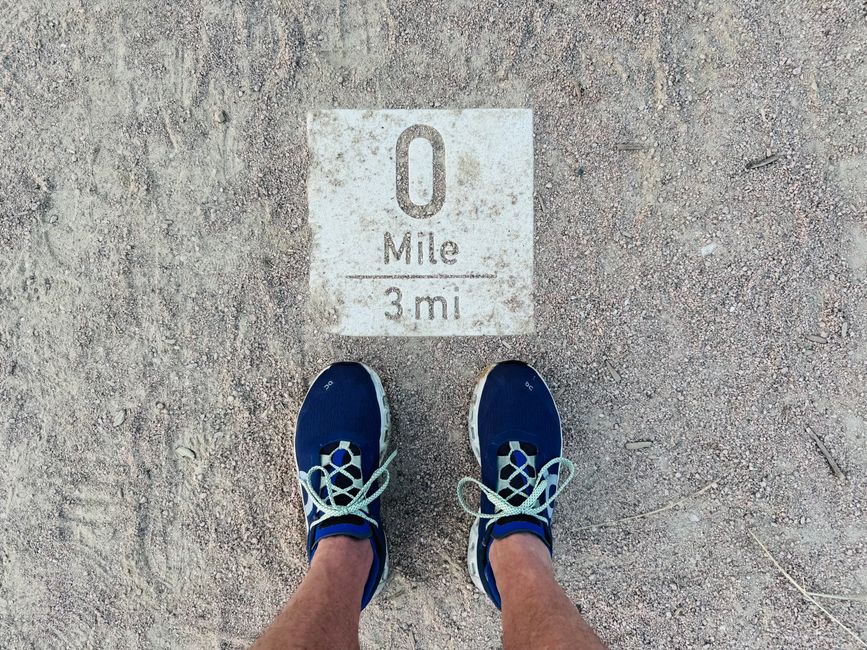
For most women, 10,000 steps equals roughly 4.2 to 5.0 miles. The exact number depends on your stride length, which is largely determined by your height. A woman who is 5 feet 4 inches tall with an average stride length of 2.2 feet will cover about 4.2 miles. A taller woman at 5 feet 8 inches with a 2.4-foot stride will reach nearly 4.6 miles. Stride length varies by person, so the range of 4.2 to 5.0 miles is the most honest and useful answer for most women.
How Is the Distance from Steps Calculated?
The math is straightforward. One mile equals 5,280 feet. To find your distance, you multiply your number of steps by your stride length in feet, then divide by 5,280.
For a woman with a 2.2-foot stride: 10,000 steps x 2.2 feet = 22,000 feet. Divide 22,000 by 5,280 and you get 4.17 miles. For a woman with a 2.4-foot stride: 10,000 x 2.4 = 24,000 feet. Divide by 5,280 and you get 4.55 miles. The American Council on Exercise confirms that average stride length for women ranges from about 2.1 to 2.5 feet depending on height.
Your stride length is the distance from the heel print of one foot to the heel print of the other. It changes with walking speed. When you walk faster your stride naturally lengthens. A leisurely stroll might give you a shorter stride and fewer miles per 10,000 steps. A brisk power walk stretches your stride and increases your mileage.
How Many Miles Is 10000 Steps For A Woman Based on Height?
Height is the single biggest factor that determines your stride length. Taller women cover more ground per step. Shorter women take more steps to cover the same distance. The table below gives you a clear picture based on common female heights.
| Height | Average Stride Length (feet) | Miles for 10,000 Steps |
|---|---|---|
| 5’0″ | 2.0 | 3.8 miles |
| 5’2″ | 2.1 | 4.0 miles |
| 5’4″ | 2.2 | 4.2 miles |
| 5’6″ | 2.3 | 4.4 miles |
| 5’8″ | 2.4 | 4.6 miles |
| 5’10” | 2.5 | 4.7 miles |
These numbers assume a natural walking pace. If you run or jog the stride length increases significantly. A woman running 10,000 steps might cover 5.5 to 6.5 miles because her stride opens up. The table is for walking only.
Does the 10,000 Steps Goal Actually Come from Science?
No. The 10,000-step goal did not come from medical research. It came from a Japanese pedometer company in the 1960s. The company named its device “manpo-kei,” which translates to “10,000 steps meter.” The number was a marketing choice, not a clinical threshold. It caught on globally and became a default fitness target.
Research published in JAMA Internal Medicine in 2019 found that women who walked about 4,400 steps per day had significantly lower mortality rates than those who walked 2,700 steps. The benefits increased up to about 7,500 steps per day. After that point, the additional benefit leveled off. The study followed nearly 17,000 older women. It did not find a special benefit at 10,000 steps.
Another study from the same journal in 2020 confirmed similar results. Walking more than 10,000 steps was not harmful, but it was not necessary for health gains. The sweet spot for most health benefits appears to be between 6,000 and 8,000 steps per day for older adults. Younger women may benefit from more, but the evidence does not support 10,000 as a magic number.





What Does the Distance Actually Mean for Your Health?
The distance you cover matters less than the fact that you are moving. The CDC recommends 150 minutes of moderate-intensity aerobic activity per week. That is about 30 minutes of brisk walking five days a week. For most women, 30 minutes of brisk walking equals roughly 3,000 to 4,000 steps. That is about 1.3 to 1.7 miles.
Hitting 10,000 steps in a day does not guarantee you meet the aerobic activity guidelines. You could accumulate those steps slowly throughout the day without ever raising your heart rate. A study from the British Journal of Sports Medicine found that step intensity matters. Women who walked at a faster pace got more cardiovascular benefit than those who walked the same number of steps at a slow pace.
The distance itself is a useful benchmark. It gives you a tangible goal. But do not fixate on hitting exactly 5 miles. If you walk 3 miles at a brisk pace you are likely getting more health benefit than someone who shuffles 5 miles slowly. The quality of your steps matters as much as the quantity.
How Can You Measure Your Own Stride Length Accurately?
You do not need a lab test to find your stride length. There is a simple method you can do at home. Mark a starting line on the ground. Walk ten natural steps at your normal pace. Mark where your tenth step lands. Measure the distance in feet from the starting line to the mark. Divide that number by ten. That is your average stride length.
Repeat the process three times and take the average. Walk at the pace you typically use for daily walking, not a race pace. Your stride length changes with speed, so measure at your usual speed. Once you have your stride length, use the formula: steps x stride length in feet / 5,280 = miles.
Most fitness trackers and smartphone apps use a default stride length based on your height and gender. These estimates are reasonably accurate for most people. If you want a precise number, the manual measurement method is better. Some women find that their tracker overestimates their distance by 10 to 15 percent because the default stride length is too generous.
What Factors Change How Many Miles a Woman Walks in 10,000 Steps?
Several factors shift the distance beyond just height. Walking speed changes your stride length. A faster walk lengthens your stride naturally. A slow shuffle shortens it. The surface you walk on also matters. Walking uphill shortens your stride. Walking downhill lengthens it slightly, though your step count may decrease because you cover more ground per step.
Shoe type can affect your gait. Wearing shoes with thick soles or a rocker bottom changes how your foot rolls. This can shorten or lengthen your stride slightly. Walking on a treadmill versus pavement also changes things. Treadmills tend to encourage a slightly shorter stride because the belt pulls your foot back.
Age and joint health play a role. Older women often have shorter strides due to reduced hip mobility or knee stiffness. A 65-year-old woman with mild arthritis may have a stride length of 2.0 feet, meaning 10,000 steps covers only 3.8 miles. A 25-year-old woman with full hip mobility may have a 2.5-foot stride, covering 4.7 miles. The same step count can mean very different distances.
Common Misconceptions About Steps and Distance
The biggest myth is that 10,000 steps equals exactly 5 miles for everyone. This is false. It is an average for men of average height. For women, the number is lower. Another myth is that you must hit 10,000 steps to be healthy. As discussed, research shows meaningful benefits start well below that threshold.
Some people believe that step counters are perfectly accurate. They are not. A 2019 study in the Journal of Medical Internet Research tested several popular fitness trackers. It found that step counts varied by up to 20 percent between devices. Two women walking the same distance could get different step counts from different trackers. The distance estimate is only as good as the device and the stride length setting.
Another misconception is that walking 10,000 steps burns a specific number of calories that is the same for everyone. It is not. A 150-pound woman walking 4.5 miles burns roughly 300 to 350 calories. A 200-pound woman walking the same distance burns about 400 to 450 calories. The distance matters, but your body weight and walking speed determine the calorie burn.
What to Avoid When Tracking Steps and Distance
Avoid obsessing over the exact number. A difference of 0.2 miles between your tracker and a manual calculation is normal. Do not adjust your stride length every week trying to get a perfect match. Set it once based on your measurement and trust the trend over time.
Do not compare your distance to a man’s distance. Men typically have longer strides. A 6-foot man with a 2.7-foot stride covers 5.1 miles in 10,000 steps. Comparing your 4.2 miles to his 5.1 miles is meaningless. Your body is different. Your health benefits are not less valuable because your steps cover less ground.
Avoid the trap of thinking more steps always means better health. A study from the American Heart Association in 2021 found that walking more than 12,000 steps per day did not provide additional cardiovascular protection compared to 8,000 steps. Beyond a certain point, you are just adding miles without proportional benefit. Your time is better spent on intensity or strength training than on extra steps.
Frequently Asked Questions
How many miles is 10,000 steps for a 5’4″ woman?
A 5’4″ woman with an average stride length of 2.2 feet will cover about 4.2 miles in 10,000 steps. This is the most common height for women in the United States.
Does walking 10,000 steps a day help with weight loss?
Walking 10,000 steps burns roughly 300 to 450 calories depending on your weight and walking speed. It can support weight loss when combined with a calorie-controlled diet.
Is 10,000 steps per day necessary for good health?
Research shows that health benefits plateau around 7,500 steps per day for most women. Ten thousand steps is not a medical requirement, just a popular goal.
How long does it take to walk 10,000 steps?
At a moderate pace of about 3 miles per hour, walking 10,000 steps takes roughly 80 to 90 minutes. A brisk pace reduces that time to about 60 to 70 minutes.
