
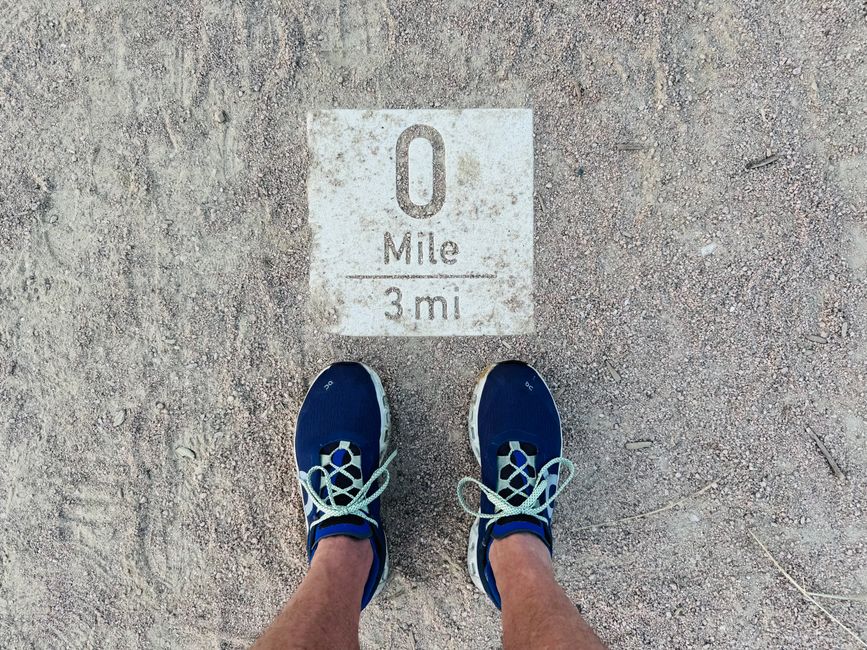
Ten thousand steps is roughly five miles for most people. That estimate is based on an average step length of about 2.5 feet. Your actual distance depends on your height, leg length, and walking speed, so your personal number could be anywhere from four to six miles.
How Many Miles Is 10 000 Steps A Day?
Ten thousand steps equals about five miles for an average adult. This is a general estimate, not a precise measurement for every person. Step length is the main factor that changes the math.
Most health tracking devices assume an average step length of 2.5 feet. Multiply 10,000 steps by 2.5 feet and you get 25,000 feet. Divide that by 5,280 feet in a mile, and you land at roughly 4.7 miles. Round up and you have your five-mile figure.
Your actual step length depends on your body. Taller people naturally take longer strides. A person who is 6 feet tall might cover closer to six miles in 10,000 steps. A shorter person with a stride under 2.5 feet might cover only four miles.
Where Did the 10,000 Step Goal Come From?
The 10,000-step goal did not come from scientific research. It started as a marketing campaign in Japan in the 1960s. A company selling pedometers named their device the “manpo-kei,” which translates to “10,000 step meter.” The number was catchy and easy to remember.
Research on step counts came later. Studies have since examined how daily step totals relate to health outcomes. Some research suggests that health benefits increase as people move from very low step counts to around 7,500 to 10,000 steps per day. The benefits do not appear to stop abruptly at 10,000, but the evidence for additional benefit beyond that level is less clear.
The goal is not a medical prescription. It is a reasonable daily target for many adults, but it is not a threshold where health suddenly improves or declines.
How to Calculate Your Personal Step Distance
You can figure out your own distance with a simple measurement. Find a flat stretch of ground and mark a starting point. Walk 20 steps at your normal pace. Measure the distance from start to finish in feet. Divide that number by 20 to get your average step length.
Once you have your step length, multiply it by 10,000. Divide by 5,280 to get your miles. For example, if your step length is 2.3 feet, the math looks like this: 2.3 times 10,000 equals 23,000 feet. Divide 23,000 by 5,280 and you get about 4.4 miles.
Walking speed does not change your step length much at normal paces. Faster walking tends to lengthen your stride slightly, which means fewer steps per mile. Running uses a different stride pattern entirely and will produce a different steps-per-mile count.





Is 10,000 Steps Per Day Actually Necessary?
No. The 10,000-step target is a useful benchmark, not a biological requirement. Research consistently shows that moving more than being sedentary is what matters for health.
Studies have found that significant health benefits appear when inactive people increase their daily steps. Some research indicates that benefits level off around 8,000 to 10,000 steps per day for younger adults. For older adults, the benefit threshold may be lower, around 6,000 to 8,000 steps.
The key point is that going from 3,000 to 6,000 steps daily likely produces more health benefit than going from 10,000 to 13,000. The largest gains come from getting off the couch, not from chasing a specific number.
If 10,000 steps feels overwhelming, start lower. A target of 7,000 or 8,000 steps is still a meaningful increase for most sedentary people. Consistency matters more than hitting an arbitrary round number.
How Long Does It Take to Walk 10,000 Steps?
Most people walk at a pace of about 2.5 to 3 miles per hour. At that speed, covering five miles takes roughly 1 hour and 40 minutes to 2 hours. This time is usually spread across the day rather than done in one continuous walk.
A typical day includes steps from routine activities. Walking to the car, moving around the house, errands, and work-related movement all add up. Many people find they accumulate 3,000 to 5,000 steps without any dedicated exercise. A single 30-minute walk at a brisk pace adds roughly 3,000 to 4,000 steps depending on your stride.
Breaking the goal into smaller chunks makes it more manageable. Three 20-minute walks spread through the day can get you close to 10,000 steps without a long dedicated session.
Does Intensity Matter or Just Step Count?
Both matter. Step count measures volume. Intensity measures how hard your body works during those steps.
Current physical activity guidelines recommend at least 150 minutes of moderate-intensity aerobic activity per week for adults. Moderate intensity means your heart rate is elevated and you can talk but not sing. Brisk walking qualifies.
Step count alone does not capture intensity. Ten thousand slow steps around the house is not the same as 10,000 brisk steps on a hilly route. Your body responds differently to sustained elevated heart rate compared to casual movement.
The best approach combines both. Track your steps for overall volume, but also include periods of purposeful walking at a brisk pace. This aligns with established physical activity guidance and gives you measurable health benefits beyond just step accumulation.
Can You Lose Weight With 10,000 Steps a Day?
Walking 10,000 steps burns calories, but weight loss is not guaranteed. The calorie burn depends on your weight, walking speed, and terrain.
A person weighing 150 pounds burns roughly 300 to 400 calories walking five miles at a moderate pace. A person weighing 200 pounds burns more, around 400 to 500 calories for the same distance. These are estimates, not exact figures, because individual metabolism varies.
Weight loss requires a consistent calorie deficit. Exercise alone rarely produces significant weight loss without dietary changes. Walking 10,000 steps daily can contribute to a deficit, but if calorie intake stays high, weight may not change.
Walking does provide other benefits even without weight loss. It improves cardiovascular fitness, supports blood sugar regulation, and helps maintain muscle mass. These effects are valuable independent of the scale.
What If You Cannot Reach 10,000 Steps?
Do not treat 10,000 as a failure threshold. Any increase from your current activity level is beneficial.
Research consistently shows that the biggest health differences appear between the least active people and moderately active people. Moving from 2,000 to 5,000 steps daily produces meaningful improvements in cardiovascular risk markers. Going from 5,000 to 8,000 adds further benefit, though the gains are smaller per additional step.
People with mobility limitations, joint pain, or chronic conditions may not be able to reach 10,000 steps. That is acceptable. Walking within your limits, using assistive devices if needed, and focusing on consistency over volume is the evidence-based approach.
Some clinicians recommend setting a personal baseline first. Wear a step counter for a week without changing your routine. Whatever your average is, add 1,000 to 2,000 steps per day. Build from there gradually.
Frequently Asked Questions
How many miles is 10,000 steps for a woman?
About four to five miles, depending on height and stride length. Shorter women with smaller strides will be closer to four miles, while taller women may reach five.
How many miles is 10,000 steps for a man?
About five to six miles, because men on average have longer strides. Actual distance depends on individual height and walking speed.
Is 10,000 steps a day good enough for health?
Yes, it is a solid target for most adults. Research shows meaningful health benefits from reaching this level, though some benefits appear at lower step counts like 7,000 to 8,000.
How long does walking 10,000 steps take?
About 1 hour and 40 minutes to 2 hours of total walking time. Most people accumulate this across the day rather than in one session.
