
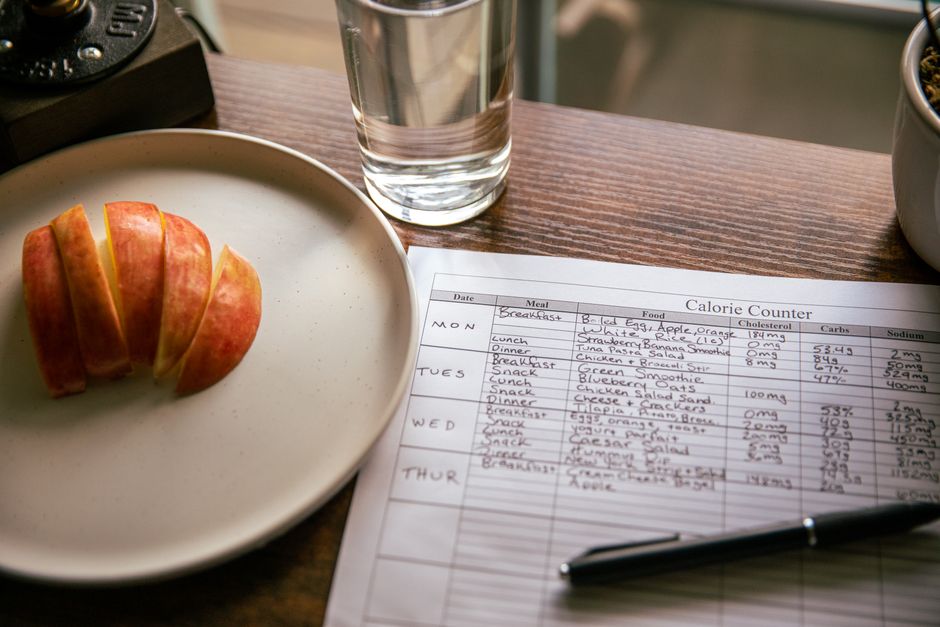
Most adults need between 1,600 and 3,000 calories per day. Your exact number depends on your age, sex, height, weight, and how active you are. A 35-year-old woman who exercises moderately needs about 2,000 calories. A 45-year-old man with a desk job needs closer to 2,400. These are not guesses. They come from the Dietary Guidelines for Americans, which are based on decades of metabolic research. The real question is not just a number. It is whether that number helps you feel good and stay healthy over time.
How Many Calories Should I Eat In A Day Based on My Age and Sex?
Research from the National Institutes of Health shows that calorie needs change across your lifespan. For women aged 31 to 50, the standard range is 1,800 to 2,200 calories per day if you are moderately active.1Dietary Guidelines for Americans, 2025–2030, RealFood.Gov. For men in the same age group, it is 2,400 to 2,800. These numbers drop slightly after age 60 because muscle mass naturally decreases and metabolism slows down.
Sex matters because of body composition. Men generally have more lean muscle mass, which burns more calories at rest. Women have a higher percentage of body fat, which requires fewer calories to maintain. This is not a judgment. It is biology. The USDA food patterns use these sex-specific baselines to build healthy eating plans that meet nutrient needs without exceeding calorie limits.
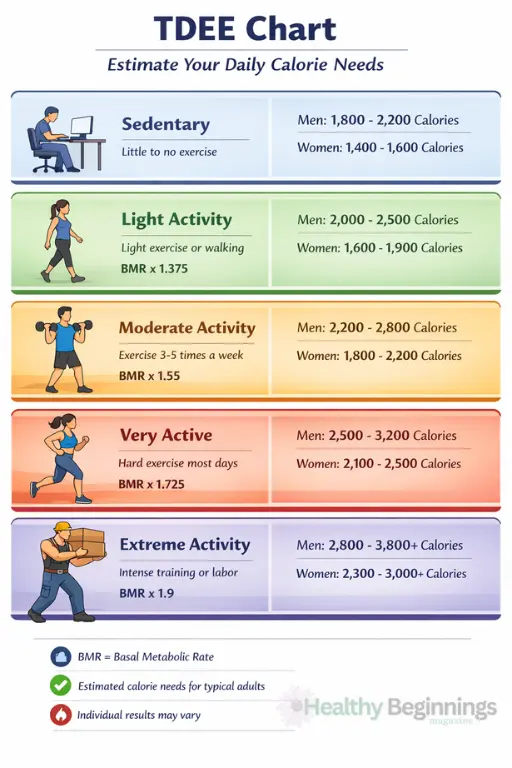
Do not assume you need the same calories as your partner or friend. A 40-year-old woman who runs 20 miles per week needs more calories than a 40-year-old man who sits at a desk all day. Activity level often outweighs age and sex as a factor. The table below shows the standard ranges from the 2020-2025 Dietary Guidelines for Americans.
| Age Group | Women (Moderately Active) | Men (Moderately Active) |
|---|---|---|
| 19–30 years | 2,000–2,200 | 2,600–2,800 |
| 31–50 years | 1,800–2,200 | 2,400–2,800 |
| 51–60 years | 1,600–2,200 | 2,200–2,600 |
| 61+ years | 1,600–2,000 | 2,000–2,600 |
What Is the Most Accurate Way to Calculate Your Personal Calorie Needs?
The Mifflin-St Jeor equation is the gold standard used by registered dietitians and clinical researchers. It calculates your basal metabolic rate, or BMR, which is the number of calories your body burns at complete rest just to keep your heart beating, lungs working, and cells repairing. For women, the equation is: (10 × weight in kg) + (6.25 × height in cm) – (5 × age in years) – 161. For men, it ends with +5 instead of –161.
Once you have your BMR, you multiply it by an activity factor. Sedentary people multiply by 1.2. Lightly active people multiply by 1.375. Moderately active people multiply by 1.55. Very active people multiply by 1.725. The result is your total daily energy expenditure, or TDEE. This is the number of calories you need to maintain your current weight.
Online calculators that use this equation are fairly reliable if you enter your measurements honestly. The biggest source of error is overestimating your activity level. Most people who think they are moderately active are actually lightly active. If you sit for eight hours a day and exercise for 30 minutes, you are lightly active, not moderate. That mistake can add 200 to 300 calories to your target, which leads to slow weight gain over months.
How Many Calories Should I Eat In A Day to Lose Weight?
To lose one pound of body fat per week, you need a deficit of about 500 calories per day. This is based on the well-established fact that one pound of fat stores roughly 3,500 calories. A 500-calorie deficit can come from eating less, moving more, or a combination of both. The CDC recommends losing one to two pounds per week as a safe and sustainable rate.
Do not go below 1,200 calories per day if you are a woman or 1,500 if you are a man unless you are under medical supervision. Very low-calorie diets can cause muscle loss, gallstones, nutrient deficiencies, and a drop in metabolic rate that makes weight regain more likely. Research published in the New England Journal of Medicine found that people who lost weight slowly and steadily kept it off longer than those who used crash diets.
Some people report success with intermittent fasting or low-carb diets, but strong evidence is limited for long-term superiority over a standard calorie deficit. The key variable is consistency, not the specific method. A 2022 study in the Annals of Internal Medicine found that people who tracked their food intake, even imperfectly, lost more weight than those who did not track at all. The act of paying attention matters more than the precision of the numbers.





What Happens If You Eat Too Few Calories for Too Long?
Your body adapts. This is called adaptive thermogenesis, and it is a survival mechanism. When you eat fewer calories than your body needs for an extended period, your metabolism slows down to conserve energy. Your thyroid hormone levels drop. Your heart rate slows. You feel cold, tired, and irritable. Your body also starts breaking down muscle tissue for energy because it is easier to access than fat stores.
Research from the University of Colorado found that people who lost weight through severe calorie restriction had a 15 to 20 percent reduction in their resting metabolic rate beyond what would be expected from weight loss alone. This means they needed fewer calories than a person of the same weight who had never dieted. That is why many people regain weight after stopping a restrictive diet. Their metabolism is slower, and they go back to eating the way they did before.
Women are especially vulnerable to hormonal disruption from low-calorie diets. Eating too few calories can suppress estrogen production, which affects bone density, menstrual cycles, and mood. The Female Athlete Triad is a well-documented condition in which low energy availability leads to irregular periods and weakened bones. This is not rare. It happens in recreational exercisers and non-athletes too.
How Many Calories Should I Eat In A Day to Build Muscle?
To build muscle, you need a calorie surplus of 100 to 300 calories per day above your maintenance level. This is called lean bulking. The extra calories provide the energy needed for muscle protein synthesis, which is the process your body uses to repair and grow muscle tissue after resistance training. A larger surplus does not build more muscle. It builds more fat alongside the muscle.
Protein intake matters here. The Academy of Nutrition and Dietetics recommends 1.6 to 2.2 grams of protein per kilogram of body weight per day for people who are actively trying to build muscle. That is roughly 0.7 to 1 gram per pound. For a 150-pound person, that means 105 to 150 grams of protein daily. Spreading protein across three to four meals per day is more effective than eating it all at once, according to research in the Journal of the International Society of Sports Nutrition.
Carbohydrates also play a role. They replenish glycogen stores in your muscles, which gives you the energy to lift heavier weights. Fat is not the enemy either. It supports hormone production, including testosterone, which is involved in muscle growth. A common ratio for muscle building is 40 percent carbohydrates, 30 percent protein, and 30 percent fat. These numbers can be adjusted based on individual tolerance and preference.
What Are the Most Common Mistakes People Make When Counting Calories?
The biggest mistake is underestimating portion sizes. A 2018 study in the Journal of the Academy of Nutrition and Dietetics found that people underestimated their calorie intake by an average of 20 to 30 percent. This is not about lying. It is about visual misjudgment. A serving of peanut butter looks like one tablespoon, but is often two or three. A restaurant pasta dish can contain 1,200 calories, not the 600 you guessed.
Another mistake is ignoring liquid calories. A 16-ounce latte with whole milk and syrup has about 300 calories. A can of soda has 150. A glass of wine has 125. These add up quickly and do not trigger the same fullness signals as solid food. Research from the University of California found that people who drank sugary beverages consumed an average of 200 more calories per day than those who did not, with no reduction in food intake to compensate.
Relying solely on fitness tracker estimates is another problem. A 2017 study in the Journal of Personalized Medicine found that wrist-worn trackers overestimated energy expenditure by 16 to 40 percent during walking and running.2Accuracy in Wrist-Worn, Sensor-Based Measurements of Heart Rate and Energy Expenditure in a Diverse Cohort, PubMed Central. If you trust your tracker when it says you burned 500 calories during a workout, you might eat back 600 and end up in a surplus. Use trackers as rough guides, not precise measurements.
Here are three practical steps to avoid these mistakes:
- Weigh or measure your food for at least one week to calibrate your eye. Most people are shocked by what a real serving looks like.
- Track everything you drink for three days. Include coffee creamer, juice, alcohol, and sports drinks. The total might surprise you.
- Subtract 100 to 200 calories from your fitness tracker estimate before eating back exercise calories. This accounts for typical overestimation.
How Many Calories Should I Eat In A Day as I Get Older?
After age 60, your calorie needs drop by about 100 calories per decade. This is because you lose muscle mass, and muscle burns more calories than fat. The American College of Sports Medicine reports that adults lose 3 to 8 percent of their muscle mass per decade after age 30. That decline accelerates after 60. If you keep eating the same number of calories you ate at 40, you will gradually gain weight.
The solution is not to starve yourself. It is to prioritize nutrient density. Older adults need the same or higher levels of protein, calcium, vitamin D, and B12, but in fewer calories. That means choosing foods that deliver more nutrition per bite. Lean meats, eggs, dairy, beans, nuts, and leafy greens are better choices than bread, pasta, and sugary snacks. A 2021 study in the Journal of Nutrition found that older adults who followed a nutrient-dense diet maintained muscle mass better than those who simply ate less.
Strength training also helps. Lifting weights or doing bodyweight exercises two to three times per week can slow or even reverse age-related muscle loss. More muscle means a higher resting metabolism, which means you can eat more calories without gaining fat. This is one of the few interventions that actually changes your calorie equation as you age. It is not about eating less. It is about building a body that can handle more.
Frequently Asked Questions
How many calories should I eat in a day to maintain my weight?
Multiply your weight in kilograms by 10, then add 6.25 times your height in centimeters, subtract 5 times your age, and adjust for sex and activity level. The result is your maintenance calories.
Is 1,200 calories a day safe for weight loss?
For most women, 1,200 calories is too low and can cause nutrient deficiencies and metabolic slowdown. It should only be used under medical supervision for short periods.
Do calories from different foods affect the body differently?
Yes. A calorie from protein supports muscle repair, while a calorie from sugar spikes blood sugar. Total calorie count matters for weight, but food quality matters for health.
Can I trust calorie counts on packaged foods?
They are usually within 10 to 20 percent of the actual amount. The FDA allows this margin of error, so treat labels as estimates, not guarantees.
Scientific References
- 1Dietary Guidelines for Americans, 2025–2030, RealFood.Gov. ↩︎
- 2Accuracy in Wrist-Worn, Sensor-Based Measurements of Heart Rate and Energy Expenditure in a Diverse Cohort, PubMed Central. ↩︎
