
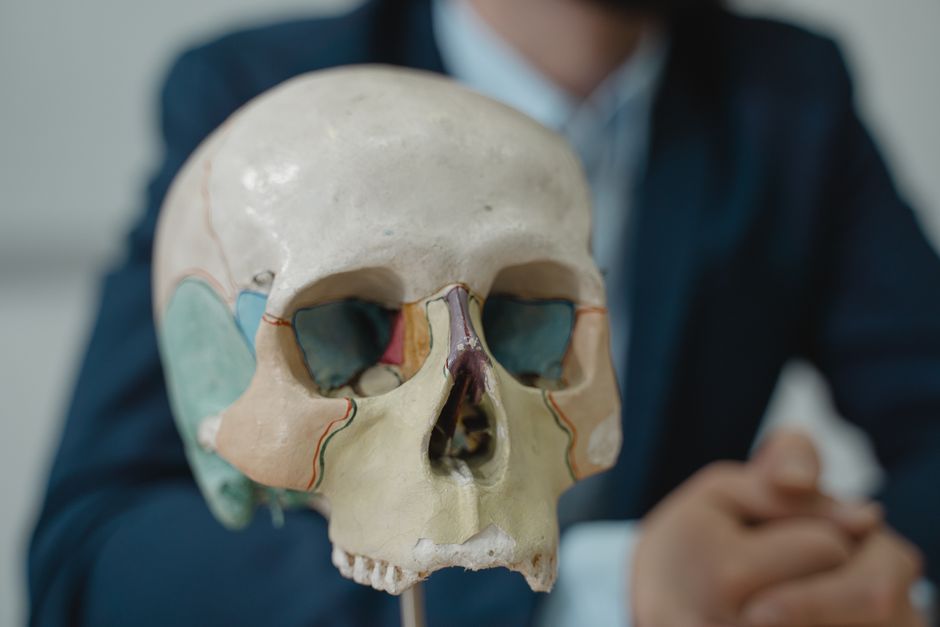
You are born with about 270 bones. That number is higher than the 206 bones you have as an adult, which surprises most people. The reason is simple: many of your infant bones are separate pieces that later fuse together into single adult bones.
This process happens naturally as you grow. By the time you stop growing, usually in your late teens or early twenties, the count settles at 206. Not everyone ends up with exactly 206, though. Small differences are normal.
How Many Bones Are You Born With and Why Does the Number Change?
Newborns have roughly 270 bones, though some sources put the range between 270 and 300. The exact count varies because not every baby’s bones fuse on the same schedule or in the same way.
The key point is that infant bones are not simply smaller versions of adult bones. Many are made of separate sections that need to join. The skull is a good example. A newborn’s skull has distinct bony plates with soft gaps between them, called fontanelles. These gaps let the head flex slightly during birth and give the brain room to grow. Over time, the plates fuse into the solid skull structure you have as an adult.
The spine works the same way. An infant spine has separate bony segments that gradually merge. The sacrum, the triangular bone at the base of your spine, starts as several separate vertebrae and becomes one bone. The same happens in the pelvis.
Why Do Babies Have More Bones Than Adults?
Babies have more bones because many of their bones have not yet fused. Fusion is not a flaw. It is how the skeleton adapts to growth.
Consider the long bones in your arms and legs. In a child, the ends of these bones are separated from the main shaft by areas of cartilage called growth plates. Cartilage is softer and more flexible than bone. Growth plates allow the bone to lengthen. As a child grows, the cartilage slowly turns into bone in a process called ossification. When growth is complete, the growth plates close and the bone becomes one solid piece.
This is why a child’s X-ray looks different from an adult’s. Doctors can actually estimate a child’s remaining growth by looking at how open the growth plates are.
Fusion also serves a mechanical purpose. A single solid bone is stronger than several smaller pieces joined by cartilage. Once growth stops, there is no advantage to keeping the pieces separate.
How Many Bones Are in the Adult Body?
The standard adult count is 206 bones. This number appears in anatomy textbooks and is widely used in medical education.
That said, 206 is a convention, not a universal law. Some people have extra bones, called supernumerary bones. Others have fewer because certain bones that usually stay separate fuse together. Sesamoid bones, which are small bones embedded in tendons, vary widely between individuals. The kneecap is the largest sesamoid bone, and almost everyone has one, but smaller sesamoid bones in the hands and feet are not always present.
So while 206 is the number you will see in most references, real human skeletons differ slightly from person to person.





Where Does the 270 Number Come From?
The 270 figure comes from counting every separate bony structure in a newborn, including the unfused segments that will later merge. It is an anatomical count, not a medical measurement used in clinical practice.
Different textbooks give slightly different numbers depending on how they count. Some count each ossification center separately. Others group them. That is why you may see the newborn count listed as 270, 300, or somewhere in between.
The important idea is not the exact number. It is that the newborn skeleton is made of more separate parts than the adult skeleton, and those parts fuse over time.
When Do Bones Stop Fusing?
Most bone fusion is complete by the late teens or early twenties. The timing differs by bone and by person.
The bones in the hands and feet tend to finish earlier. The long bones of the arms and legs finish later. The collarbone is often one of the last to complete fusion, sometimes not until the mid-twenties.
Sex plays a role. Girls generally finish growing earlier than boys. This is why growth charts and bone-age assessments are interpreted differently for boys and girls.
Nutrition, hormones, and overall health also affect timing. Conditions that affect growth hormone or thyroid function can delay or accelerate bone maturation. This is one reason pediatricians sometimes order a bone-age X-ray when a child’s growth pattern seems unusual.
What Else Changes in the Skeleton as You Grow?
Fusion is the main change, but it is not the only one. Bone is living tissue. It is constantly being broken down and rebuilt throughout life.
In childhood and adolescence, bone formation outpaces breakdown. This is how bones get larger and denser. Peak bone mass, the maximum bone density a person reaches, is typically achieved in the late twenties.
After that, breakdown slowly begins to exceed formation. This is a normal part of aging. It is also why bone health earlier in life matters later. A person who builds more bone during youth has more to draw on as they age.
Calcium, vitamin D, and weight-bearing activity all support bone development during the growing years. The evidence for these is well established. What is less clear is how much any single lifestyle factor can change peak bone mass in an individual, since genetics also play a large role.
Common Myths About Baby Bones
One common myth is that babies have no kneecaps. This is not accurate. Babies do have kneecaps, but they are made mostly of cartilage at birth and turn into bone later. The kneecap, or patella, typically begins to ossify between ages 2 and 6.
Another myth is that the soft spots on a baby’s head are gaps where the brain is unprotected. The fontanelles are covered by a tough membrane. They are not open holes. They allow for growth and slightly flex during birth, but they are not a sign of weakness.
A third myth is that the number of bones you are born with determines your final height. It does not. Height depends on the growth of individual bones, especially the long bones, not on how many separate pieces exist at birth.
Why the Number of Bones Is Not the Whole Story
Focusing only on the count misses what matters. The skeleton is a dynamic system that changes shape, density, and structure across a lifetime.
A newborn skeleton is built for growth and flexibility. An adult skeleton is built for strength and support. The transition between the two involves hundreds of small changes happening on their own timelines.
Understanding this helps explain why bone health is not just about calcium or a single number. It is about a process that starts before birth and continues for decades.
Frequently Asked Questions
How many bones are you born with?
You are born with about 270 bones. This number is higher than the 206 bones in a typical adult skeleton because many infant bones fuse together as you grow.
Why do babies have more bones than adults?
Babies have more bones because many of their bones are still in separate pieces. These pieces fuse into single bones over time, reducing the total count.
At what age do bones stop fusing?
Most bone fusion is complete by the late teens or early twenties. The exact timing varies by bone and by individual.
Does everyone have exactly 206 bones?
No, 206 is the standard count used in anatomy, but small differences are common. Some people have extra bones, and others have bones that fuse differently.
