
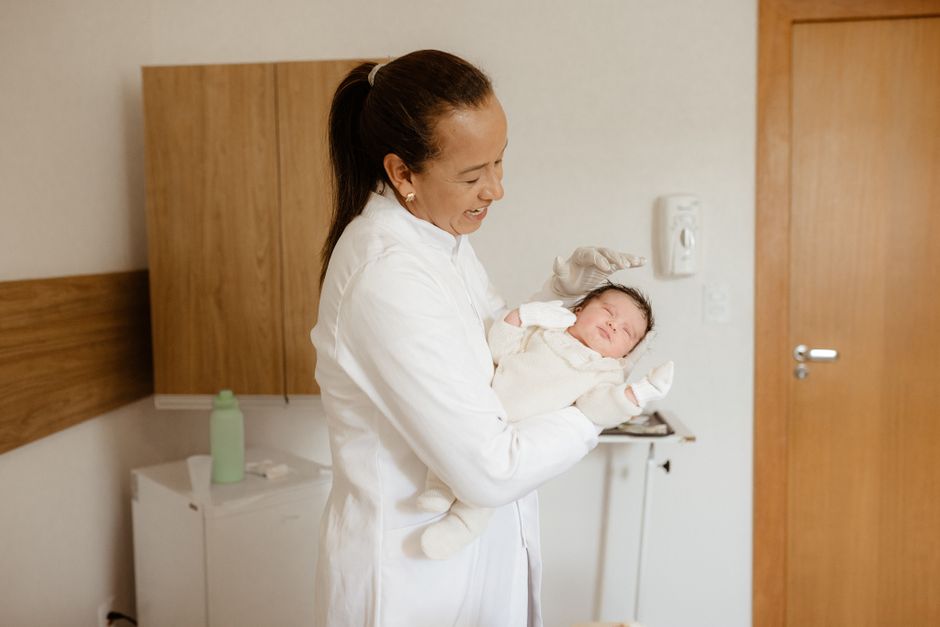
Newborn vision is a common source of curiosity for new parents. When you look into your baby’s eyes, you might wonder what they are actually seeing. The direct answer is yes, babies can see when they are born, but their vision is far from fully developed. A newborn’s world is a blurry mix of light, shapes, and movement, and it takes months for their sight to sharpen into full color and depth perception.
What Exactly Can a Newborn See?
A newborn’s visual acuity is quite poor. Most experts compare it to a legal blindness level in adults, roughly around 20/400. This means an object that appears clear to an adult at 400 feet would need to be 20 feet away for a newborn to see it with the same clarity.
This blurriness is normal and expected. The structures of the eye, including the macula (the part of the retina responsible for sharp central vision), are not fully mature at birth. The brain is also still learning how to process the visual signals it receives. Vision is a learned skill that develops rapidly over the first year of life.
Despite the blur, newborns are not blind. They are particularly drawn to high-contrast patterns, like black and white checkerboards. They also prefer looking at faces over other objects. This preference for faces is an important survival instinct that helps with bonding and social development.
How Far Can a Newborn See?
The clearest focal distance for a newborn is about 8 to 12 inches from their face. This is no accident. That is roughly the distance between a baby’s eyes and a parent’s face during feeding or cradling. Nature has designed this distance to encourage eye contact and bonding.
Anything beyond that 12-inch range appears as indistinct shapes and shadows. If you hold your baby at arm’s length, they can see the general outline of your head and shoulders, but they cannot make out your facial features clearly. To get a good look at you, they need you to be close.
This short focal range is why newborns often seem to stare intently at a parent’s face while nursing or bottle-feeding. They are not just eating; they are studying you. They are memorizing the basic shapes of your face, even if the details are fuzzy.
Do Newborns See in Color?
Yes, but not the full spectrum. Newborns can distinguish between red and green, but their color vision is limited compared to adults. The cone cells in the retina, which are responsible for color perception, are present but not fully mature or efficient.
At birth, babies see the world in shades of gray, black, and white, with some ability to perceive red and green. They have difficulty distinguishing between similar hues, such as blues and purples. This is why high-contrast black and white toys are often recommended for the first few weeks of life.
Color vision improves significantly by the time a baby is 3 to 4 months old. By 5 months, most infants have color vision that is nearly equivalent to an adult’s. They begin to show preferences for bright, saturated colors like red and blue over pastel shades.
-
 EyeFortin Reviews 2026: Clear Vision Or A marketing Scam?
 -
Mounjaboost Reviews & Complaints: Does Drops Work for Weight Loss?
-
Yu Sleep Weight Loss Supplement Reviews. Critical March 2026 Update.
-
Neuro Energizer Review 2026. Legit Brain Tool or Just Hype?
-
Acupuncture for Weight Loss: Does It Really Work?





When Does a Baby’s Vision Fully Develop?
Vision development follows a predictable timeline, though every baby is slightly different. The first few months bring rapid changes in clarity, focus, and depth perception.
- 0 to 2 months: Vision is blurry. Babies focus on faces and high-contrast patterns. They may begin to track moving objects with their eyes, though this is often jerky at first.
- 3 to 4 months: Color vision improves dramatically. Babies can now track objects more smoothly and begin to reach for things they see.
- 5 to 8 months: Depth perception develops. Babies can judge distances better and begin to coordinate their eyes and hands. This is the age when they master the pincer grasp, picking up small objects between thumb and finger.
- 9 to 12 months: Vision is close to adult levels in terms of clarity. Babies can recognize familiar faces from across a room and understand object permanence visually.
By the end of the first year, most children have vision that is nearly as sharp as an adult’s. The brain and eyes have worked together to build the complex neural pathways needed for clear, three-dimensional sight.
Why Do Newborns Cross Their Eyes?
Intermittent eye crossing is common in newborns. This is often due to underdeveloped eye muscles and a lack of coordination between the two eyes. The muscles that control eye movement are weak, and the brain has not yet learned to fuse the images from both eyes into a single, clear picture.
In most cases, this crossing resolves on its own by 3 to 4 months of age. However, persistent eye crossing or drifting after this age should be evaluated by a pediatrician. This could be a sign of strabismus, a condition where the eyes do not align properly.
Another common concern is a blocked tear duct, which can cause watery eyes. This is a plumbing issue, not a vision issue, and it usually clears up on its own within the first year. Vision itself is rarely affected by a blocked tear duct.
How Can Parents Support Healthy Vision Development?
You do not need special toys or expensive programs to support your baby’s vision. Simple daily interactions are the most effective way to encourage healthy visual development.
Make eye contact during feeding. Move your face slowly from side to side to encourage your baby to track you. Use high-contrast toys and books with bold patterns. Give your baby plenty of supervised tummy time, which helps strengthen the neck and eye muscles needed for visual tracking.
Limit screen time. The American Academy of Pediatrics recommends avoiding screens for children under 18 months, except for video chatting. A newborn’s developing visual system is not designed to process the rapid, unnatural movements of digital screens. Real, three-dimensional objects and faces are far more beneficial.
When Should a Parent Be Concerned About Vision?
Most vision problems in infancy are identified during routine well-child visits. However, there are signs that warrant an earlier evaluation by a pediatrician or pediatric ophthalmologist.
If your baby is not tracking objects or faces by 3 months, this is a red flag. Other signs include eyes that are persistently crossed or drifting, excessive tearing, or a white pupil instead of a red one in photographs. A white pupil can indicate a serious condition like a cataract or retinoblastoma, a rare eye cancer.
Premature babies are at higher risk for vision problems, including retinopathy of prematurity. These infants should have a comprehensive eye exam by a specialist, even if they appear to see normally. Early detection is critical for many eye conditions, as treatment is often most effective in infancy.
If you have any doubts about your baby’s vision, trust your instincts. A referral to a specialist for an eye exam is a low-risk step that can provide peace of mind or catch a problem early. It is always better to check than to wait.
Frequently Asked Questions
Can newborns recognize their mother’s face?
Yes, newborns can recognize their mother’s face, but only at close range. Within days of birth, they show a preference for their mother’s face over a stranger’s, especially when it is held 8 to 12 inches away.
Do babies need sunglasses?
Yes, protecting a baby’s eyes from UV rays is wise. The lenses of an infant’s eyes are more transparent than an adult’s, allowing more ultraviolet light to reach the retina, so a good pair of infant sunglasses during outdoor time is a reasonable precaution.
Is it bad to look at a baby’s eyes with a flashlight?
No, a brief, indirect light is not harmful. However, shining a bright light directly into a baby’s eyes is uncomfortable and can startle them, so it is best to avoid it unless a doctor is performing a specific examination.
When do babies start crying with tears?
Babies are born with tear glands, but they usually do not produce visible tears until they are 2 to 4 weeks old. Crying without tears is normal for the first few weeks of life.
