
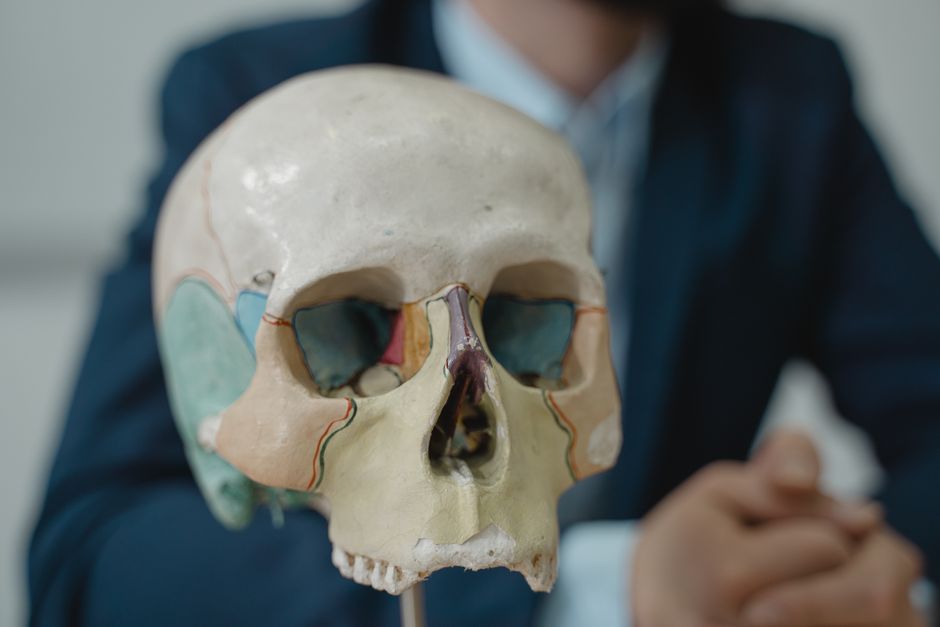
An adult human skeleton has 206 bones. That number is the standard taught in anatomy courses and used in clinical settings. It counts the bones of the skull, spine, rib cage, arms, hands, legs, and feet after the skeleton has finished maturing.
Babies are born with far more separate bone pieces — roughly 270 — because many of them are still made of cartilage or exist as distinct segments that will later fuse. Growth and fusion slowly bring the count down to 206. The number 206 is therefore a snapshot of the fully mature skeleton, not a fixed figure that applies at every age.
How Many Bones Are In The Human Skeleton and Why the Number Changes
A newborn skeleton contains around 270 bone and cartilage elements, and many of these are not yet true bone. Large parts of the infant skeleton are made of cartilage, a flexible tissue that gradually hardens into bone through a process called ossification.
Ossification continues for years. Some bones start as several separate centers that later merge into one. The hip bone, for example, begins as three distinct parts — the ilium, ischium, and pubis — that fuse during childhood and adolescence. The sacrum at the base of the spine starts as several separate vertebrae and becomes a single fused bone.
This is why the count falls over time. It is not that bones disappear. Separate pieces join together, and cartilage turns into bone. By early adulthood, most of this fusion is complete, and the total settles at 206.
One point worth clarifying: 206 is an average and a convention. Some healthy people have extra small bones called sesamoids, and others have slightly fewer because certain bones fuse. The number is a reliable standard, not a precise count that holds for every single person.
Which Bones Make Up the 206?
Anatomists usually divide the skeleton into two main parts. The axial skeleton forms the central axis of the body. The appendicular skeleton includes the limbs and the girdles that attach them.
The axial skeleton has 80 bones:
- Skull: 22 bones (8 cranial and 14 facial)
- Ear bones: 6 (three tiny bones in each middle ear)
- Hyoid: 1 (a small bone in the neck)
- Vertebral column: 26 (24 vertebrae plus the sacrum and coccyx)
- Thoracic cage: 25 (12 pairs of ribs, the sternum, and related structures)
The appendicular skeleton has 126 bones:
- Shoulder girdles: 4 (two clavicles and two scapulae)
- Arms and hands: 60
- Pelvic girdle: 2
- Legs and feet: 60
The hands and feet alone hold more than half of all the bones in the body. Each hand has 27 bones and each foot has 26. That concentration is one reason these areas have so many small joints and are prone to fractures and arthritis.
Why Do Babies Have More Bones Than Adults?
Babies have more separate bone elements because their skeletons are built for birth and rapid growth. A flexible skeleton helps a baby pass through the birth canal, and cartilage allows bones to lengthen as the child grows.
As a child develops, growth plates at the ends of long bones add new bone tissue. These plates stay open until growth stops, which is typically in the late teens or early twenties. Once growth is complete, the plates close and harden into solid bone.
At the same time, separate bone pieces fuse. The skull is a clear example. A newborn’s skull has gaps called fontanelles, where the bone plates have not yet joined. These soft spots let the skull flex during birth and allow room for the growing brain. They usually close within the first couple of years of life.
By the time a person reaches adulthood, the fusions are done and the count reaches 206.





Does Everyone Have Exactly 206 Bones?
No. The 206 figure is a standard reference, but normal human variation exists.
Some people have extra sesamoid bones — small bones embedded in tendons. The kneecap, or patella, is the largest sesamoid, and it is counted in the 206. But smaller sesamoids can appear in the hands and feet, and not everyone has the same number.
Other people have fewer bones because certain structures fuse that usually stay separate, or because they lack a small bone that most people have. These differences are usually harmless and often discovered by accident on an X-ray.
There are also genetic conditions that change the bone count. Some cause extra fingers or ribs. Others cause bones to fuse abnormally. These are not part of typical anatomy, but they show that the skeleton is not identical from person to person.
What Is the Smallest Bone in the Body?
The smallest bone is the stapes, one of three tiny bones in the middle ear. It is roughly the size of a grain of rice. The stapes helps transmit sound vibrations from the eardrum to the inner ear.
The longest and strongest bone is the femur, or thigh bone. It supports most of the body’s weight and plays a central role in walking, running, and standing.
The smallest and largest bones sit at opposite ends of a system that balances strength and delicacy. The stapes is built for precise vibration. The femur is built to bear load.
Do Bone Counts Matter for Health?
For most people, the exact number of bones is not something to track. What matters more is bone quality and density.
Bone is living tissue. It constantly breaks down and rebuilds. During childhood and early adulthood, the body builds bone faster than it breaks it down. Peak bone mass is usually reached by around age 30. After that, breakdown slowly outpaces building.
This shift is why bone health becomes more important with age. When bone loss speeds up, it can lead to osteopenia or osteoporosis, conditions where bones become weaker and more likely to fracture. The wrist, hip, and spine are common fracture sites.
Factors that support bone health across life include adequate calcium and vitamin D, regular weight-bearing activity, not smoking, and limiting alcohol. These are well-established influences on bone. The precise effect of any single change varies from person to person.
Bone density is typically assessed with a DXA scan, and results are reported as a T-score. A T-score of −2.5 or lower is the diagnostic threshold for osteoporosis. This is a standard definition, not a gray area.
Common Myths About the Human Skeleton
One common myth is that adults and babies have the same number of bones. They do not. Babies have roughly 270 separate elements that later fuse and harden into 206 bones.
Another myth is that bone is dead tissue. Bone is alive. It has blood vessels, nerves, and cells that rebuild it throughout life. That is why bones can heal after a fracture.
A third myth is that the skeleton stops changing in adulthood. It does not. Bone is remodeled continuously, and its density can rise or fall depending on nutrition, activity, hormones, and age.
Finally, some people assume a higher bone count means a stronger skeleton. That is not true. Extra small bones do not make a skeleton stronger. Bone strength depends on density, structure, and the quality of the bone tissue itself.
Frequently Asked Questions
How many bones are in the human skeleton?
An adult human skeleton has 206 bones. Babies are born with roughly 270 separate bone and cartilage elements that fuse and harden over time.
Why do babies have more bones than adults?
Many infant bones are still cartilage or exist as separate pieces that later fuse into single bones. This flexibility supports birth and allows rapid growth.
Does everyone have exactly 206 bones?
No. The 206 figure is a standard average, and normal variation exists. Some people have extra small sesamoid bones, while others have slightly fewer due to fusion differences.
What is the smallest bone in the human body?
The stapes, located in the middle ear, is the smallest bone. It is about the size of a grain of rice and helps transmit sound vibrations.
