
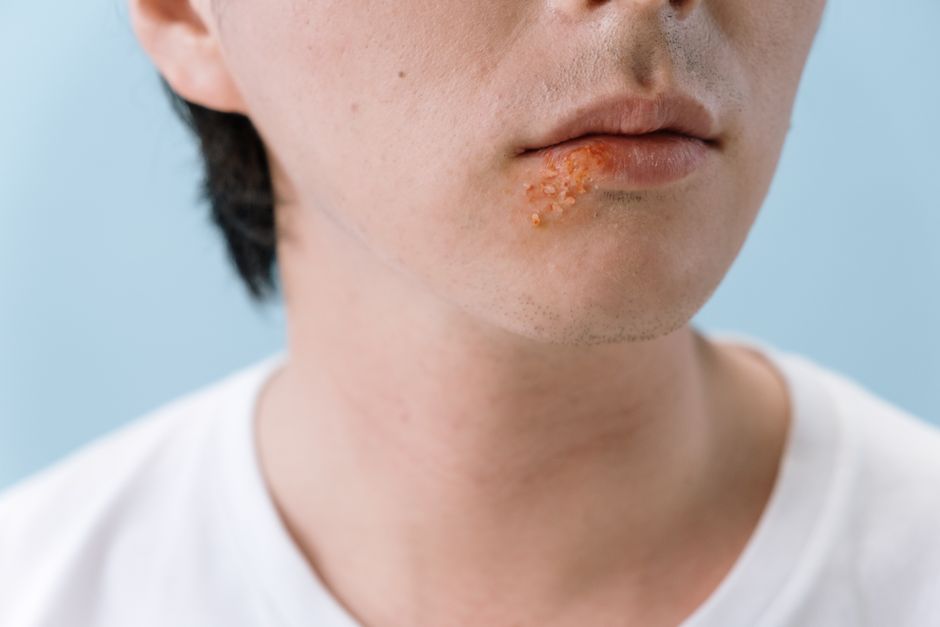
Cold sores spread through direct contact with the herpes simplex virus (HSV-1) from an infected person’s skin or saliva. The virus enters your body through a small break in the skin or through the moist lining of your mouth, nose, or eyes. You do not need an active blister to pass the virus — research shows that viral shedding can happen even when no sore is visible.
What Exactly Is a Cold Sore and What Causes It?
A cold sore is a small, fluid-filled blister that usually appears on or around your lips. It is caused by the herpes simplex virus type 1 (HSV-1). According to the World Health Organization, roughly 67% of people under age 50 carry HSV-1 worldwide. Most people get the virus in childhood.
Once you have the virus, it stays in your body for life. It lives quietly in nerve cells near your ear, called the trigeminal ganglion. The virus can reactivate when your immune system is stressed. Triggers include illness, fatigue, sun exposure, or hormonal changes.
Many people never get symptoms. Others get one or two outbreaks a year. The first infection is often the worst, with fever and multiple sores inside the mouth. Later outbreaks are usually milder and limited to the lip area.
How Is Cold Sore Virus Spread From Person to Person?
The virus spreads mainly through skin-to-skin contact. Kissing someone with an active cold sore is the most common route. Sharing utensils, razors, towels, or lip balm can also pass the virus. The virus survives on surfaces for a short time, but direct contact is the main risk.
Oral sex can spread HSV-1 to the genitals. This is becoming more common. Research published in the Journal of Infectious Diseases found that up to 30% of new genital herpes cases are now caused by HSV-1, not HSV-2. The virus does not care where it lands — it infects skin and mucous membranes.
You can also spread the virus to other parts of your own body. Touching a cold sore and then touching your eye can cause herpes keratitis, a serious eye infection. This is rare but can damage your vision. Always wash your hands after touching a sore.
Can You Spread Cold Sores Without Having a Blister?
Yes. This is called asymptomatic viral shedding. The virus can be present on your skin or in your saliva even when no sore is visible. Studies using PCR testing have found HSV-1 DNA on the lips of people with no symptoms on up to 20% of days tested.
This means you can infect someone without knowing you are contagious. The risk is highest during the prodrome phase — the tingling or burning sensation that happens a day or two before a blister appears. But shedding can happen at any time.
Some people shed the virus more often than others. People with frequent outbreaks tend to shed more. But even someone who has never had a cold sore can carry and spread the virus. That is why the infection is so common.





What Are the Early Signs You Are Contagious?
The first sign is usually a tingling, itching, or burning sensation on your lip. This is called the prodrome stage. It lasts a few hours to a day. During this time, the virus is actively replicating and you are highly contagious.
After prodrome, small red bumps appear. These quickly fill with clear fluid and become blisters. The blisters may merge into one larger sore. This stage lasts 2 to 3 days. The fluid in the blisters contains millions of virus particles.
The sore then breaks open, crusts over, and heals. The crusting stage lasts about 2 to 4 days. You are still contagious until the sore is completely healed and the skin looks normal again. The whole process takes 7 to 10 days on average.
To be safe, avoid close contact from the first tingle until the skin is fully healed. That is the only window where you can be reasonably sure the virus is active.
How Does the Virus Survive Outside the Body?
HSV-1 is fragile outside the body. It does not survive long on dry surfaces. Research shows the virus can live on plastic or metal for a few hours under ideal conditions. On dry skin, it dies within minutes.
Moist environments are different. The virus can survive longer on wet towels, damp razors, or shared lip balm. One study found HSV-1 could still be detected on wet fabric for up to 6 hours. This is why sharing personal items is a real risk, especially if they are damp.
However, surface transmission is much less common than direct contact. You are far more likely to get the virus from kissing someone than from sitting on a toilet seat. The toilet seat myth has no evidence behind it. The virus does not survive on hard, dry surfaces long enough to infect someone that way.
What Factors Increase Your Risk of Catching or Spreading the Virus?
Several things make transmission more likely:
- Active sores or blisters — the highest viral load is in the fluid from broken blisters
- Broken skin — even a tiny crack or chapped lip gives the virus an entry point
- Weakened immune system — people on chemotherapy or with autoimmune conditions shed more virus
- Recent sunburn or windburn — damaged lip skin is more vulnerable
- Shared items — lip balm, toothbrushes, razors, and towels can carry the virus
- Kissing or oral sex — direct mucous membrane contact is the most efficient route
Children are at higher risk because they share toys, cups, and utensils more freely. They also have less developed immune systems and more frequent minor skin injuries. Most people acquire HSV-1 before age 10.
How Do You Know If You Already Have the Virus?
Most people with HSV-1 do not know they have it. The CDC estimates that up to 80% of people with the virus have never had a noticeable symptom. Many mild cases are mistaken for chapped lips or small pimples.
A blood test can detect antibodies to HSV-1. This tells you if you have been exposed to the virus at some point in your life. It does not tell you when you were infected or if you are currently shedding virus. The test is not routinely recommended unless you have symptoms or a known exposure.
If you have had a cold sore before, you have the virus. You cannot get rid of it. But you can reduce how often you get outbreaks and lower the risk of passing it to others. Antiviral medications like acyclovir or valacyclovir can shorten outbreaks and reduce shedding.
What Are Common Misconceptions About Cold Sore Transmission?
The most persistent myth is that cold sores are caused by stress alone. Stress can trigger an outbreak, but the virus is the cause. Without HSV-1, no amount of stress gives you a cold sore.
Another myth is that only people with visible sores are contagious. As discussed earlier, viral shedding happens without symptoms. This misconception leads to many infections. People assume they are safe if no blister is visible, but that is not true.
Some believe cold sores are the same as canker sores. They are not. Canker sores are small ulcers inside the mouth, not caused by herpes. They are not contagious. Cold sores are caused by a virus and are highly contagious.
A third myth is that once you have had a cold sore, you are immune to further infections. You are not. You can reinfect yourself in a different body part, such as your finger (herpetic whitlow) or your eye (herpes keratitis). You can also catch HSV-1 in a new location if you have never had it there before.
Frequently Asked Questions
Can you get a cold sore from sharing a drink?
Yes, if the person with the virus has an active sore or is shedding the virus. The virus can transfer to the rim of a cup and then to your lip.
How long is a cold sore contagious?
You are contagious from the first tingle until the sore is completely healed and the skin looks normal. This is usually 7 to 10 days.
Can you spread cold sores to other parts of your body?
Yes. Touching a cold sore and then touching another area, especially your eye or genitals, can spread the virus. Wash your hands after contact.
Is it possible to never have an outbreak but still carry the virus?
Yes. Most people with HSV-1 never have symptoms. You can still shed the virus and infect others without knowing it.
