
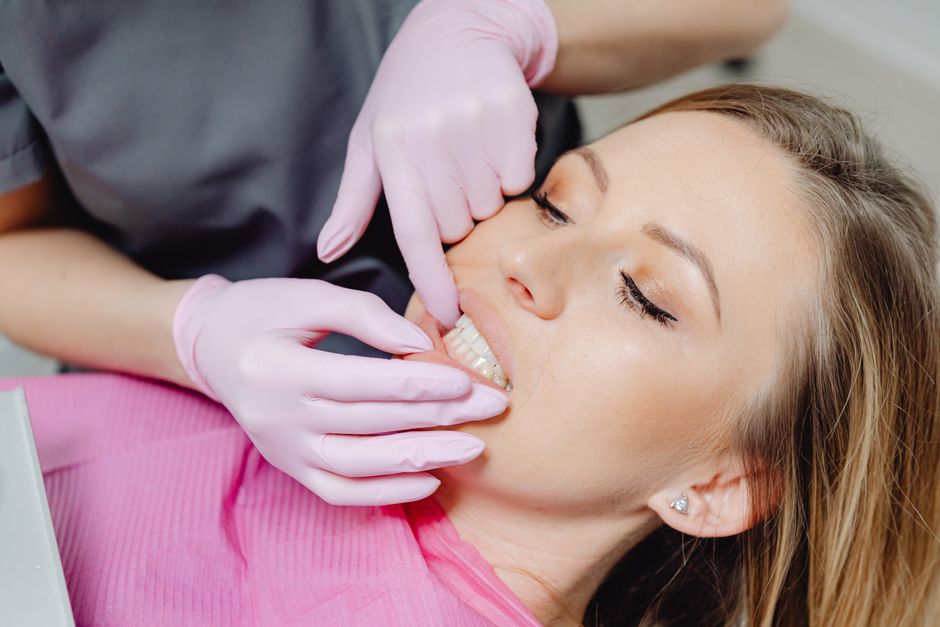
You peel the strip from its backing, press the gel side against your front teeth, fold the remainder behind them, and leave it in place for the time printed on the package. Then you remove it, brush away any leftover gel, and repeat daily for the number of days the kit specifies. That is the whole routine. The details that decide whether it works well or leaves your teeth sensitive are in the preparation, the placement, and what you do afterward.
How Do You Use Whitening Strips? Step By Step
Most kits follow the same basic sequence. Read your own package insert first, because wear times and treatment lengths differ between products.
- Brush and floss first. Start with clean teeth. Whitening gel works best on a surface free of plaque and food film.
- Dry your front teeth. Wipe them with a clean tissue or let them air dry for a moment. A dry surface helps the strip grip and keeps it from sliding.
- Peel off the backing. Most strips come on a thin liner. Remove it to expose the gel side.
- Place the strip on your front teeth. Line the gel side against the tooth surface, starting at the gumline. Press gently from the center outward to smooth out bubbles.
- Fold the extra behind the teeth. The strip usually extends past the biting edge. Wrap that tail onto the back of the same teeth so it stays put.
- Press firmly along the gumline. Run a clean finger along the top edge. This is where gel contact matters most and where gaps cause uneven results.
- Leave it for the labeled time. Do not extend the wear time to try for faster results. More time does not mean more whitening, and it raises the risk of gum irritation.
- Remove and rinse. Peel the strip off slowly. Brush away any gel left on the teeth, or rinse with water.
- Repeat as directed. Follow the kit’s schedule, usually once a day for a set number of days.
One thing people get wrong: they press the strip down hard and then talk, sip water, or check their phone. Movement lets saliva creep under the edges. A strip that stays flat and still does more than one pressed in with force.
What Should You Do Before You Apply Whitening Strips?
Brush your teeth within the half hour before you apply. A clean surface is the single most useful thing you can do for an even result.
Floss too. Debris between teeth can hold gel away from the surface or leave those spots less whitened than the rest. Dry the front teeth after brushing. Wet teeth make the strip slide and weaken the grip.
Check your mouth for problems first. Skip whitening if you have a canker sore, a cut on your gums, or gums that are already sore or bleeding. The peroxide in strips can sting open tissue.
If you have untreated cavities, a cracked tooth, or receding gums, talk to a dentist before starting. Whitening gel can pass through a break in the enamel and reach the sensitive inner layer of the tooth, which is where sharp pain comes from. This is not a reason to avoid whitening forever. It is a reason to get those issues looked at first.
Also think about timing. Do not apply strips right before bed if you tend to grind your teeth, and do not apply them right after eating something acidic like citrus or soda. Acid softens the outer enamel temporarily, and it is generally better to wait a while before putting a whitening product on it.
How Long Should You Leave Whitening Strips On?
Leave them on for exactly the time your product’s instructions state. That number is set by the manufacturer for that specific gel strength, and it is not a target to beat.
Wear times vary widely between products, from a few minutes to around half an hour per application. Because the range is so broad, no single number applies to every kit. Your package insert is the only reliable source for your product.
Leaving a strip on longer than directed does not speed up whitening. The active ingredient, usually hydrogen peroxide or carbamide peroxide, has a limited amount it can do in one session. Extra time mostly increases the chance of gum irritation and tooth sensitivity. If you forget and leave one on too long, remove it, rinse, and skip that day’s remaining schedule. Do not double up the next day to catch up.





Why Do Whitening Strips Cause Sensitivity?
Tooth sensitivity is the most common side effect of at-home whitening, and it is well understood. Peroxide-based gels reach the inner layer of the tooth, called the dentin, and temporarily irritate the nerve inside.
Most people describe it as a brief sharp twinge to cold air or cold drinks. It usually fades within a day or two after you stop. Some people get gum irritation too, usually where gel sat against the gumline or where a strip slipped.
A few practical ways to lower the risk:
- Do not extend wear time past the label.
- Trim the strip if it overlaps your gums.
- Use a soft toothbrush and avoid scrubbing the gumline.
- Space out applications if your teeth feel sensitive.
- Ask a dentist about a sensitivity toothpaste containing potassium nitrate or stannous fluoride before you start.
Stop using the strips and see a dentist if pain is severe, lasts more than a few days after you stop, or comes with gum swelling or bleeding. That goes beyond ordinary whitening sensitivity.
Do Whitening Strips Actually Whiten Your Teeth?
Yes, for a specific kind of stain. Strips reliably lighten surface stains on the front teeth, the kind built up from coffee, tea, red wine, and tobacco. Research on peroxide-based at-home whitening has generally found real, measurable lightening compared with no treatment.
What they cannot do is change the natural color underneath. If your teeth are yellow-gray because of the dentin layer showing through thin enamel, or because of tetracycline staining from earlier in life, strips will do little. Those cases are where in-office treatment or veneers come up, and even those have limits.
Strips also only touch the front six or so teeth. They do not reach molars, and they do not whiten crowns, veneers, or fillings. Those materials do not respond to peroxide the way natural enamel does. This is a point many people miss: if you have a visible filling on a front tooth, whitening the teeth around it can make the filling look darker by comparison.
Results are also not permanent. New stains accumulate with normal eating and drinking. Most people need touch-up sessions every few months to keep the shade, though the exact interval varies by diet and habits.
What Mistakes Should You Avoid With Whitening Strips?
The biggest mistake is treating the label as a suggestion. Wear times and treatment lengths exist because they were tested. Going longer or more often than directed is the most common route to sore gums and sensitive teeth.
Other common errors:
- Applying to wet teeth. The strip slides and the gel spreads onto gums.
- Skipping the fold. The tail behind the teeth is what keeps the strip anchored.
- Eating or drinking while wearing them. Hot drinks can soften the strip; anything else shifts it.
- Whitening over untreated problems. Cavities and gum disease should be addressed first.
- Expecting a shade change overnight. Most kits work over a series of days, not one session.
One clarification worth knowing: whitening strips remove stains. They do not remove plaque or tartar, and they are not a substitute for a cleaning. If your teeth feel rough or look dull despite whitening, a professional cleaning may do more for the appearance than another box of strips.
When Should You See a Dentist Instead?
See a dentist if you have ongoing sensitivity, gum pain, or a shade change that does not match your expectations after a full course. Also go if you notice a single dark tooth. A change in one tooth rather than all of them can point to a problem inside that tooth, not a stain on the surface.
People with gum recession, worn enamel, many fillings, or a history of sensitive teeth may get better results and fewer side effects from a dentist-supervised approach. That does not mean strips are off-limits. It means the plan should be checked first.
And if you have not had a checkup in a while, book one before starting a whitening routine. It is the cheapest way to avoid whitening a problem you did not know was there.
Frequently Asked Questions
Can I use whitening strips every day?
Follow your kit’s schedule, which is often once a day for a set number of days. Using them more often than directed raises the risk of sensitivity and gum irritation without speeding results.
Should I brush my teeth before or after whitening strips?
Brush before you apply, then gently brush or rinse after you remove them to clear leftover gel. Avoid brushing hard right after removal, since teeth can feel more sensitive at that point.
Can I drink water with whitening strips on?
It is best not to. Drinking shifts the strip and lets saliva under the edges, which weakens the gel’s contact with your teeth.
How long do whitening strip results last?
Results vary by diet and habits, and most people need touch-up sessions every few months to maintain the shade. No at-home whitening is permanent.
