
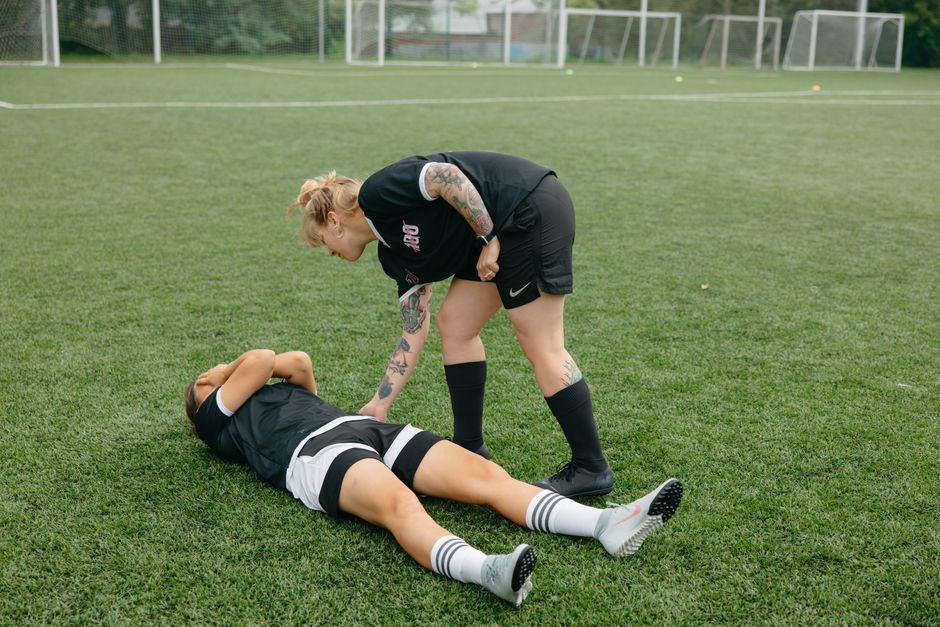
A concussion in football happens when a blow to the head — or a blow to the body that snaps the head — makes the brain move forcefully inside the skull. This movement stretches and damages brain cells, which triggers a temporary loss of normal brain function. In football, most concussions come from helmet-to-helmet hits, head-to-ground impacts, or whiplash-style tackles that jerk the neck violently. The damage is not from the impact itself but from the brain’s rapid acceleration and deceleration inside the skull.
What Exactly Happens to the Brain During a Football Collision?
The brain floats inside the skull, surrounded by cerebrospinal fluid. That fluid normally cushions the brain from everyday bumps. But a football hit is not an everyday bump.
When a player takes a hard tackle, the head accelerates forward in a fraction of a second. The brain lags behind because of its inertia — it wants to stay still. Then the head stops suddenly, often bouncing off the ground or another helmet. The brain slams against the inside of the front of the skull, then rebounds and hits the back of the skull.
This back-and-forth motion is called coup-contrecoup injury. The impact stretches axons — the long nerve fibers that carry signals between brain cells. When axons stretch too far, they can tear or stop functioning temporarily. This disrupts the brain’s electrical signaling, which produces the symptoms of a concussion.
Researchers used to think a concussion required a direct blow to the head. Studies now show that a blow to the chest or body can cause the same injury if it makes the head whip forward and backward. This is why linemen and defensive players can get concussions without ever being hit in the helmet.
How Do You Get a Concussion in Football — the Most Common Plays
Not all football plays carry the same concussion risk. Some situations are far more dangerous than others.
Tackling and being tackled account for the majority of football concussions. When a tackler leads with the crown of his helmet, he creates a direct impact to the ball carrier’s head. This is why the NFL and NCAA have banned “spearing” — leading with the top of the helmet. But even a clean shoulder tackle can cause a concussion if the momentum snaps the ball carrier’s head sideways or backward.
Blocking is the second most common cause. Offensive and defensive linemen collide on every play. Their helmets often hit each other’s helmets or the ground during the scramble. These impacts may seem smaller than a full-speed tackle, but they happen dozens of times per game. The cumulative effect matters.
Kickoff and punt returns produce some of the highest-speed collisions in football. Players sprint at full speed toward each other from opposite directions. The closing speed can exceed 20 miles per hour. A head-to-head hit at that speed delivers far more force than a typical scrimmage play.
Defensive backs covering receivers are at risk when they come down awkwardly. A receiver who jumps for a pass and lands on his head or neck can sustain a concussion without being touched. The ground itself is a common cause of head injury in football.
Why Helmets Do Not Prevent Concussions
Helmets protect the skull from fractures. They do not protect the brain from moving inside the skull.
A football helmet absorbs some of the impact energy and spreads it across a larger surface area. This prevents the skull from cracking on hard impacts. But the brain still accelerates and decelerates inside the skull, regardless of how well the helmet cushions the outside.
Think of it this way: put an egg inside a box filled with foam. Drop the box on the floor. The egg may not crack if the foam is thick enough. But if you shake the box violently, the egg can still break from the internal motion. The brain is the egg. The skull is the box. The helmet is the foam.
This is why newer “concussion-proof” helmet marketing is misleading. No helmet on the market has been proven to eliminate concussions. Some helmets reduce the force transmitted to the head, which may lower risk, but no helmet can stop the brain from moving when the head changes direction suddenly.
Research consistently shows that proper tackling technique — keeping the head up and out of the line of impact — reduces concussion risk more than any equipment change.





Recognizing a Concussion on the Sideline
Concussion symptoms can appear immediately or develop over several hours. A player does not need to lose consciousness to have a concussion. In fact, most concussions occur without any loss of consciousness.
Common signs a coach, teammate, or parent might observe include:
- Confusion or difficulty answering simple questions
- Slow reaction time or delayed responses
- Clumsy movements or balance problems
- Vacant stare or glassy eyes
- Memory problems — forgetting the play, the score, or the opponent
- Mood changes — irritability, sadness, or unusual emotional reactions
- Ringing in the ears or sensitivity to light and noise
Symptoms the player may report include headache, dizziness, nausea, blurred vision, and feeling “off” or “foggy.” Many players minimize these symptoms because they want to stay in the game. This is dangerous. Returning to play while concussed increases the risk of a second concussion, which can cause catastrophic brain swelling — a condition called second impact syndrome.
Any player suspected of having a concussion should be removed from play immediately and evaluated by a medical professional trained in concussion assessment. The old culture of “shake it off and get back in” has no place in modern football.
Recovery Time and Return-to-Play Rules
Most concussion symptoms resolve within 1 to 2 weeks. Some people recover faster. Others take longer, especially if they have had previous concussions or a history of migraines or learning disabilities.
The brain needs rest to heal after a concussion. This means both physical rest and cognitive rest. Physical rest means no exercise, no running, no lifting. Cognitive rest means limiting screen time, schoolwork, and activities that require concentration. The brain is working hard to repair itself, and demanding mental activity can slow that process.
Return-to-play protocols follow a gradual stepwise progression. The player must be symptom-free at rest before beginning any activity. Then they advance through stages: light aerobic exercise, sport-specific drills, non-contact practice, full-contact practice, and finally game play. Each stage takes at least 24 hours. If symptoms return at any stage, the player drops back to the previous stage.
These protocols exist because the brain is more vulnerable to injury while it is still healing. A second concussion during this window can be far more dangerous than the first.
Long-Term Risks of Repeated Concussions
One concussion is usually recoverable. Repeated concussions — especially over many years — carry different risks.
Chronic traumatic encephalopathy (CTE) is a brain disease linked to repeated head impacts. CTE can only be diagnosed after death, during an autopsy. Researchers have found CTE in the brains of many former football players, including some who never had a diagnosed concussion. This suggests that repeated sub-concussive hits — impacts that do not cause symptoms — may also contribute to brain damage over time.
Sub-concussive hits are routine in football. Every lineman collision, every tackle, every block delivers a small force to the brain. Individually, these hits cause no noticeable symptoms. Accumulated over years, they may cause lasting damage.
The exact relationship between football and long-term cognitive decline is still being studied. Some former players develop memory problems, mood disorders, and behavioral changes in their 40s and 50s. Others play for decades and show no measurable decline. The research is not complete, and scientists do not yet know why some brains are more resilient than others.
What is clear: reducing the total number of head impacts — not just diagnosed concussions — is the best strategy for protecting the brain. This is why youth football leagues have limited full-contact practice time and why the NFL has moved kickoffs forward to reduce high-speed returns.
Prevention: What Actually Reduces Concussion Risk
Concussions cannot be completely eliminated from football. But the risk can be meaningfully reduced.
Proper tackling technique is the most effective prevention. Players who keep their heads up and lead with their shoulders — not their helmets — dramatically reduce their concussion risk. This must be taught at the youth level and reinforced at every level of play.
Neck strength matters. Stronger neck muscles can absorb some of the energy of a blow and reduce how far the head snaps backward or sideways. This does not prevent all concussions, but research suggests it lowers risk.
Rule changes have made football safer. Targeting penalties, helmet-to-helmet bans, and kickoff rule changes have all reduced high-risk impacts. The evidence for these rule changes is strongest at the professional and college levels.
Limiting contact in practice is one of the simplest ways to reduce total head impacts. Many teams now hold no-contact practices during the week and reserve full contact for games. This reduces the cumulative number of sub-concussive hits a player experiences each season.
No prevention strategy is perfect. But a player who uses proper technique, has good neck strength, and plays under modern safety rules faces far lower risk than a player who does not.
Frequently Asked Questions
Can you get a concussion in football without being hit in the head?
Yes. A blow to the body that snaps the head forward or backward can cause a concussion. The brain moves inside the skull from the whiplash motion alone.
How long does a football concussion take to heal?
Most concussions resolve within 1 to 2 weeks. Some people take longer, especially with prior concussions or other risk factors.
Do football helmets prevent concussions?
No. Helmets prevent skull fractures but cannot stop the brain from moving inside the skull. Proper tackling technique reduces risk more than any helmet.
What is second impact syndrome?
It is a rare but catastrophic condition where a second concussion occurs before the first has healed, causing rapid brain swelling. It can be fatal.
